
Coquitlam's four small-scale zones, and why R-4 sets a floor instead of a cap
Coquitlam rebuilt its residential zoning into four new zones rather than bolting rules onto the old ones. One of them requires a minimum of three units. That is a different kind of rule than anywhere else nearby.
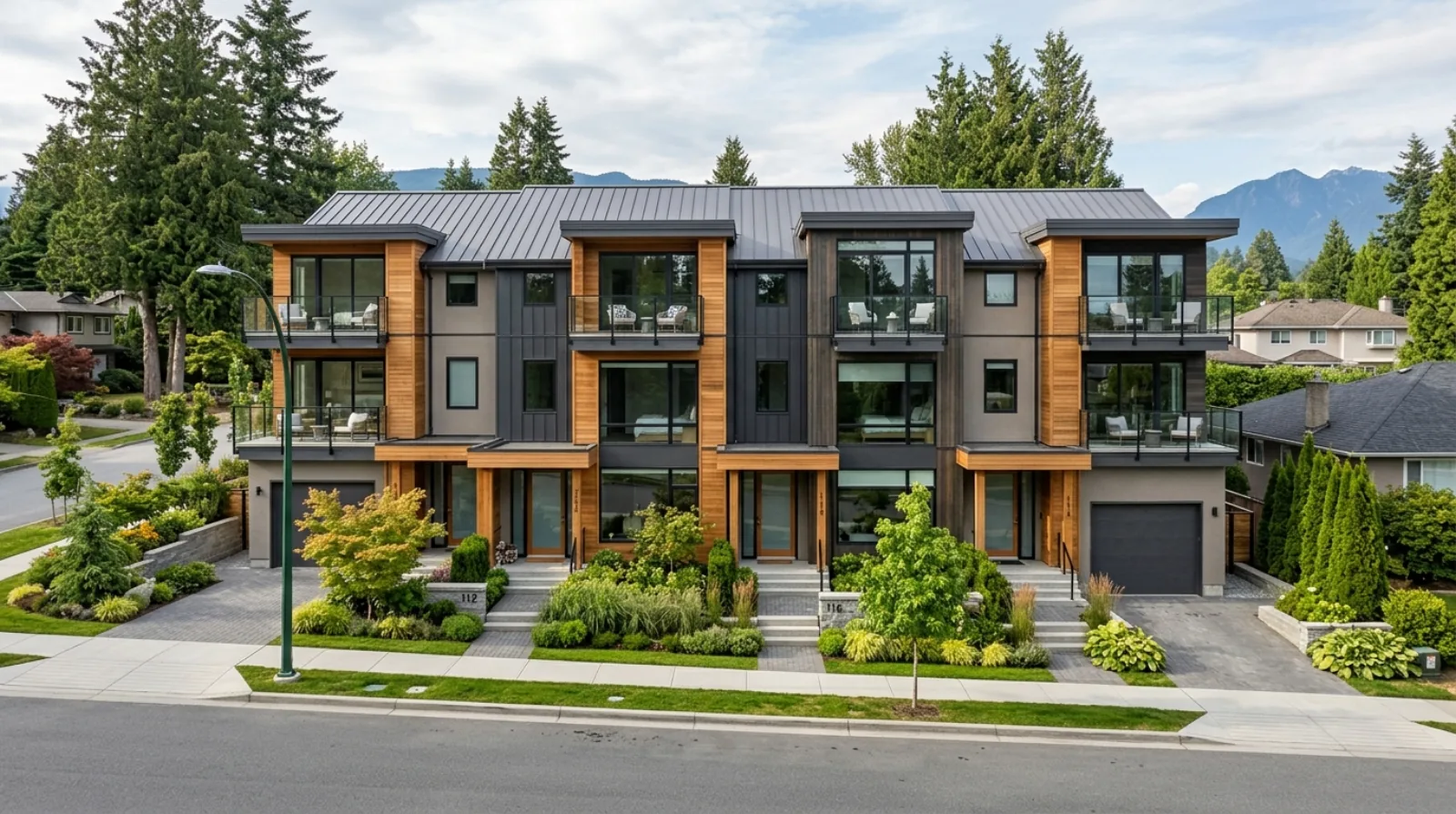
In short, Coquitlam's Bylaw No. 5449, adopted June 9 2025, rezoned most one-family and duplex lots into four zones: R-1 Small-Scale Residential, R-2 Compact Small-Scale Residential, R-3 Transitional Small-Scale Residential, and R-4 Intensive Small-Scale Residential. R-1 permits a maximum of four dwelling units with a minimum lot area of 650 square metres. R-2 permits a maximum of four, dropping to three on lots of 280 square metres or less. R-3 permits a maximum of two principal and two accessory dwelling units. R-4 requires a minimum of three dwelling units and is not permitted on lots under 930 square metres, making it the only zone in the group that sets a floor rather than a ceiling.
When BC required municipalities to permit small-scale housing, most of them took the path of least disruption. They added a permitted use to the residential zones they already had and left the rest of the bylaw alone.
Coquitlam rebuilt instead. Bylaw No. 5449, adopted June 9 2025, moved most one-family and duplex lots in the city into four purpose-built zones. It is a more thorough approach, and it produced at least one rule that has no equivalent anywhere nearby.
The four zones
R-1 Small-Scale Residential, R-2 Compact Small-Scale Residential, R-3 Transitional Small-Scale Residential, and R-4 Intensive Small-Scale Residential. The names describe intensity, and the rules track that.
- R-1: a maximum of four dwelling units on a lot. Minimum lot area 650 square metres, minimum lot width 18.5 metres.
- R-2: a maximum of four dwelling units, reducing to three where the lot is 280 square metres or less. Minimum lot area 465 square metres, minimum width 12.5 metres.
- R-3: a maximum of two principal dwelling units and two accessory dwelling units. On lots of 280 square metres or less, three units of which at most two are principal.
- R-4: a minimum of three dwelling units required, and small-scale residential not permitted on a lot of less than 930 square metres.
Read that last line again, because it is doing something different from the other three.
R-4 sets a floor
Every small-scale rule we have read across Metro Vancouver caps what may be built. Three units up to a threshold, four above it, six near qualifying transit. The number is a ceiling and a landowner can always build less.
Coquitlam's R-4 requires a minimum of three dwelling units. Combined with the 930 square metre lot area floor, it says that where small-scale residential is being developed in that zone, it delivers at least three homes.
R-4 is the only zone in the group that tells a landowner what they must build rather than what they may. That changes how a project in that zone gets planned.
For a landowner with an R-4 lot, this matters at the decision stage rather than the design stage. The question is not how many units to build, it is whether to develop under the framework at all, because a smaller project is not one of the options that zone offers. That is worth knowing before an architect is engaged around a two-unit concept.
Principal versus accessory in R-3
R-3 is the zone people misread most, because its numbers only make sense once the two categories are separated.
It permits a maximum of two principal dwelling units and two accessory dwelling units. A landowner scanning for a single number sees four and moves on, but the composition is fixed. Two of those four have to be accessory units, which are a different thing from principal units in how they are built, how they are used, and, as covered below, whether they can be sold separately.
On lots of 280 square metres or less the total drops to three, of which at most two may be principal. The accessory category is where the flexibility sits at the small end.
Coquitlam answers the ownership question
Here is where Coquitlam is more helpful than most of its neighbours. Its FAQ states that small-scale housing such as duplexes, triplexes, fourplexes and multiplexes can be stratified and sold, and that secondary suites and accessory dwelling units cannot be stratified or subdivided.
That is a direct answer to a question many municipalities leave open. When we looked at Surrey, we found its pages describe unit counts, lot widths, and access in real detail while never naming a fee-simple option, which is why our Surrey piece tells landowners to confirm with the city rather than assume. Coquitlam does not leave that gap on the strata question.
Note what it means for R-3 specifically. If two of the four permitted units are accessory, and accessory units cannot be stratified, then the saleable structure of an R-3 project is different from an R-1 or R-2 project with the same headline unit count. That flows straight into the tenure decision covered in strata or rental.
No frequent transit path, for now
Coquitlam states that it currently has no bus stops meeting the provincial criteria for frequent service, and that the provincial requirement to permit up to six units near frequent-service stops therefore does not apply at this time.
In a city with SkyTrain, that reads as counterintuitive until you notice the test is about bus service frequency at a stop rather than transit quality generally. The practical effect is clean: in Coquitlam the unit count comes from the zone, full stop. There is no proximity argument to make. We go through how differently this provision lands across the region in the six-unit transit rule.
The city's own phrasing, does not apply at this time, is worth respecting. It describes the present rather than a permanent state, and service levels are set by the transit authority rather than the zoning bylaw.
Existing lots versus new lots
The zone minimums cause confusion because two different questions get answered by different numbers.
R-1's 650 square metre minimum lot area, and the widths attached to each zone, govern lots being created through subdivision. For building on a lot that already exists, Coquitlam states the minimum lot size is 280 square metres, about 3,014 square feet, with no minimum width.
So an existing lot below a zone's stated minimum is not automatically excluded from developing. It is the subdivision question and the development question being different, and reading one number as the answer to both is a common way to reach the wrong conclusion about a parcel.
What we cannot confirm
One gap worth naming rather than papering over. Coquitlam's small-scale pages point to the parking section of the zoning bylaw, and the document published there does not contain a small-scale residential line reflecting the 2025 zones.
Rather than quote a rate from a table that appears to predate the current framework, our position is that a Coquitlam landowner should confirm the applicable parking requirement directly with the city. Parking has more effect on achievable unit count than most people expect, for reasons set out in parking requirements by city, so it is not a detail to leave to an assumption.
Confirm your zone first
The single most useful step for a Coquitlam landowner is also the simplest. Find out which of the four zones your lot actually landed in.
The rezoning moved most one-family and duplex properties in one bylaw, so the current designation will not match what an owner remembers, and it may not match an older document sitting in a file. Everything else, the unit maximum, whether a minimum applies, the lot area rules, follows from that one fact.
Frequently asked
What are Coquitlam's small-scale residential zones?
Bylaw No. 5449 created four: R-1 Small-Scale Residential, R-2 Compact Small-Scale Residential, R-3 Transitional Small-Scale Residential, and R-4 Intensive Small-Scale Residential. Most one-family and duplex lots in the city were rezoned into one of them when the bylaw was adopted on June 9, 2025.
How many units does Coquitlam's R-1 zone allow?
A maximum of four dwelling units on a lot. R-1 carries a minimum lot area of 650 square metres and a minimum lot width of 18.5 metres, which are the largest minimums among the four zones.
Why does R-4 have a minimum number of units?
R-4 Intensive Small-Scale Residential requires a minimum of three dwelling units on a lot, and small-scale residential is not permitted on a lot of less than 930 square metres in that zone. It is the only one of the four that sets a floor rather than a ceiling, which means an R-4 lot developed under the small-scale framework has to deliver at least three units rather than choosing a smaller project.
What is the difference between R-2 and R-3 in Coquitlam?
R-2 Compact Small-Scale Residential permits a maximum of four dwelling units, reducing to three where the lot is 280 square metres or less. R-3 Transitional Small-Scale Residential is written differently, permitting a maximum of two principal dwelling units and two accessory dwelling units, with lots of 280 square metres or less limited to three units of which at most two are principal. The distinction between principal and accessory units is what separates them.
Can I build six units in Coquitlam near a bus stop?
Not currently. Coquitlam states that the city has no bus stops meeting the provincial criteria for frequent service, and that the provincial requirement to allow up to six units near frequent-service bus stops therefore does not apply at this time. Unit counts in Coquitlam come from the zone the lot sits in.
Can small-scale units in Coquitlam be stratified and sold?
Coquitlam's own FAQ addresses this, stating that small-scale housing such as duplexes, triplexes, fourplexes and multiplexes can be stratified and sold, while secondary suites and accessory dwelling units cannot be stratified or subdivided. That makes Coquitlam unusually clear on the ownership question compared with neighbouring municipalities.
What is the minimum lot size to build on an existing Coquitlam lot?
The city states that for building on an existing lot the minimum lot size is 280 square metres, about 3,014 square feet, with no minimum width. The larger minimums attached to each zone, such as R-1's 650 square metres, apply to lots being created rather than to existing parcels.
How do I find out which zone my Coquitlam lot is in?
Confirm it with the City directly rather than inferring it from what the property was zoned before. The rezoning moved most one-family and duplex properties into the new zones in a single bylaw, so the current designation may not match what an owner remembers or what an older document shows.
Our Coquitlam area page covers how we work in the city. If you own a Coquitlam lot and want the zone, the unit count, and the ownership structure confirmed before anyone draws anything, book a free consultation.
Sources
- City of Coquitlam, Zoning Bylaw Part 10, Low Density Residential Zones
- City of Coquitlam, Small-Scale Multi-Unit Housing in Coquitlam
- City of Coquitlam, Zoning Amendment public notice (Bylaw 5449)
- City of Coquitlam, Information for building small-scale multi-unit housing
- City of Coquitlam, Small-scale housing FAQ
Written by

Acquisitions and Development
Trent Praski leads investment and development at Venture Pacific, sourcing missing-middle opportunities across Metro Vancouver and the Fraser Valley and structuring transparent homeowner and investor partnerships.
Full profile