
Pitt Meadows put the unit count in the zone name
Most cities buried their small-scale rules inside existing zones. Pitt Meadows eliminated three zones and built three new ones whose names tell you the unit count, then tied parking to unit size.
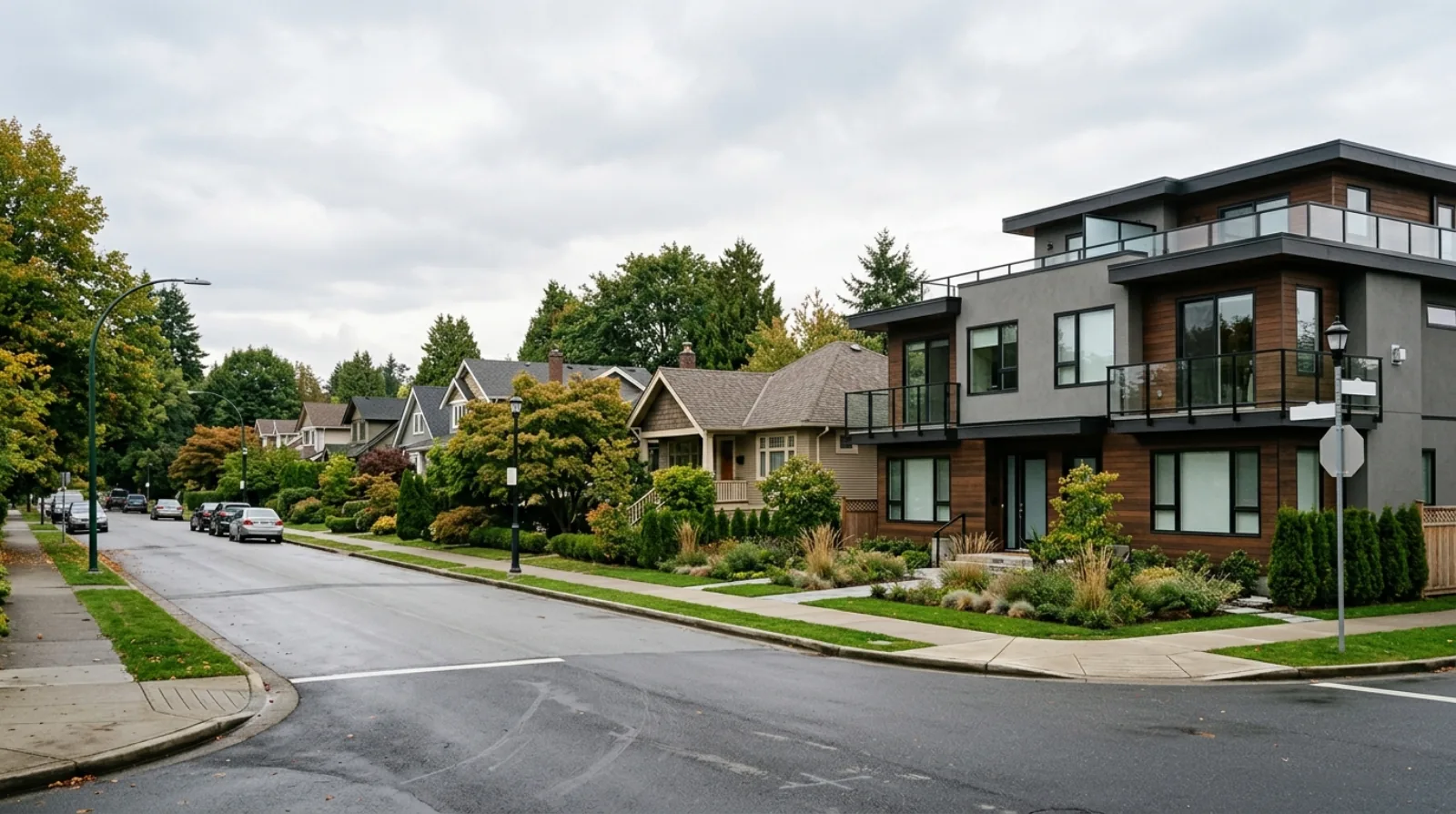
In short, Pitt Meadows adopted small-scale multi-unit housing bylaws in June 2024, eliminating its R-1 Medium Lot Residential, R-2 Small Lot Residential and RD Duplex Residential zones and replacing them with Urban Residential R-3, R-4 and R-6, permitting up to three, four and six units respectively. Parking in the R-3 and R-4 zones is reported at 0.5 spaces per dwelling unit for units of 90 square metres or less and 1.5 spaces for larger units. Parking is not required in the R-6 zone though the city encourages it. Pitt Meadows states that provincial legislation and its zoning bylaw do not override restrictive covenants.
Across Metro Vancouver, municipalities implemented the same provincial legislation in strikingly different ways. Some added a permitted use to zones they already had. Some rewrote their residential zoning wholesale.
Pitt Meadows produced the version that is easiest to read, and it is worth looking at for that reason alone.
Three zones, three numbers
The city adopted its small-scale housing bylaws in June 2024. It eliminated three existing zones, R-1 Medium Lot Residential, R-2 Small Lot Residential, and RD Duplex Residential, and replaced them with Urban Residential R-3, R-4 and R-6.
Up to three units in R-3, four in R-4, six in R-6. The number in the zone name is the unit count.
That sounds trivial until you compare it with the alternative. In most municipalities, finding the unit count for a lot means reading a zone label, then a lot-area threshold, then possibly a transit distance, then an exemption list, and assembling the answer yourself. We have written up how that works in Coquitlam's four zones, where the same exercise takes more reading.
Pitt Meadows made the zoning map answer the question directly. That is rarer than it should be.
Parking that scales with unit size
The other distinctive choice is parking, and this one has real design consequences.
Rather than a flat rate per unit, Pitt Meadows scales by how large each unit is. The reported rates for the R-3 and R-4 zones are 0.5 spaces per dwelling unit for units of 90 square metres or less, and 1.5 spaces per dwelling unit above that. In the R-6 zone parking is not required for small-scale developments, though the city states it is strongly encouraged.
The gap between those two rates is threefold, triggered by a single dimension. A four-unit project built at or under 90 square metres per unit carries a fraction of the parking obligation of the same four units built larger, on the same lot in the same zone.
That is unusual. Most municipalities treat unit size as a market question and parking as a fixed input. Pitt Meadows connected them, which means the unit mix decision and the parking layout have to be worked out together rather than in sequence. We go through why parking drives buildable area so heavily in parking requirements by city.
The covenant warning
Pitt Meadows publishes a caution that most municipalities leave out, and it is the single most useful line in its handout.
The city states that provincial housing legislation and its zoning bylaw do not override restrictive covenants, and that additional uses on a property may therefore not be permitted.
A restrictive covenant is a private restriction registered against a specific title. The provincial reform changed public zoning and did not reach into private charges, so a lot can be correctly zoned R-4, fully serviced, and still restricted by a document registered decades ago. This applies everywhere in BC. Pitt Meadows is simply one of the few cities that says so on its own page. We cover what to look for in restrictive covenants and your title.
A second approval to ask about
The city also notes that small-scale developments may require a Ground Oriented Residential Development Permit.
That matters for scheduling, because a development permit is a separate approval from a building permit with its own review process. A landowner who has budgeted time for a building permit alone, on the assumption that small-scale housing is purely as-of-right, may be working from an incomplete schedule. Confirm with the city whether one applies to your specific property.
What the guide does not say
Pitt Meadows is candid about the limits of its own material, and we will be equally candid about the gaps.
The handout states that it is not exhaustive and is not a bylaw. It does not state the lot-area threshold that assigns a property to R-3 rather than R-4, and it does not state the transit distance behind the R-6 designation.
We are not going to fill those gaps with figures borrowed from neighbouring municipalities. The 280 square metre threshold is close to universal across the region and the 400 metre transit distance is common, but common is not the same as confirmed for a specific city. A Pitt Meadows landowner should get both numbers from the city.
Not the same as Maple Ridge
Pitt Meadows and Maple Ridge sit beside each other and are routinely discussed together. On development rules they diverge.
Maple Ridge added an Urban Infill Residential use directly into its existing residential zones rather than creating new ones, uses a 281 square metre threshold, and requires 1.5 spaces per principal dwelling unit plus one per accessory unit, with none required in Prescribed Bus Stop Areas. Pitt Meadows created named zones and scales parking by unit size.
Different structure, different thresholds, different parking logic. A landowner reading Maple Ridge material for a Pitt Meadows lot will be wrong on all three. Our Pitt Meadows and Maple Ridge pages are separate for that reason.
Where to start on a Pitt Meadows lot
Four steps, none of which need a designer.
- Confirm which of R-3, R-4 or R-6 the lot now sits in, since the bylaws replaced three previous zones and old documents will not match.
- Order a title search and have every registered charge read, given the city's own covenant warning.
- Ask whether a Ground Oriented Residential Development Permit applies to the property.
- Confirm the parking rate against the actual unit sizes you are considering, since the 90 square metre threshold changes the count.
The fourth one is the item most likely to change your plan. Work out the parking implication of your intended unit sizes before a designer commits to a layout, because discovering the higher rate applies after the drawings exist means redrawing them.
Frequently asked
What are Pitt Meadows' small-scale housing zones?
Urban Residential R-3, R-4 and R-6, permitting up to three, four and six units respectively. The city adopted the bylaws in June 2024 and eliminated its former R-1 Medium Lot Residential, R-2 Small Lot Residential and RD Duplex Residential zones, replacing them with the three new ones.
How does parking work in Pitt Meadows?
It scales with unit size rather than being a flat rate. Reported rates for the R-3 and R-4 zones are 0.5 spaces per dwelling unit for units of 90 square metres or less, and 1.5 spaces per dwelling unit for units larger than that. Parking is not required for small-scale developments in the R-6 zone, though the city states it is strongly encouraged.
Why does parking scaling by unit size matter?
Because it makes unit size a design lever with a threefold effect on the parking obligation. A project of units at or below 90 square metres carries a third of the per-unit parking requirement of one built above that size, on the same lot in the same zone. That changes which unit configurations physically fit.
Can a restrictive covenant block a project in Pitt Meadows?
The city warns that it can. Its handout states that provincial housing legislation and the city zoning bylaw do not override restrictive covenants, and that additional uses on a property may therefore not be permitted. A title search is the way to find out, and it should happen before design work is commissioned.
Do I need a development permit for small-scale housing in Pitt Meadows?
The city notes that small-scale developments may also require a Ground Oriented Residential Development Permit. Whether one applies to a specific property should be confirmed with the city, since it is a separate approval from the building permit and carries its own review.
What lot size puts my property in R-3 versus R-4?
The city's published guide does not state the lot-area threshold that assigns a property to one zone or the other, and it says outright that it is not exhaustive and is not a bylaw. Confirm the current designation and the governing thresholds with the city directly rather than inferring them from a neighbouring municipality's numbers.
Is Pitt Meadows the same as Maple Ridge for development rules?
No. They are separate municipalities and they took different approaches. Maple Ridge added an Urban Infill Residential use into its existing residential zones and requires 1.5 spaces per principal dwelling unit. Pitt Meadows created named zones and scales parking by unit size. Rules from one do not carry over to the other.
How do I confirm which zone my Pitt Meadows lot is in?
Ask the city. Because the bylaws eliminated three previous zones and replaced them, a property's current designation will not match older documents or what an owner remembers, and every other rule follows from which of the three zones the lot now sits in.
If you own a lot in Pitt Meadows and want the zone, the parking rate, and the title confirmed before anything gets drawn, book a free consultation.
Written by

Acquisitions and Development
Trent Praski leads investment and development at Venture Pacific, sourcing missing-middle opportunities across Metro Vancouver and the Fraser Valley and structuring transparent homeowner and investor partnerships.
Full profile