
Maple Ridge added a use instead of a zone, and set the region's highest parking rate
You cannot read a Maple Ridge zoning label and know what a lot allows, because the permission was added as a use inside existing zones. And at 1.5 spaces per unit, parking will decide more projects there than elsewhere.
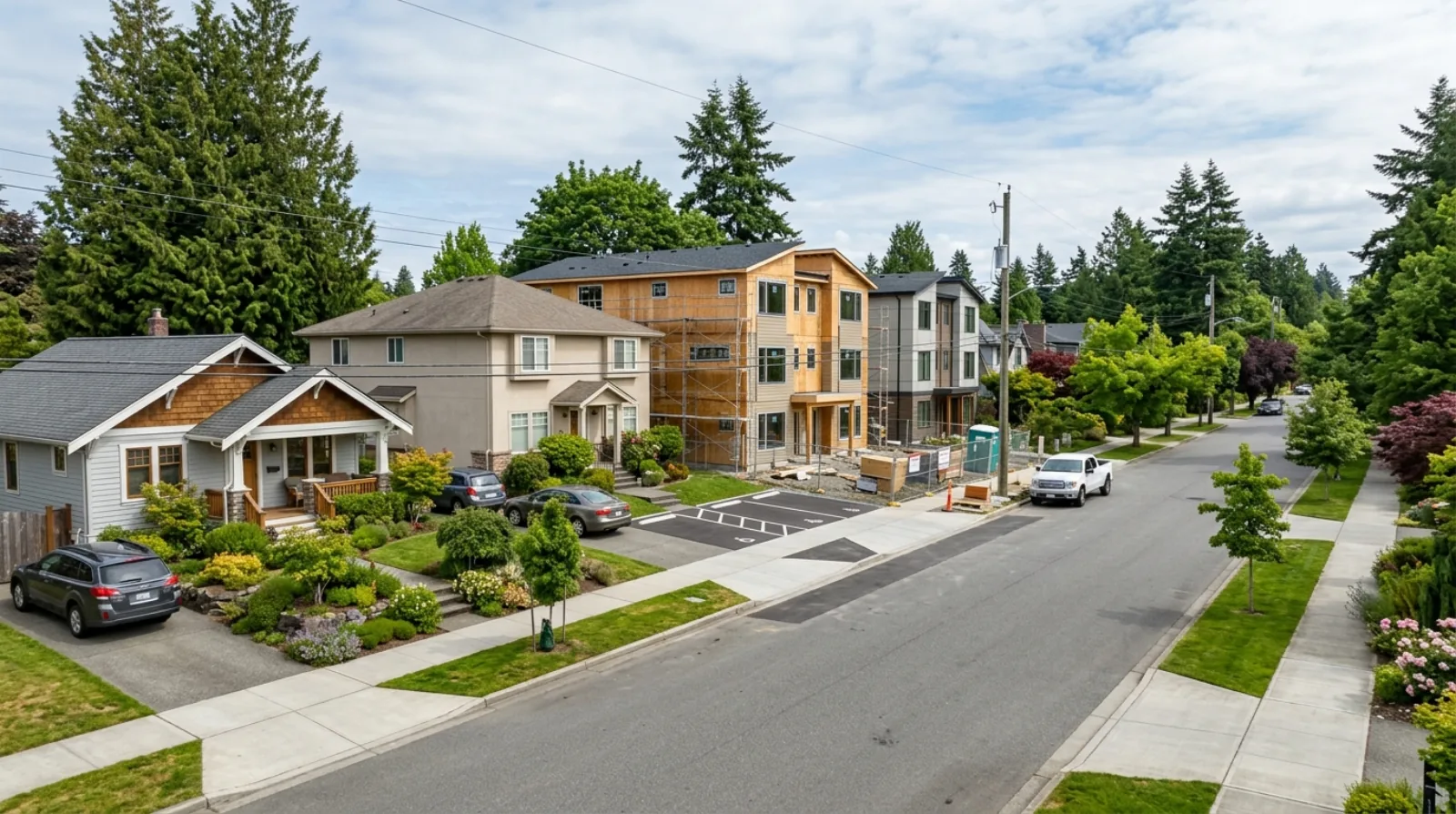
In short, Maple Ridge implemented small-scale multi-unit housing by adding an Urban Infill Residential use into its existing residential zones rather than creating dedicated zones. Up to three units are permitted on lots under 281 square metres, up to four from 281 to 4,050 square metres, and up to six on lots of at least 281 square metres within 400 metres of a bus stop with buses at least every 15 minutes on weekdays from 7 a.m. to 7 p.m. Lots must have City water and sewer service and be within the Urban Area. Parking is a minimum of 1.5 spaces per principal dwelling unit and 1 space per accessory dwelling unit, with no parking required in Prescribed Bus Stop Areas.
Maple Ridge made two implementation choices that separate it from its neighbours, and both affect how a landowner should approach a lot there.
A use, not a zone
Rather than creating dedicated small-scale zones, Maple Ridge added an Urban Infill Residential use directly into its existing residential zones.
There is a real advantage to that. Because the use sits inside zones that already exist, a conforming project proceeds through the standard building permit process. No rezoning, no separate zone to be designated into.
The cost is legibility. You cannot read a Maple Ridge zoning label and know what a lot allows. Two properties carrying identical labels can support different unit counts, because the outcome depends on lot area, servicing, Urban Area status, and transit proximity rather than on the label.
In some municipalities the zoning map answers the question. In Maple Ridge it tells you where to start asking.
That is the opposite of the approach next door in Pitt Meadows, which put the unit count into the zone name itself, as covered in Pitt Meadows R-3, R-4 and R-6. Two neighbouring cities, opposite solutions to the same requirement.
The unit thresholds, and an odd number
Maple Ridge permits up to three units on a lot under 281 square metres, up to four from 281 to 4,050 square metres, and up to six on qualifying lots near frequent transit.
Note 281. Nearly every other municipality in the region uses 280 square metres as its threshold. Maple Ridge uses 281.
One square metre is immaterial on most lots and decisive on a lot sitting exactly at the line. More usefully, it is a reminder that these numbers should be read from the municipality rather than carried over from a regional summary, because the small differences are exactly the ones a general article smooths away.
Servicing is an eligibility condition
Maple Ridge requires lots to have City water and sewer service, and to be within the city's Urban Area.
That makes servicing a gate rather than a construction detail. A lot on a well or a septic system does not qualify, and neither does one outside the Urban Area, regardless of its zoning or size. In a municipality with as much rural and semi-rural land as Maple Ridge, that removes a substantial amount of territory from the framework.
It is the first thing to confirm on any Maple Ridge property, ahead of unit counts, for the reasons set out in servicing is the quiet gate.
The highest parking rate in the region
Maple Ridge requires a minimum of 1.5 spaces per principal dwelling unit and 1 space per accessory dwelling unit, with no parking required in Prescribed Bus Stop Areas.
Of the Metro Vancouver municipalities publishing clear figures, that is the highest per-unit rate we have found. Work through what it means on a four-unit project: six spaces for the principal units, before any accessory unit is added.
Six stalls is not six rectangles. Each one needs manoeuvring space, they need an access point, and they need a drive aisle connecting them. All of that area comes out of the same lot that has to hold the building, the setbacks, and any required landscaping.
On a standard lot in Maple Ridge, parking is frequently the constraint that decides whether the fourth unit is achievable. Not the unit maximum, not the setbacks. Parking. This is why we treat it as a feasibility input rather than a design detail, as set out in parking requirements by city.
Where parking goes to zero
The Prescribed Bus Stop Area exemption is correspondingly valuable in Maple Ridge, precisely because the base rate is so high.
Moving from 1.5 spaces per principal unit to none is a larger swing than the same exemption produces in a city requiring one space per unit. On a four-unit project it frees up six stalls worth of site area, which can be the difference between a cramped layout and a workable one.
So confirming whether a lot sits inside a Prescribed Bus Stop Area is a high-value question in Maple Ridge specifically. It is worth asking early, and worth asking about the boundary rather than the general area.
The transit definition is precise
Maple Ridge's six-unit case requires a lot of at least 281 square metres within 400 metres of a bus stop providing frequent service, which it defines as buses arriving at least every 15 minutes on weekdays from 7 a.m. to 7 p.m.
That window is more specific than most municipalities publish, and the specificity is helpful. A stop that runs every 15 minutes during peak periods and thins out midday is a different thing from one that maintains the frequency across a twelve hour weekday. Maple Ridge's definition distinguishes them.
For how narrow the six-unit provision turns out to be across the region, including one municipality where it does not currently apply at all, see the six-unit transit rule.
How to approach a Maple Ridge lot
- Confirm servicing and Urban Area status first, since both are eligibility conditions.
- Get the exact lot area, particularly near the 281 square metre line.
- Ask whether the lot sits in a Prescribed Bus Stop Area, because the parking swing is large.
- Work the parking layout into the first design pass, given the 1.5 space rate.
- Do not rely on the zoning label alone, since the permission sits in a use rather than in the zone name.
Frequently asked
How many units can I build in Maple Ridge?
Up to three units on a lot under 281 square metres, up to four on a lot from 281 square metres to 4,050 square metres, and up to six on a qualifying lot near frequent transit. Maple Ridge uses 281 square metres as its threshold, one square metre above the 280 used by most neighbouring municipalities.
What is the Urban Infill Residential use?
It is the mechanism Maple Ridge used to implement small-scale housing. Rather than creating dedicated new zones, the city added this use directly into its existing residential zones. That means a project proceeds through the standard building permit process without a rezoning, and it also means the zone label alone does not tell you what a lot allows.
Why can I not tell what my lot allows from its zoning?
Because the permission sits in a use added to the zone rather than in the zone's name. Two lots can carry the same zoning label and support different unit counts, since the outcome depends on lot area, servicing, whether the lot is within the Urban Area, and transit proximity. The label is the starting point rather than the answer.
What is Maple Ridge's parking requirement?
A minimum of 1.5 spaces per principal dwelling unit and 1 space per accessory dwelling unit, with zero parking required in Prescribed Bus Stop Areas. Of the Metro Vancouver municipalities publishing clear figures, that is the highest per-unit rate we have found.
What qualifies as frequent transit in Maple Ridge?
The city describes a bus stop providing frequent service as one where buses arrive at least every 15 minutes on weekdays from 7 a.m. to 7 p.m., with the lot within 400 metres and at least 281 square metres in area. Note the defined weekday window, which is more specific than a general reference to 15 minute service.
Does my lot need municipal servicing?
Yes. Maple Ridge requires lots to have City water and sewer service and to be within the city's Urban Area. That makes servicing an eligibility condition rather than a construction detail, so a lot on a well or septic system, or outside the Urban Area, falls outside the framework.
Is Maple Ridge the same as Pitt Meadows?
No. They are neighbouring municipalities that took opposite approaches. Pitt Meadows created named zones, R-3, R-4 and R-6, and scales parking by unit size. Maple Ridge added a use to existing zones and applies a flat 1.5 spaces per principal unit. Neither one's rules carry over to the other.
How does the parking rate affect unit count?
Substantially, because every stall needs manoeuvring space as well as the stall itself, and that area competes with the building footprint. At 1.5 spaces per principal unit, a four-unit project carries six spaces for the principal units alone before any accessory units are counted. On a standard lot that is often what decides whether the fourth unit is achievable.
Our Maple Ridge area page covers how we work in the city. If you own a lot there and want the unit count confirmed against parking and servicing rather than against a headline, book a free consultation.
Written by

Acquisitions and Development
Trent Praski leads investment and development at Venture Pacific, sourcing missing-middle opportunities across Metro Vancouver and the Fraser Valley and structuring transparent homeowner and investor partnerships.
Full profile