
Servicing is the quiet gate on a multiplex project
Zoning gets all the attention. But several Metro Vancouver municipalities make municipal water and sewer connection an eligibility requirement, not a detail, and the pipe at your street was sized for one house.
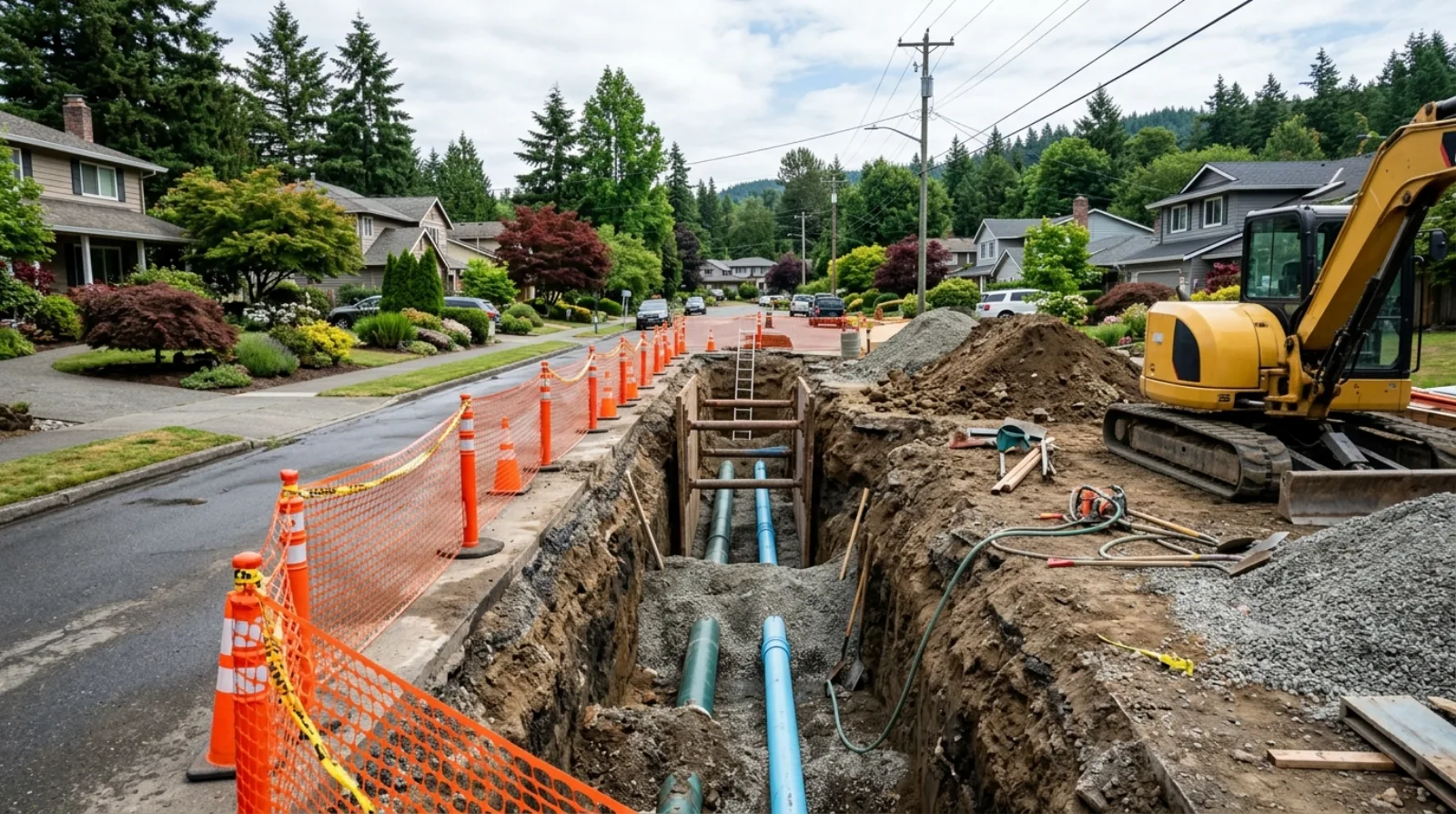
In short, Municipal water and sewer servicing is an eligibility requirement for small-scale multi-unit housing in several Metro Vancouver municipalities, not merely a construction detail. Maple Ridge requires lots to have City water and sewer service and to sit within the Urban Area. The Township of Langley requires connection to municipal water and sewer within the Urban Containment Boundary. The District of North Vancouver exempts unserviced lots. Beyond eligibility, existing service laterals were commonly sized for a single dwelling, so a multiplex may require upgraded connections determined by engineering review.
Landowners arrive well prepared on zoning. They know their zone, they have read the city's small-scale housing page, and they have a number in mind for how many units the lot allows.
Far fewer have asked what is in the ground at the street. That question decides more projects than most people expect, and in several municipalities it decides them before zoning even gets a say.
Servicing as an eligibility test
This is the part that surprises people. In a number of Metro Vancouver municipalities, being connected to municipal services is not a construction requirement to be satisfied later. It is a condition of the small-scale housing framework applying to the lot at all.
- Maple Ridge requires lots to have City water and sewer service and to be within the city's Urban Area.
- The Township of Langley requires connection to municipal water and sewer, inside the Urban Containment Boundary.
- The District of North Vancouver lists unserviced lots among its exemptions from the framework.
A lot on a well or a septic field, or sitting outside a containment boundary, can be zoned in a way that reads as permissive and still fall outside the framework entirely. No amount of design work changes that, which is why it belongs in the first hour of feasibility rather than the first month.
The lateral was sized for one house
Suppose the lot is serviced and eligible. There is a second question that applies everywhere, including in Vancouver and Burnaby where eligibility is not tied to servicing the same way.
The service lateral running from the main to the property was sized for the building currently standing on it. On most Metro Vancouver lots that is a single house, connected at a time when nobody was contemplating four dwellings on the parcel. Whether that lateral supports a multiplex is a question about a specific pipe under a specific street, and it is answered by engineering review rather than by assumption.
An existing connection proves there is a pipe. It does not prove the pipe is big enough for what you are planning.
Three separate systems get reviewed, and they can return different answers. Water supply has to meet the demand of the finished units, including fire flow requirements. Sanitary sewer has to carry the discharge. Storm systems have to handle what the site sheds after the roof and paved area increase, which is a different calculation from either of the other two.
Surrey shows what the process actually looks like
Surrey publishes the clearest description of the pre-application work we have found, and it is a useful template for what to expect anywhere.
Before submitting a houseplex building permit application, Surrey expects a landowner to have investigated sanitary sewer, storm sewer, and water connection requirements through the city's Engineering Front Counter, confirmed electrical capacity with BC Hydro where the connection will exceed 200 amps, checked gas line locations with FortisBC, and obtained an arborist report covering any off-site or shared trees.
Notice how much of that sits with parties other than the city. BC Hydro and FortisBC run their own processes on their own timelines, and neither one is waiting on the municipality. We cover the broader Surrey picture in strata vs freehold multiplex ownership in Surrey.
The electrical question nobody asks
The 200 amp threshold in Surrey's guidance is worth pulling out, because electrical capacity is the servicing item landowners think about least.
A single house on an older Metro Vancouver lot may have a service that was adequate for its era. A multiplex has multiple panels, and where the units are heated and cooled with electric equipment rather than gas, the load profile is different again. That can exceed what the existing service to the property was built to carry, and upgrading it is a BC Hydro process with its own timeline.
This interacts with the energy and emissions requirements a new multiplex has to meet. We have written about what the BC Energy Step Code means for a multiplex, and the mechanical choices that follow from it land squarely on the electrical service.
Stormwater is its own problem
Sanitary capacity and stormwater get conflated in conversation and they are not the same review.
Replacing one house with a multiplex increases the roof area and usually the paved area, particularly where parking is required on site. More of the lot sheds water rather than absorbing it, and municipalities look at how the project manages that. Depending on the city and the site, that can mean on-site detention, absorbent landscaping, or a specific design approach agreed with engineering.
It is one more reason the parking requirement matters beyond the stalls themselves, a point covered in parking requirements by city. Paved area is not a neutral use of space, it feeds directly into the stormwater question.
What an upgrade means for the project
Where the review concludes that a service needs upgrading, the project carries the work. The scope depends on what is required, and it ranges from a larger lateral from the main to the property line, up to work within the road itself.
Two things matter about that beyond the obvious. First, work involving municipal infrastructure in the road brings its own approvals and coordination, separate from the building permit. Second, it can sit on the critical path rather than beside it, because the connection has to be in place before certain construction milestones.
Consistent with how we handle every cost question, we are not going to quote a figure for that work. It varies with the street, the distance, the depth, and what the city requires. What we will say is that identifying it during feasibility, when it is a known input, is a different situation from discovering it during permitting, when it is a problem.
Where servicing changes the unit count
The most useful thing about early servicing investigation is that it sometimes changes the answer rather than ending the project.
A lot that supports four units cleanly on the zoning may face a servicing constraint that makes the fourth unit disproportionately expensive to service. Knowing that before design means the project can be planned around three well-executed units instead, which is a decision made from information rather than a compromise forced late. That is exactly the kind of trade-off the feasibility review exists to surface.
Making the calls
Practical sequence, and it takes a week rather than a month.
- Confirm with the municipality whether servicing affects eligibility for the framework on your lot.
- Ask the engineering department what they require for a preliminary servicing review at your address.
- Contact BC Hydro about the existing electrical service and what the proposed unit count implies.
- Confirm gas line locations with FortisBC if any gas service is contemplated or existing.
- Ask specifically about stormwater expectations, since it is reviewed separately from sanitary.
Frequently asked
Can servicing actually make my lot ineligible for a multiplex?
Yes, in several municipalities. Maple Ridge requires lots to have City water and sewer service and to be within the Urban Area. The Township of Langley requires connection to municipal water and sewer inside the Urban Containment Boundary. The District of North Vancouver lists unserviced lots among its exemptions. In those places servicing is an eligibility test rather than a construction detail.
My house is already connected. Is that enough?
Not necessarily. The existing connection was sized for one dwelling, and a multiplex places different demands on water supply, sanitary discharge, and stormwater. Whether the current lateral is adequate is an engineering question answered against the actual pipe and the actual proposed unit count, not something that can be assumed from the fact that a connection exists.
Who determines whether servicing capacity is sufficient?
The municipality's engineering department, working from the proposed development. Surrey, for example, expects a landowner to investigate sanitary sewer, storm sewer, and water connection requirements through its Engineering Front Counter before submitting a building permit application for a houseplex. Other municipalities run a comparable review, and the outcome is specific to the lot and the street it sits on.
What happens if the service needs upgrading?
The project carries the work. Depending on what is required, that can mean a larger lateral from the main to the property, and in some cases work in the road. The scope is determined by the engineering review, and it is the kind of item that should be identified during feasibility rather than discovered during permitting.
Does electrical capacity need checking too?
Yes, and it is often overlooked. Surrey directs landowners to confirm electrical capacity with BC Hydro where the connection will exceed 200 amps, and gas line locations with FortisBC. A multiplex with multiple panels and electric heating equipment can exceed what the existing service to the property was built to carry.
Is stormwater handled separately from sanitary sewer?
Generally yes. Sanitary sewer carries waste from the building and storm systems handle rainwater, and municipalities review them as distinct questions. Increasing the roof and paved area on a lot changes how much rainwater it sheds, which is why stormwater management can require its own design work on a multiplex even where the sanitary connection is adequate.
When should servicing be investigated?
During feasibility, alongside zoning and title. It belongs in the first pass because a servicing constraint can change the viable unit count or end the project, and finding that out after design work has been commissioned is a pure loss.
Does servicing affect the project schedule?
It can. Work that involves the municipality's infrastructure in the road brings its own approvals and coordination, and utility connections have their own scheduling independent of the construction sequence. Where an upgrade is required, it is worth understanding the timeline early, because it can sit on the critical path rather than alongside it.
None of that requires a designer, and all of it informs what a designer should be asked to draw. If you own a Metro Vancouver lot and want the servicing questions answered before design money is committed, book a free consultation.
Sources
- City of Maple Ridge, Small-Scale Multi-Unit Housing
- Township of Langley, Report to Council on Small-Scale Multi-Unit Housing
- District of North Vancouver, New provincial housing legislation fact sheet
- City of Surrey, Houseplexes (residential building permits)
- Metro Vancouver, Liquid waste development cost charges
Written by

Acquisitions and Development
Trent Praski leads investment and development at Venture Pacific, sourcing missing-middle opportunities across Metro Vancouver and the Fraser Valley and structuring transparent homeowner and investor partnerships.
Full profile