
Building a house on ALR farmland in Langley: what the rules allow
How big a house can be on ALR land in the Township of Langley, when a second home for family needs no application, what counts toward 500 m² and 90 m², and how a NARU application moves through the Township and the ALC.
In short, On Agricultural Land Reserve land in the Township of Langley, the Agricultural Land Commission allows one principal residence of up to 500 m² of total floor area, measured to the outer surface of the exterior walls, without an application. Basements, crawl spaces, truss attics and the first 42 m² of attached garage and carport are left out. Since December 31, 2021, section 34.3 of the ALR Use Regulation allows one detached additional residence of up to 90 m² on parcels of 40 ha or less (186 m² over 40 ha), measured to the inner surface of the walls with the basement counted, if only one residence exists when construction starts and local zoning allows it. Fill for the main house is limited to 1,000 m² of area including the driveway and yard; any fill for an additional residence needs a $150 Notice of Intent. Larger homes, extra homes and living in the old house during construction need a Non-Adhering Residential Use application ($900, half to the Township), which the Township reviews and Council may refer to the ALC. Township zones RU-1 to RU-5 allow two dwellings subject to the ALC Act; RU-3A allows one.
Four questions come first on a farm parcel in Langley, before anything is drawn. How big can the house be? Can my parents have their own home on the land? Can we stay in the old farmhouse while the new one goes up? And how much gravel can we bring in? The answers come from two governments. The Agricultural Land Commission (ALC) sets limits for all land in the Agricultural Land Reserve (ALR), and the Township of Langley adds its zoning and permits. The Township says "approximately 75%" of its land is in the reserve, so these rules reach a large share of its lots.
Our page on acreage and farm homes in Langley lists the basic limits. This post works through them with examples and covers what that page leaves out: second homes, older homes kept under earlier rules, short-term rentals, and how an application moves through the Township and the ALC.
Is my lot in the ALR, and which zone applies?
Search the PID or civic address in the ALC's ALR Property and Map Finder. If the parcel is in the reserve, the ALC limits apply in every zone. Local governments can set stricter rules on top, and the ALC says they cannot be more permissive than its own when they count floor area.
The Township's rural zones include RU-1 to RU-5 and RU-3A, and they differ on a second home. RU-1 allows up to two single family dwellings or mobile homes on a lot, subject to the Agricultural Land Commission Act, and RU-2, RU-3, RU-4 and RU-5 allow all RU-1 uses. RU-3A allows one single family dwelling only, so a second home on an RU-3A lot needs a zoning change before the ALC rules matter.
Parcel size matters as well, because the ALC's limit for a second home changes at 40 hectares. The Township's Rural Plan says 37% of rural lots are under 1.7 ha and 48.7% are between 1.7 and 7.5 ha. That text dates from the plan's adoption in 1993, but it shows why the 40 ha and smaller rules below are the ones most Langley owners work with.
How big can the main house be?
The ALC allows one principal residence of up to 500 m² of total floor area without an application. Every floor is measured to the outer surface of the exterior walls, including halls, stairwells, enclosed porches and verandas. Basements and crawl spaces are left out. So is the first 42 m² of attached garage and unenclosed carport, and an unfinished attic made by roof trusses.
Here is how that works on a plan. Take a two-storey farmhouse with 240 m² on the main floor, 220 m² upstairs, a 150 m² basement and a 64 m² attached double garage.
- Main floor: 240 m², counts
- Upper floor: 220 m², counts
- Basement: 150 m², left out
- Garage: 64 m², of which 42 m² is left out and 22 m² counts
- Total floor area: 482 m², which is under the 500 m² limit
Now enclose a 25 m² front porch as a mud room. Enclosed porches count, so the total becomes 507 m², and the house needs a Non-Adhering Residential Use (NARU) application. The same thing happens if the attic is framed with attic trusses or rafters, because that attic space counts. A few square metres decide whether a project goes to the ALC, so we total the floor area on the first sketch.
A separate building cannot add living space. The ALR Use Regulation allows a structure that is necessary for a residential use, and Bulletin 05 says such a building may not hold rooms that belong in a home, such as a sleeping area, recreation room, gym or spa. A detached guest room or home gym cannot be used to get around the 500 m² limit. The bulletin also says an owner may have to show the Township or the ALC why a building is necessary. The Township sets its own cap as well: in RU-1, accessory buildings that are not used for farming may total 200 m² of ground floor area.
Can I build a second home for family on the farm?
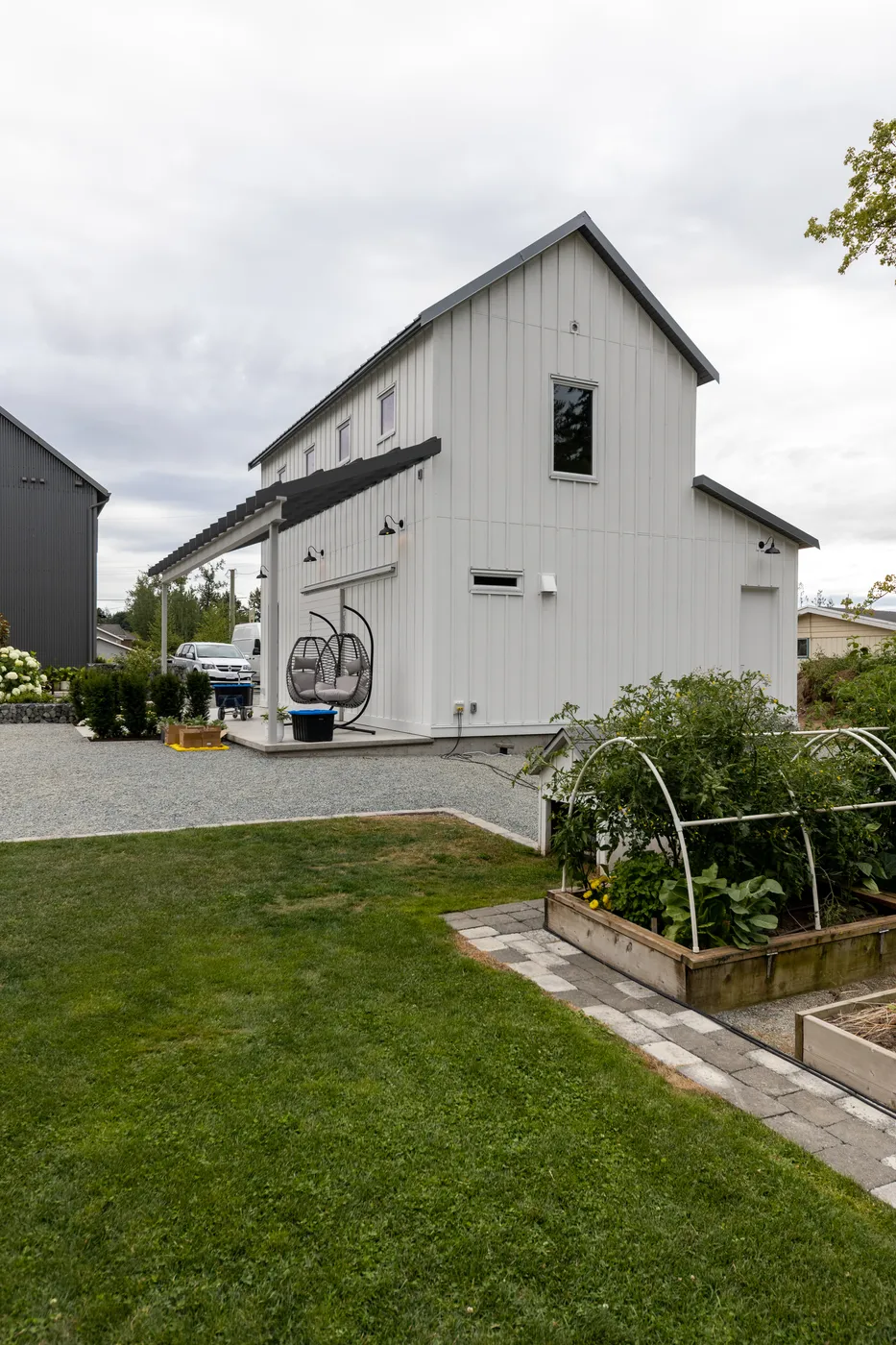
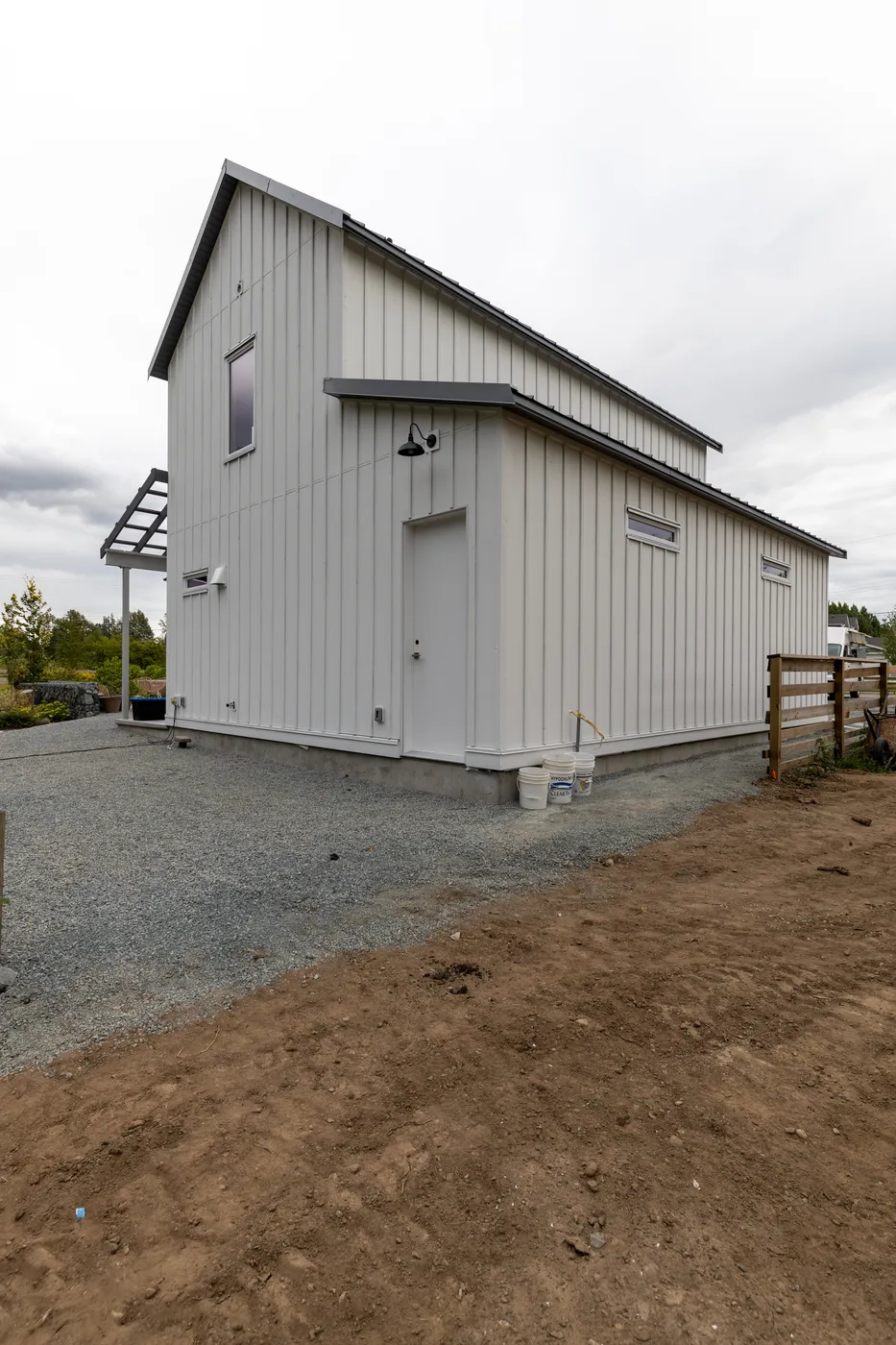
Often, yes, with no application. Since December 31, 2021, section 34.3 of the ALR Use Regulation has allowed one additional residence on a parcel when these conditions are met. Only one residence stands on the parcel when construction of the second one begins, and a permitted suite inside that house does not count as a second residence. The two homes are detached from each other. On a parcel of 40 ha or less, the main house is 500 m² or less and the additional residence is 90 m² or less. On a parcel over 40 ha with a lawfully built main house, the additional residence can be 186 m². The local zoning must allow it as well.
The ALC says family members or other people may live in the additional residence, whether or not they work on the farm, as long as the use meets local bylaws.
It is measured differently from the main house. The ALC measures it to the inner surface of the exterior walls, and the basement counts. A crawl space under 1.8 m high is left out, and so is an unfinished attic made by roof trusses. A garage or carport attached beside it or under it counts. For example, a one-storey cottage with 30 cm thick walls that measures 8.6 m by 11.6 m outside is 8.0 m by 11.0 m inside, or 88 m². Add a 20 m² attached carport and it becomes 108 m², which is over the limit.
One layout gives more room. A single level of living space above a one-storey garage can leave the garage out of its floor area when the garage holds the main house's vehicles, is one open space with garage doors, is no larger than the 90 m² or 186 m² limit, has no inside connection to the home above, and sits next to the main house. The ALC calls this a carriage house.
In the Township, the permit type is called "ALR second dwelling under 90m²". Its form list matches a new house: the application form and checklist, the septic Building Permit Referral Form, soil and erosion forms, energy forms, a stormwater checklist and the tree cutting declaration. The Township's Step 4 and EL-3 energy rule covers all new Part 9 homes. Any fill for the second home, even a small gravel pad, needs a Notice of Intent to the ALC first. And BC Housing says a standalone accessory home, such as a garden suite, meets the Homeowner Protection Act's definition of a new home, so a licensed residential builder builds it and home warranty insurance covers it. An owner builder must use it personally for at least one year from first occupancy.
Principal residence
- Size without an ALC application
- 500 m²
- How floor area is measured
- To the outer surface of the exterior walls
- Basement
- Left out
- Attached garage or carport
- First 42 m² left out, the rest counts
- Fill
- Up to 1,000 m² of fill area, including the driveway and yard
- Secondary suite
- One suite allowed inside the house
- Short stays
- Bed and breakfast in up to 4 bedrooms while the owner lives there
Additional residence
- Size without an ALC application
- 90 m² (186 m² on parcels over 40 ha)
- How floor area is measured
- To the inner surface of the exterior walls
- Basement
- Counts
- Attached garage or carport
- Counts, except a carriage house above the main house's garage
- Fill
- Any fill needs a Notice of Intent
- Secondary suite
- Cannot be used as the suite
- Short stays
- Only as agri-tourism on a property with farm classification
Source: Agricultural Land Commission, Housing in the ALR; ALC Information Bulletin 05: Residences in the ALR (revised June 13, 2024)
What about a suite, or a short-term rental?
On ALR land a secondary suite is allowed only inside the main house, and a detached building cannot serve as that suite. The Township caps a secondary suite at 120 m² of gross floor area, and its zoning bylaw says a suite in the ALR must follow the ALC's rules. Under the ALC rules, one parcel can hold a main house with a suite inside it and one detached additional residence, when each meets its limit. We confirm the zone allows the same before design starts.
Short-term rentals are limited. In a principal residence where the owner lives, the ALC allows bed and breakfast use in up to four bedrooms in total, counting bedrooms in a suite, with no guest staying more than 30 days in a row. Renting the whole house for short stays needs ALC approval. An additional residence can take short stays only as agri-tourism accommodation, on a property with farm classification under the Assessment Act. The ALC notes that local bylaws and the provincial Short-Term Rental Accommodations Act may also apply.
Can we live in the old farmhouse while the new one is built?
In most cases, only with ALC approval. If the old house is demolished and removed first, the new main house needs no application as long as it meets the 500 m² limit. Living in the old house during construction means two principal residences on one parcel, which the Act does not allow, so it needs a NARU application.
Bulletin 05 names one exception: no application is needed if the new residence complies with the additional residence rules in section 34.3, which on a parcel of 40 ha or less means one home of 500 m² or less and one of 90 m² or less. Ask the ALC or the Township how this applies to your two buildings before you rely on it.
When the ALC approves a request to stay in the old house, it may require a restrictive covenant on title to remove the old house once the new one is finished, a financial security, and rules on where the new house goes. The application has to explain why you need to stay, or why the new house cannot go where the old one stands. The ALC suggests checking with your financial institution before you apply. For what the Township allows to happen to the old building on an RU lot, see our acreage and farm homes page.
Older homes have their own rule. Some parcels have a second house, or a manufactured home, allowed under rules from before February 22, 2019. Bulletin 05 says there is no right to replace a home that is allowed only because of these grandfathering rules, so replacing it needs an ALC application. On a parcel with more than one residence, the same applies to homes older than the ALR itself, which dates from December 21, 1972, and to homes approved under earlier versions of the Act.
How much fill can go in, and what kind?
For a main house of 500 m² or less, the ALC allows fill and soil removal over an area of up to 1,000 m² without authorization, and that area includes the driveway and the yard that serve the house. In a floodplain, the result must also match the local flood protection level. A long driveway can use most of that area. Picture a house set 150 m back from the road on a 4 m wide gravel driveway: the driveway alone covers 600 m², which leaves 400 m² for the house pad, parking and yard.
Past 1,000 m², or for any fill at all for an additional residence or a building that serves the house, the owner files a Notice of Intent with the ALC at least 60 days before the work, with a $150 fee. Within 60 days of receiving the notice and the fee, the ALC's Chief Executive Officer may ask for more information, approve the fill in writing, or order in writing that the work not go ahead unless an application permits it.
Section 36 of the ALR Use Regulation bans some materials as fill: construction and demolition waste such as concrete, masonry rubble, rebar, drywall and wood waste, plus asphalt, glass, synthetic polymers, treated wood and unchipped lumber. Concrete from the old foundation is on that list, so it cannot go under the new driveway.
The Township adds its own rules. Before fill arrives for a new house, a civil engineer seals a Stormwater Management Plan, and the fill may only build up the house site. In the Rural Floodplain zone RU-4, the house must stand on natural ground at or above the Flood Construction Level, and no fill or structural raising may be used to reach it. In RU-5, the level may be reached with up to 0.91 m of fill on the building site, with structural elevation, or with both.
What if the plan needs more than the rules allow?
Then it needs a Non-Adhering Residential Use application. The ALC lists the cases: a main house over 500 m², an additional residence over 90 m² (or 186 m²), more than one additional residence, keeping the old house until the new one is finished, and any other home that does not fit the Act or the regulation. In the Township, the application goes through both governments in this order.
- 01
Pre-application comments
Send the Township's Pre-Application Request Form. A Development Planner gives first feedback within 30 days.
- 02
Apply on the ALC Portal
Log in with a BCeID, submit the application, and pay the Township its $450 share of the $900 fee.
- 03
Township development application
Submit a separate application through MyTownship, as Development Application Procedures Bylaw No. 5760 requires.
- 04
Staff report and Council
Staff report to Council with a recommendation. Council may refer the application to the ALC or deny it.
- 05
ALC decision
If it is referred, pay the ALC its $450. The Commission decides and writes to you and the Township.
- 06
Building permit
With approval in hand, apply for the building permit. ALC authorizations should come before soil or building permits are issued.
Source: Agricultural Land Commission, Application Process; Township of Langley, Agricultural Land Use; ALC Information Bulletin 05: Residences in the ALR
Council considers how the proposal fits Township policy, whether it suits the area, site limits such as slopes and watercourses, whether it could lead to similar proposals nearby, and the history of the parcel. For a large house, the ALC may weigh whether it supports or reflects the farming on the property, the scale of that farming, and whether the effect on farmland is kept small. For extra homes beyond the one permitted, the ALC can approve them only if they are necessary for farm use. ALC staff cannot advise on the likely outcome, so we also draw a version of the house that fits within the limits, in case the answer is no.
If the ALC refuses, the Township says reconsideration can be requested only with "substantial new information", or where the decision rested on information that was wrong or false.
Housing for farm workers and temporary homes
The Township's RU-1 zone has separate rules for people who work on the farm. Seasonal farm labourer housing may be lived in from April 1 to November 30 on a bona fide farm of at least 4 ha, at up to 10 people for each 4 ha and 40 per farm, with no more than 10 m² of floor area per person. A mobile home as a temporary second dwelling needs the owner living in the main house, an occupant who is a farm employee or one of the close relatives the bylaw lists, and a property of 8,094 m² or more, with a medical exception that Council must approve. The permit lasts one year and can be renewed, the mobile home must be removed within 90 days once the conditions end, and additions to it are limited to 24 m². On ALR land the ALC rules apply as well, and homes for farm help beyond the one permitted additional residence need ALC approval based on the farm's need.
Where we start on an ALR parcel
Frequently asked
How big can a house be on ALR land in the Township of Langley?
Up to 500 m² of total floor area without an application to the Agricultural Land Commission. The ALC measures every floor to the outer surface of the exterior walls and leaves out basements, crawl spaces, truss attics and the first 42 m² of attached garage and carport. A bigger house needs a Non-Adhering Residential Use application, which the Township reviews first.
Can I build a second house for my parents on my Langley farm?
Often, yes. The ALC allows one detached additional residence without an application when only one residence stands on the parcel as construction starts: up to 90 m² on parcels of 40 ha or less with a main house of 500 m² or less, and up to 186 m² on larger parcels. Family members or others may live in it, whether or not they work on the farm. The zone must allow it too: RU-1 to RU-5 allow two dwellings subject to the ALC Act, and RU-3A allows one.
Does an attached garage count toward the ALR house size limit?
For the main house, the first 42 m² of attached garage and unenclosed carport is left out, and anything above 42 m² counts. For an additional residence, an attached garage counts in full, unless the home is a carriage house over a one-storey garage that serves the main house and meets the ALC's conditions.
Can I rent out my farmhouse on ALR land in Langley as a short-term rental?
Bed and breakfast use is allowed in a principal residence you live in, with up to four bedrooms and stays of no more than 30 days in a row per guest. Renting the whole house for short stays needs ALC approval. An additional residence can take short stays only as agri-tourism accommodation on a property with farm classification, and local bylaws can add limits.
What does a NARU application cost in the Township of Langley?
The ALC's application fee for a Non-Adhering Residential Use is $900. You pay the Township $450 when you submit, and the other $450 goes to the ALC only if Council refers the application. The Township also requires a separate development application through MyTownship.
Can I use crushed concrete from my old house as fill on ALR land?
No. Section 36 of the ALR Use Regulation bans construction and demolition waste as fill, and its list names concrete, masonry rubble, rebar, drywall and wood waste. Asphalt, glass, synthetic polymers, treated wood and unchipped lumber are banned as well.
Can I put a gym or guest room in a separate building on ALR land?
The ALC says no. A building that serves the house may not contain rooms that belong inside a home, such as a sleeping area, recreation room, gym or spa, and it cannot be used to get around the house size limits. Those rooms go inside the principal residence or the additional residence.
Can I replace an old second house or mobile home on my ALR property?
Only with ALC approval if that home exists because of the grandfathering rules for homes from before February 22, 2019. ALC Information Bulletin 05 says there is no right to replace a home that is allowed only under those rules. The same applies on a parcel with more than one residence to homes that predate the ALR, from before December 21, 1972.
We start with three numbers on the first site sketch: the main house's total floor area by the ALC's method, the fill area from the road to the back of the yard, and the size of any second home measured inside its walls. When all three fit, the project goes to the Township as a building permit, and our Township of Langley building permit guide covers the steps from there. When one does not fit, the owner decides between changing the plan and applying, before paying for full drawings. If you own farmland in Langley, book a free consultation.
Sources
- Agricultural Land Commission, Housing in the ALR
- Agricultural Land Commission, Information Bulletin 05: Residences in the ALR (revised June 13, 2024)
- Agricultural Land Commission, Application Process
- Agricultural Land Commission, Notice of Intent Process
- Agricultural Land Commission, Agricultural Land Reserve Maps
- Township of Langley, Agricultural Land Use
- Township of Langley, Residential Building Permits
- Township of Langley Zoning Bylaw 2500, Section 200: Rural Zones
- Township of Langley Zoning Bylaw 2500, Section 100: Administration
- Township of Langley, Rural Plan Bylaw No. 3250
- Township of Langley, Residential Construction Guide: New Single-family Dwellings (January 2025)
- Township of Langley, Green Buildings: Builders (Step Code and Zero Carbon Step Code)
- BC Housing, Secondary Suite Incentive Program (new home rules for a standalone ADU)
Written by

Founder & President
Mark Van Ek is the founder and president of Venture Pacific, bringing more than 40 years of Metro Vancouver and the Fraser Valley construction management experience, a 2026 HAVAN Award and several Georgie and HAVAN finalist placements to every custom home, renovation, and multiplex project.
Full profile