
What is a multiplex? Duplex, triplex, and fourplex explained
A multiplex is one building split into three to eight homes, each with its own front door. Here's how that differs from a duplex, a triplex, and the multi-family buildings people often confuse it with.
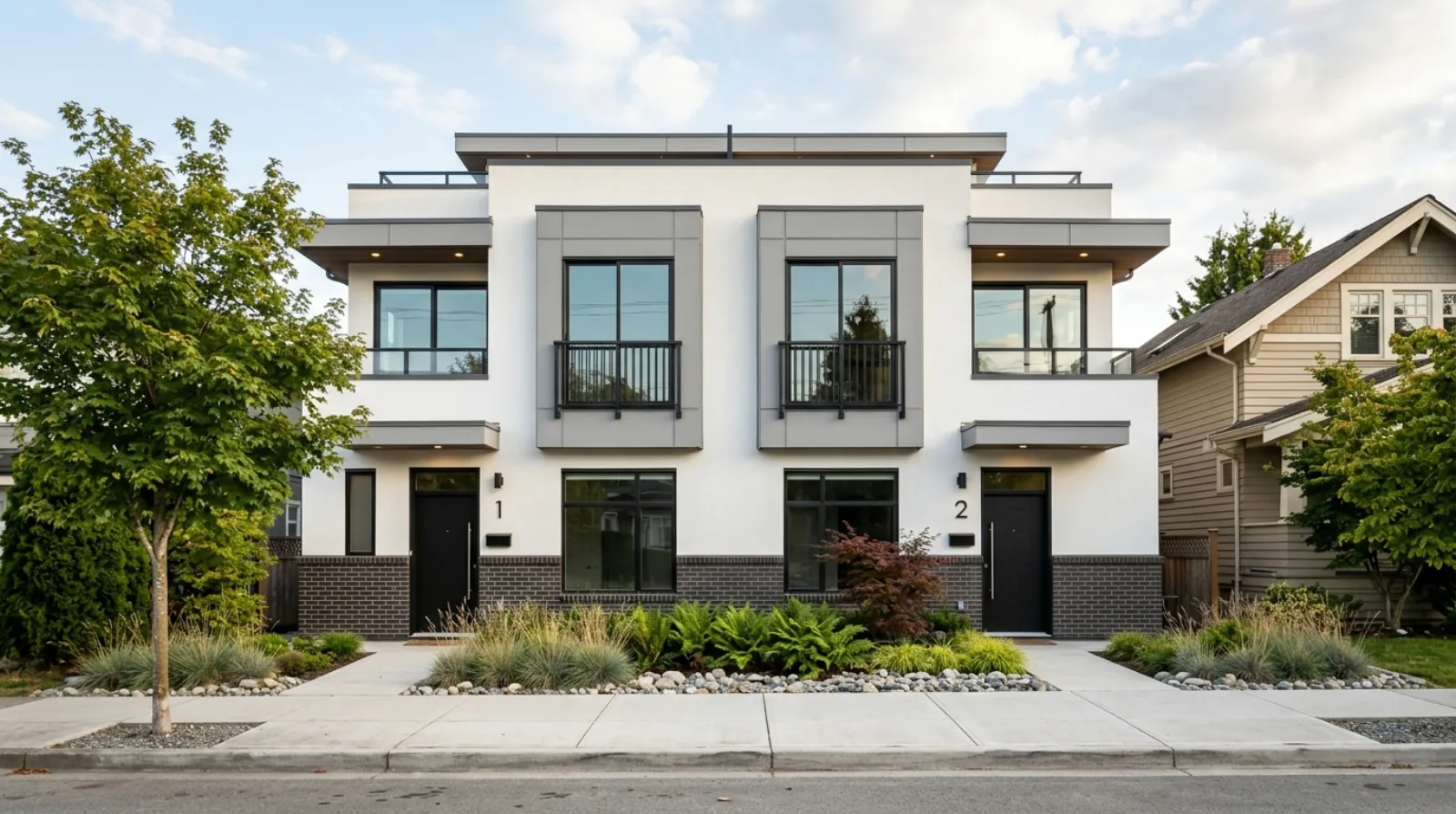
In short, A multiplex is a single building divided into three to eight independent homes, each with its own exterior entrance, built on one residential lot. Vancouver's R1-1 zone defines a multiplex this way; a duplex is the two-unit version, a triplex the three-unit version, and a fourplex the four-unit version. BC's SSMUH rules require most single-family lots to allow at least three homes on parcels of 280 square metres or smaller, and at least four above that size.
"So what exactly is a multiplex?" It's one of the first questions almost every Vancouver landowner asks us, and it's a fair one. The word gets used loosely online, sometimes to mean a duplex, sometimes an apartment building, sometimes anything with more than one door. There's an actual definition, and it matters, because the answer changes what a lot can legally hold.
What is a multiplex?
A multiplex is one building split into three to eight separate homes, each with its own exterior entrance, kitchen, and bathroom, sitting on a single residential lot. That's not our informal definition, it's the City of Vancouver's own under the R1-1 zone, which took effect in October 2023 and replaced the old RS single-family designation across most of the city.
The independent entrance is the part people miss. A multiplex doesn't have a shared lobby or a hallway connecting the units. Residents walk out their own front door onto the street or the laneway, the same way a homeowner in a detached house does. That's what makes a well-designed multiplex read as a row of small homes rather than an apartment block, even though the units may share walls, floors, and a foundation.
Duplex, triplex, fourplex: same idea, different count
Once you understand the multiplex definition, the rest is simple arithmetic. A duplex holds two homes. A triplex holds three. A fourplex holds four. A sixplex holds six. They're all built on the same underlying idea, one lot, multiple independent homes, just with a different unit count.
Technically, a duplex sits just below the multiplex threshold; Vancouver's R1-1 zone defines multiplex as 3 to 8 units, so a two-unit building is its own category. In everyday conversation, and often in city zoning language too, duplex through eightplex all get discussed together as forms of ground-oriented, multi-unit housing on a single-family-scale lot. What decides which one actually fits a given property is lot width, depth, lane access, and slope, not a homeowner's preference for a bigger number.
Multiplex vs multi-family: not the same thing
People sometimes use "multiplex" and "multi-family" interchangeably, and that's where confusion starts. A multiplex is ground-oriented: three to eight homes, individual entries, built to the scale of a large house. Multi-family, as the term is generally used in Metro Vancouver, describes a larger apartment or condo building with one shared entrance, a common lobby or corridor, and often dozens of units under a single strata.
The distinction isn't just semantic, it's zoning. A multiplex is typically permitted on a standard single-family-sized lot under SSMUH and municipal multiplex bylaws. A multi-family apartment building usually needs a different zone entirely, often requiring rezoning, and sits at a different scale and density than anything a standard 33 or 50-foot Vancouver lot could support on its own.
How many units your lot actually gets
BC's small-scale multi-unit housing (SSMUH) legislation sets a province-wide floor: most single-family lots must be allowed at least 3 homes on parcels of 280 square metres or smaller, and at least 4 on parcels larger than that, with as many as 6 required on lots near frequent transit service. That floor applies whether the lot sits in Vancouver, Burnaby, or Coquitlam.
Vancouver's own R1-1 zone goes further in places, permitting 3 to 8 units depending on lot size, configuration, and whether the homes are secured as rental. The provincial number is a minimum; what a specific address can actually carry, once setbacks, floor area, parking, and servicing are accounted for, is a separate question that only a real feasibility review answers.
Missing middle: where the term comes from
Multiplexes, duplexes, triplexes, and small townhome rows are collectively called "missing middle" housing, the range of homes that sits between a detached single-family house and a large apartment building. For decades, most Metro Vancouver residential zoning permitted only the two extremes, one house per lot, or a rezoning application for an apartment building, with almost nothing built in between.
SSMUH and municipal multiplex policies exist to bring that middle category back to ordinary residential streets. A fourplex on a standard lot is the clearest expression of missing middle: more homes than a single house, but still built at a scale that fits next to the single-family homes around it.
Laneway homes and coach houses inside a multiplex
On a lot with usable rear lane access, one of a multiplex's permitted units can often take the form of a laneway home or coach house facing the lane instead of the street. That's a common way to reach a lot's full permitted unit count without adding a storey to the main building, and it puts one home closer to the lane where parking and a separate entrance already make sense.
Whether a specific lot can actually carry a laneway unit alongside a multiplex on the front of the site depends on lot depth, the lane's condition, and the municipal multiplex bylaw the property falls under. It's a lot-specific answer, not a rule of thumb.
Ownership is a separate question from unit count
Knowing what a multiplex is answers the design and zoning question. It doesn't answer how the homes end up owned. Most stacked multiplexes are sold as strata units, because the homes physically share a building structure, foundation, and often a roof. Some projects are held entirely as secured rental under one owner instead, and a smaller number are subdivided fee-simple where the lot geometry and local zoning allow it.
We settle that ownership question early on every project we take on, because it changes the financing structure and, in some cities, the number of units a lot is even allowed to carry. A multiplex being sold strata and a multiplex held as rental can be the exact same building with a very different partnership behind it.
If you're trying to figure out what your own Vancouver, Burnaby, or Richmond lot could actually support, start with our multiplex calculator to see the permitted range, then a Feasibility & Equity Review turns that range into a real answer, tested against your lot's width, depth, and access, not just the zoning map.
Related guides: how a multiplex, duplex, or townhouse fits your lot, what a multiplex costs against a multi-family building, and SSMUH and Bill 44 explained in full. For the exact site area and frontage each unit count needs, see the unit types chapter of our multiplex design guide.
Frequently asked
What is a multiplex, in plain terms?
A multiplex is one building divided into three to eight separate homes, each with its own exterior entrance, kitchen, and bathroom, built on a single residential lot. Vancouver's R1-1 zone defines it exactly this way: 3 to 8 dwelling units on one site, which is what separates a multiplex from a duplex (2 units) or a single-family house (1 unit).
What's the difference between a duplex, a triplex, and a fourplex?
The difference is unit count on the same lot: a duplex holds two homes, a triplex holds three, and a fourplex holds four. All three are types of multiplex once you cross the three-unit threshold; a duplex sits just below that line. In Metro Vancouver, which one a lot ends up with depends mostly on lot width, depth, and access, not on a single fixed rule.
Is a multiplex the same thing as a multi-family building?
No. A multiplex is ground-oriented, three to eight homes with individual entries on one residential lot, while multi-family usually describes a larger apartment or condo building with a single shared entrance and dozens of units under one strata or ownership structure. A multiplex is a form of missing-middle housing that sits between a single house and a multi-family building, not a synonym for either.
How many units can I legally build on my Vancouver lot?
Under BC's small-scale multi-unit housing (SSMUH) rules, most single-family lots must be allowed at least 3 units on parcels of 280 square metres or smaller, and at least 4 units above that size, with up to 6 required near frequent transit service. Vancouver's own R1-1 zone permits 3 to 8 units depending on lot size and configuration, so the achievable count on a specific lot still needs a feasibility check against local setbacks and floor area rules.
Do all the homes in a multiplex share one entrance?
No, that is the defining feature that separates a multiplex from an apartment building. Vancouver's R1-1 zone requires each unit in a multiplex to have its own direct exterior entrance, so residents come and go without passing through a shared lobby or hallway, closer to how a row of townhomes works than how a condo building works.
Can a multiplex include a laneway home or coach house?
Yes. A multiplex project on a lot with rear lane access can often include a laneway home or coach house as one of its units, which helps a lot reach its permitted unit count without adding height to the main building. Whether a specific lot can carry a laneway unit alongside a multiplex depends on lot depth and the city's own multiplex bylaw.
Why is a multiplex called 'missing middle' housing?
A multiplex is called missing middle housing because it fills the gap between a single-family house and a large apartment building, a category of homes that BC's older single-family zoning excluded from most residential lots for decades. Duplexes, triplexes, fourplexes, and small townhome rows all fall under this same missing-middle umbrella.
Does a multiplex have to be sold as strata units?
Not necessarily. Most stacked multiplexes are sold as strata because the units share a single building structure, but some projects are held entirely as secured rental with one owner, or subdivided fee-simple where the lot and zoning allow it. The ownership plan is a separate decision from the unit count, and it should be settled early since it changes financing and design.
Wondering what your lot could become? Book a free consultation with Venture Pacific to find out how many units you could build on your property, whether it's a feasible project, and how our GP/LP partnership structure works.
Written by

Acquisitions and Development
Trent Praski leads investment and development at Venture Pacific, sourcing missing-middle opportunities across Metro Vancouver and the Fraser Valley and structuring transparent homeowner and investor partnerships.
Full profile