
Multiplex vs multi-family: what's the difference?
A multiplex and a multi-family building both add homes to a neighbourhood, but they sit on the land, and in the zoning code, very differently. Here's what actually separates the two.
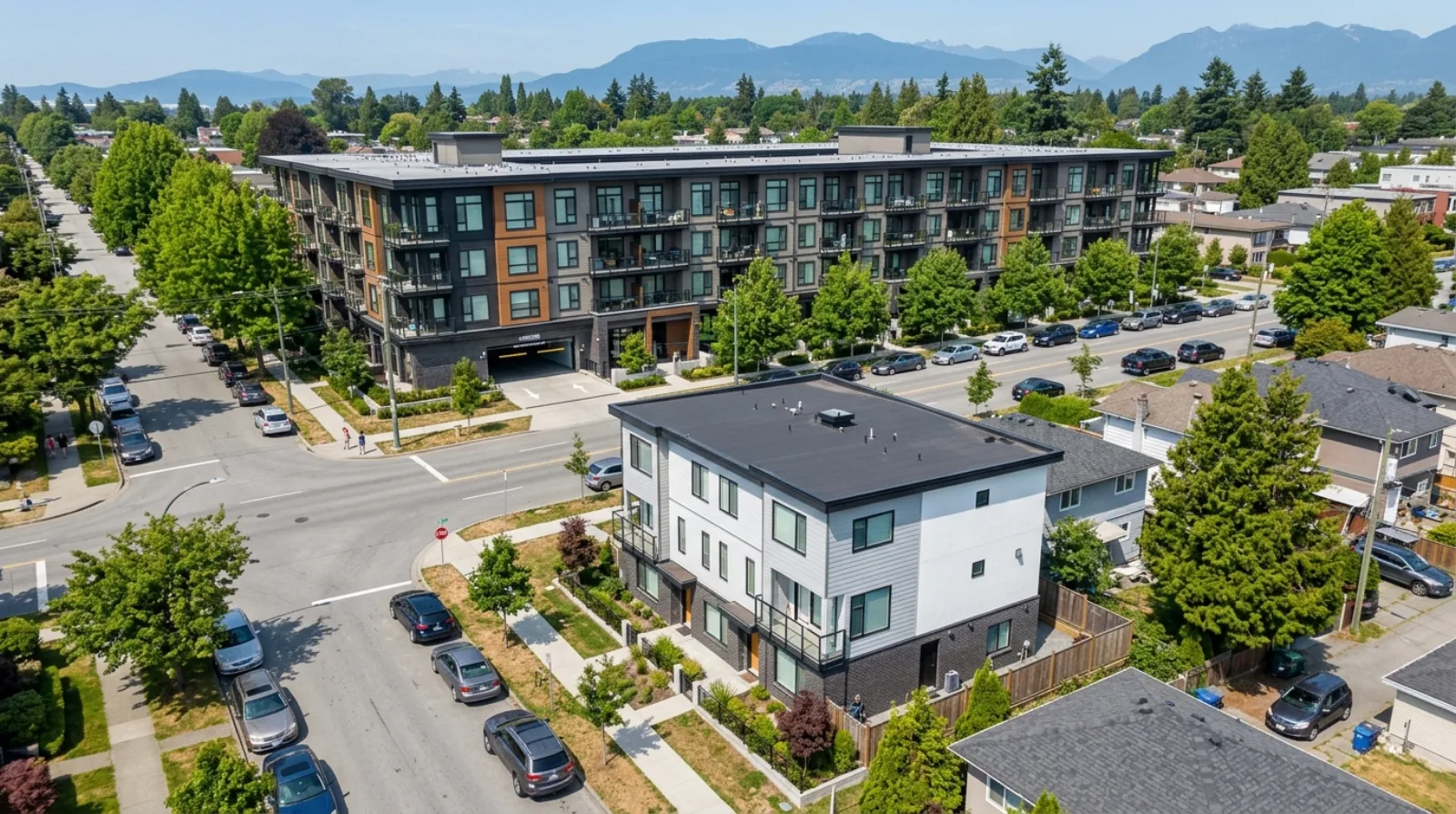
In short, A multiplex is a ground-oriented building of 3 to 8 independently-entered homes on a single residential lot, permitted under BC's SSMUH rules and Vancouver's R1-1 zone. Multi-family describes a larger apartment or condo building with a shared entrance and common corridors, usually requiring a different zoning designation than a standard single-family-sized lot.
A Burnaby homeowner called us last month convinced her lot could "go multi-family" now that the city was allowing more density everywhere. It's an understandable mix-up, and one we hear often, because both terms describe more homes on a lot than the single house that used to sit there. They're not the same building, though, and the difference decides what a standard residential lot can actually be zoned for.
The core difference: how residents get in
A multiplex is ground-oriented. It's a building of 3 to 8 homes on a single lot, and every one of those homes has its own exterior entrance. Residents walk straight out to the street or the laneway, no shared lobby, no shared hallway, no elevator.
Multi-family, as the term gets used across Metro Vancouver, generally describes an apartment or condo building with a shared main entrance and internal corridors connecting the units. It's a different building type built to a different scale, often several storeys and dozens of homes rather than a handful.
Different zoning, not just different size
A standard single-family-sized Vancouver lot is zoned R1-1, and that zone permits a multiplex, 3 to 8 ground-oriented units, not a multi-family apartment building. Multi-family apartment zoning is a separate category, usually reserved for larger assembled sites or requiring a full rezoning application most individual homeowners never file.
That's the practical answer for the vast majority of Metro Vancouver homeowners asking this question: your standard lot almost certainly qualifies for a multiplex under BC's SSMUH rules, and almost certainly does not qualify for multi-family apartment zoning on its own. The two paths lead to very different projects, timelines, and financing structures.
Density: multi-family is the denser of the two
Both forms add homes compared to the single house they replace, but they don't add the same amount. A multiplex fits 3 to 8 homes onto a single standard lot. A multi-family building achieves higher density through additional storeys and a different structural approach, often housing far more units on a comparable or assembled site.
Neither is automatically the better choice, they answer different questions. A multiplex fits into an established single-family street without changing its character dramatically. A multi-family building changes a block's density and scale outright, which is exactly why it needs a different zoning process.
Construction method shifts with scale
Most Metro Vancouver multiplexes are built with standard wood-frame construction, the same method used to build the single-family house it replaces. Larger multi-family buildings more often shift to concrete or hybrid wood-and-concrete construction once they climb past a few storeys, which the BC Building Code treats differently for fire separation, structure, and life-safety systems.
That construction shift is one more reason a multiplex on a standard lot stays achievable for an individual homeowner, and a multi-family building generally isn't. The trades, the schedule, and the budget all scale with the building type, not just the unit count.
Strata structure: same word, very different scale
Both a multiplex and a multi-family building can be sold as strata units, which sometimes adds to the confusion. But the strata itself looks nothing alike. A multiplex strata usually covers 3 to 8 owners managing one small building together. A multi-family strata can cover dozens or hundreds of owners across a much larger complex, with a correspondingly larger and more formal strata corporation, professional management, and a bigger annual budget.
A small multiplex strata runs closer to how a triplex or fourplex owner group makes decisions together than to how a large condo building's strata council operates. That's worth knowing before assuming "strata" means the same governance experience in both cases.
What this means for your lot
If you own a standard single-family-sized lot in Vancouver, Burnaby, or Richmond, the realistic path is almost always a multiplex under BC's SSMUH rules and your city's own multiplex bylaw, not a multi-family apartment building. That's not a limitation so much as a fit, a multiplex is built at a scale your lot and its neighbourhood zoning can actually support without a rezoning fight.
We run a Feasibility & Equity Review on every lot before recommending a direction, checking the real unit count your zoning allows and how a multiplex would sit on your specific property. Start with our multiplex calculator for a first read on what your lot could carry, then we'll walk through what a real multiplex project on it would actually look like.
Related guides: what a multiplex actually is, how a multiplex, duplex, or townhouse fits your lot, and what missing middle housing means for Metro Vancouver.
Frequently asked
What is the main difference between a multiplex and a multi-family building?
The main difference is how residents get in and out. A multiplex is ground-oriented, 3 to 8 homes on one lot, each with its own exterior entrance, while multi-family typically means a larger apartment or condo building where residents share a single entrance, lobby, and corridors. The two also sit under different zoning designations in most Metro Vancouver cities.
Can I build a multi-family apartment building on a standard Vancouver lot?
Generally no, not without rezoning. A standard single-family-sized Vancouver lot is zoned under R1-1, which permits a multiplex of 3 to 8 ground-oriented units, not a multi-family apartment building. Multi-family apartment zoning is usually reserved for larger sites or requires a separate rezoning application to a different density category.
Does a multiplex share a strata with a multi-family building?
No, they are unrelated strata structures even though both can involve shared ownership. A multiplex strata typically covers 3 to 8 owners in one small building, while a multi-family strata can cover dozens or hundreds of owners across a much larger apartment or condo complex, with a correspondingly larger and more formal strata corporation.
Is a multiplex considered higher density than multi-family housing?
No, a multiplex is generally lower density than multi-family housing. A multiplex adds 3 to 8 homes to a single standard lot, while a multi-family building typically holds far more units on a comparable or larger site through additional storeys and a different structural approach. Both add density compared to a single-family house, but multi-family is the denser of the two forms.
Why does BC's SSMUH legislation apply to multiplexes and not multi-family buildings?
BC's small-scale multi-unit housing (SSMUH) rules specifically target single-family and duplex-zoned lots, requiring them to allow 3 to 6 ground-oriented homes, which is the multiplex scale rather than a full apartment building. Multi-family apartment buildings fall under separate provincial transit-oriented density legislation and municipal apartment zoning, not the SSMUH framework at all.
Do multiplex and multi-family buildings get built with the same materials and methods?
Largely yes at the multiplex scale. Most Metro Vancouver multiplexes use standard wood-frame construction, the same method used for single-family homes, while larger multi-family buildings more often move to concrete or hybrid construction once they exceed a few storeys. The construction method tends to shift as a project's height and unit count grow past what a multiplex typically involves.
Which one is right for my Metro Vancouver lot, a multiplex or multi-family?
For the vast majority of standard single-family-sized lots in Vancouver, Burnaby, or Richmond, a multiplex is the realistic option, since multi-family zoning generally isn't available on that lot size without a rezoning application most homeowners won't pursue. A feasibility review is the way to confirm which category, and which unit count, your specific lot actually qualifies for.
Does a multiplex feel different to live in than a multi-family apartment?
Yes, most residents describe it differently because a multiplex functions closer to a small house than an apartment. Each home has its own front door, often its own small yard or patio, and no shared hallway or elevator, while multi-family living typically means a shared lobby, corridors, and building-wide amenities that a multiplex doesn't have.
Wondering what your lot could become? Book a free consultation with Venture Pacific to find out how many units you could build on your property, whether it's a feasible project, and how our GP/LP partnership structure works.
Written by

Acquisitions and Development
Trent Praski leads investment and development at Venture Pacific, sourcing missing-middle opportunities across Metro Vancouver and the Fraser Valley and structuring transparent homeowner and investor partnerships.
Full profile