
Strata vs freehold multiplex ownership in Burnaby
Burnaby is the rare Metro Vancouver city that writes fee-simple rowhouse subdivision directly into its zoning bylaw. Here's what that option actually requires, and when strata is still the better fit.
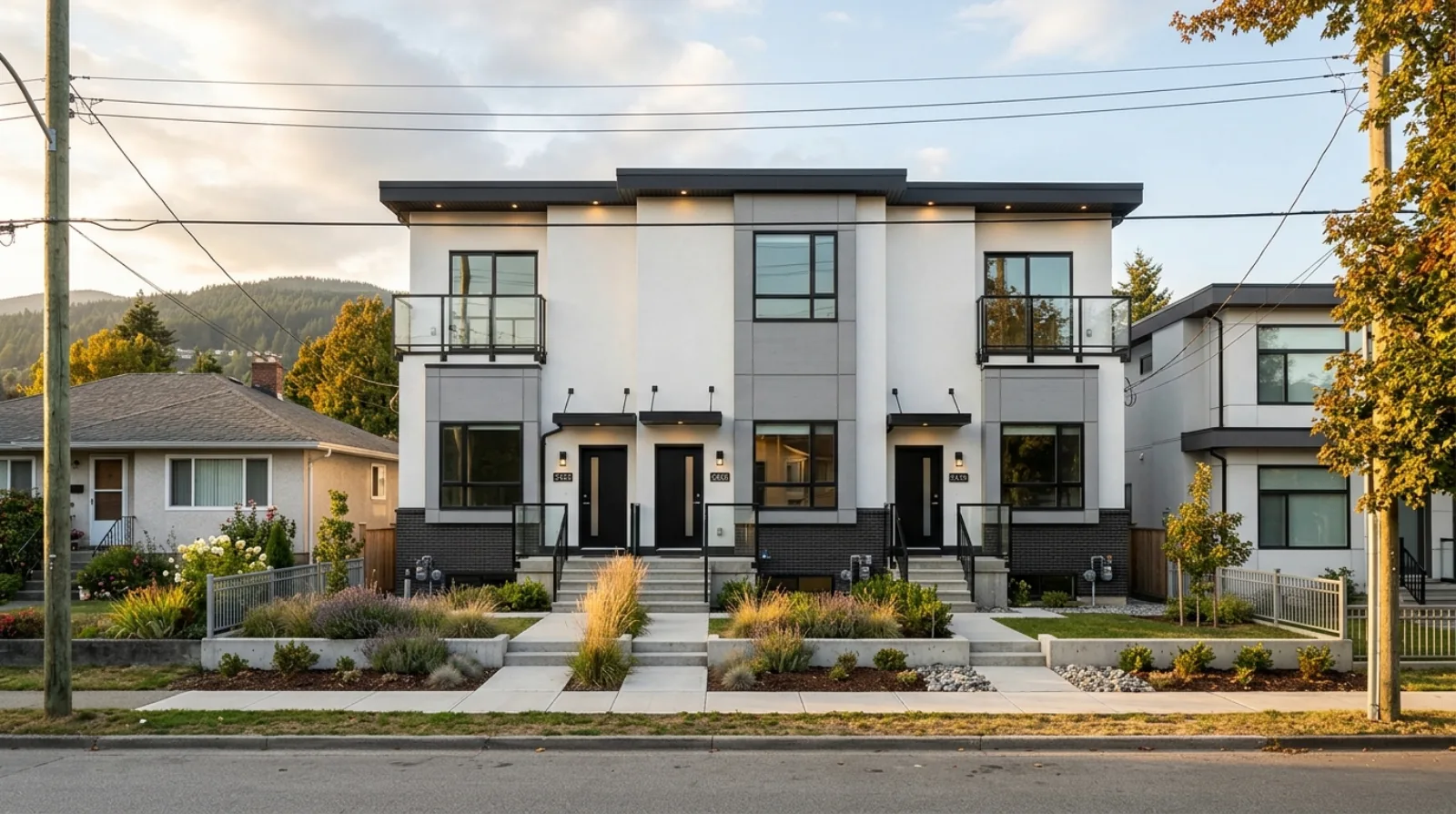
In short, Burnaby's R1 Small-Scale Multi-Unit Housing District, adopted in June 2024, allows fee-simple rowhouse subdivision as an alternative to strata ownership. Interior rowhouse lots need a minimum width of 5 metres, 6.2 metres for an end unit, 8 metres on a corner lot with a flanking street, or 6.2 metres on a corner lot with a flanking lane. Rowhouse lots are capped at 280 square metres unless a Section 219 Covenant limits the lot to 3 units. Stacked small-scale multi-unit buildings, by contrast, remain strata.
Most Metro Vancouver cities leave the strata-versus-freehold question for a multiplex mostly unaddressed on paper. Burnaby doesn't. Its zoning bylaw names the freehold option outright, sets the exact lot widths that qualify, and spells out the legal safeguard that comes with it. That level of specificity is unusual enough that it's worth walking through in full.
Burnaby's fee-simple rowhouse option
Burnaby's R1 Small-Scale Multi-Unit Housing District, in effect since June 2024, formally lists "rowhouse dwellings" as a permitted principal use alongside single-family, duplex, and small-scale multi-unit housing. A rowhouse dwelling under this district means side-by-side units, each sharing a party wall with its neighbour, each sitting on its own separately titled fee-simple lot rather than one shared strata lot.
The subdivision table in the bylaw sets exact minimum widths for these rowhouse lots: 5 metres for an interior lot, 6.2 metres if that interior lot is an end unit, 8 metres on a corner lot with a flanking street, or 6.2 metres on a corner lot with a flanking lane. A rowhouse lot is capped at a 280 square metre maximum area, though that cap can be exceeded if the owner registers a Section 219 Covenant limiting the lot to no more than 3 dwelling units.
The covenant that comes with the freehold option
Burnaby doesn't allow fee-simple rowhouse subdivision without a legal safeguard attached. At the time a subdivision plan creating two or more rowhouse lots is registered, the city requires registration of a Section 219 Covenant, a restriction under BC's Land Title Act, guaranteeing that all the adjoining rowhouse dwellings will be constructed at the same time.
That covenant protects the first owner to finish their home from being stuck beside an empty, undeveloped lot for years while a neighbouring parcel sits idle. It also means a freehold rowhouse project in Burnaby has to be coordinated as a single build across all the lots involved, not phased one home at a time by different, unrelated owners.
Where freehold stops and strata takes over
The rowhouse fee-simple option applies specifically to ground-oriented, side-by-side units, homes that already sit on their own footprint and can be legally carved into separate titled parcels. Burnaby's same R1 district also permits small-scale multi-unit housing, buildings of up to 6 units, often stacked two or three storeys to fit more homes on a standard lot.
A stacked configuration almost always has to remain strata. Once units sit on top of one another, sharing floor and ceiling assemblies, foundation, and roof, there's no way to subdivide the land itself into separate ground-level parcels the way a rowhouse can. The building has to be strata-titled instead, under Part 14 of BC's Strata Property Act, with a strata corporation managing the shared structure.
Height and massing under the current bylaw
Whichever ownership path a Burnaby lot takes, the same height limits apply. Following December 2025 amendments to the R1 district, a front principal building is capped at 10 metres with a sloping roof, or 9.5 metres with a flat roof, generally 3 storeys. A rear principal building, such as a coach house facing the lane, is capped lower, 7.5 metres sloping or 7.0 metres flat, generally 2 storeys. Rowhouse buildings specifically max out at 3 storeys and 55% lot coverage under the bylaw's built form table.
Which path actually fits your Burnaby lot
A lot that comfortably clears the rowhouse width thresholds, 5 metres per unit at minimum, genuinely has a freehold option worth pricing out, no strata fees, no strata council, and a simpler resale process. A narrower lot, or one where a stacked layout reaches meaningfully more homes, usually does better as strata, since the higher unit count outweighs the governance simplicity freehold offers.
We test both configurations against a Burnaby lot's real dimensions in every Feasibility & Equity Review, since the width that qualifies for rowhouse subdivision on paper doesn't always leave room for a livable unit once setbacks and building separation requirements are applied. Start with our multiplex calculator to see your lot's permitted range before that conversation.
Related guides: how a Burnaby multiplex development partnership works, strata vs freehold multiplex ownership explained, Burnaby's SSMUH rules for 2026, and how a strata council actually works in a small multiplex.
Frequently asked
Does Burnaby allow freehold multiplex ownership?
Yes. Burnaby's R1 Small-Scale Multi-Unit Housing District, adopted in June 2024, formally allows fee-simple rowhouse subdivision as an alternative to strata, with a minimum interior lot width of 5 metres, 6.2 metres for an end unit. This makes Burnaby one of the more explicit Metro Vancouver cities on the freehold option, since the requirement is written directly into the zoning bylaw's subdivision table.
What's the minimum lot width for a fee-simple rowhouse in Burnaby?
An interior rowhouse lot in Burnaby needs a minimum width of 5 metres, or 6.2 metres for an end unit lot. Corner lots need 8 metres if the flanking side faces a street, or 6.2 metres if the flanking side faces a lane, all figures set directly in the city's R1 zoning bylaw's subdivision regulations.
Can a stacked multiplex in Burnaby be freehold instead of strata?
Generally no. Fee-simple subdivision in Burnaby applies to rowhouse dwellings, side-by-side units each sitting on its own titled lot, not to a stacked small-scale multi-unit building where homes sit on top of one another and share a single structure. A stacked multiplex in Burnaby is built under the separate small-scale multi-unit provisions of the same R1 district and remains strata.
How many units can a Burnaby rowhouse lot hold as freehold?
A Burnaby rowhouse lot is capped at 280 square metres in area, unless the owner registers a Section 219 Covenant limiting the lot to no more than 3 dwelling units, in which case it can exceed that area. That cap is a real tradeoff to weigh against a stacked strata multiplex on the same site, which can reach a higher unit count on certain lots.
What is the Section 219 Covenant requirement for Burnaby rowhouse lots?
At the time a subdivision plan creating two or more Burnaby rowhouse lots is registered, the city requires a Section 219 Covenant guaranteeing that all the adjoining rowhouse dwellings will be built at the same time. This protects each freehold owner from ending up beside a vacant, undeveloped lot indefinitely after their own home is finished.
Does a freehold rowhouse in Burnaby still have a strata fee?
No. A fee-simple rowhouse lot in Burnaby has no strata corporation attached to it, so there are no strata fees and no strata council. Each owner holds and maintains their own titled parcel directly, the same as owning a detached single-family home, though party-wall maintenance between adjoining rowhouse units still needs to be addressed in the property's own legal agreements.
What height does a Burnaby fee-simple rowhouse allow?
Under Burnaby's R1 district as amended in December 2025, a front principal building on a rowhouse or small-scale multi-unit lot is capped at 10 metres with a sloping roof or 9.5 metres with a flat roof, generally 3 storeys. A rear principal building, such as a coach house, is capped at 7.5 metres sloping or 7.0 metres flat, generally 2 storeys.
Is freehold or strata the better choice for a Burnaby multiplex lot?
It depends on the lot's width and the owner's priorities. A Burnaby lot wide enough to clear the rowhouse subdivision thresholds can genuinely choose freehold for its lower governance burden and no strata fees, while a narrower lot, or one better suited to a stacked layout, usually reaches a higher unit count as strata. A feasibility review tests both paths against the actual lot before recommending one.
Wondering what your lot could become? Book a free consultation with Venture Pacific to find out how many units you could build on your property, whether it's a feasible project, and how our GP/LP partnership structure works.
Written by

Acquisitions and Development
Trent Praski leads investment and development at Venture Pacific, sourcing missing-middle opportunities across Metro Vancouver and the Fraser Valley and structuring transparent homeowner and investor partnerships.
Full profile