
Strata vs freehold multiplex ownership, explained
Strata and freehold are two different ways to split ownership of a multiplex among several owners, and the choice changes who sits on the strata council, who pays for the roof, and what a lawyer registers at the land title office.
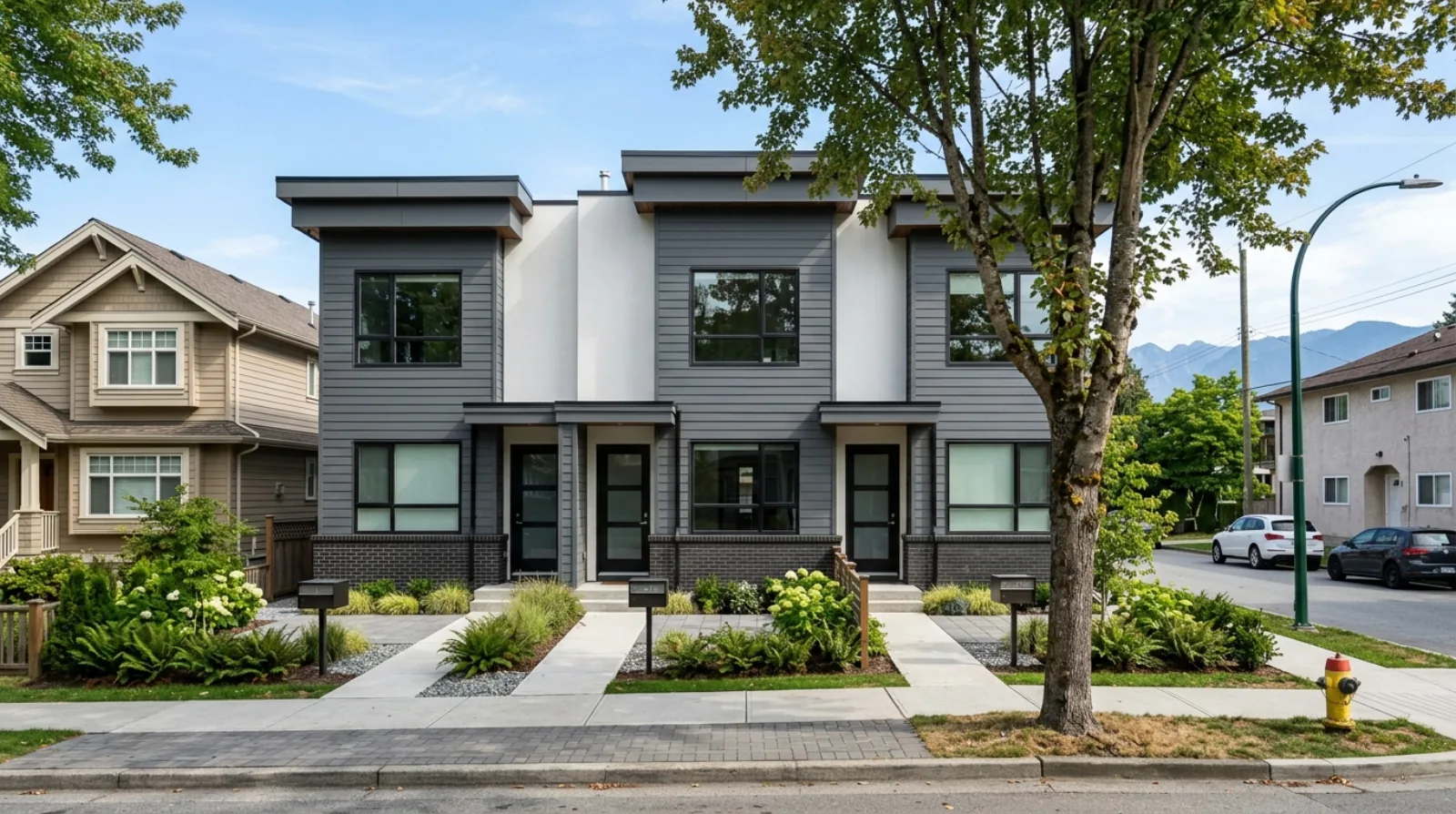
In short, A strata multiplex splits one lot into separately titled units with shared ownership of common property, managed by a strata corporation and strata council under BC's Strata Property Act. A freehold, or fee-simple, multiplex instead subdivides the lot itself into individual titled parcels, one per home, with no strata corporation and no strata fees. Burnaby's R1 SSMUH District, in effect since June 2024, formally allows fee-simple rowhouse subdivision as an alternative to strata, with a minimum interior lot width of 5 metres (6.2 metres for an end unit).
A Burnaby landowner asked us recently why her neighbour's new fourplex carried strata fees and hers, two streets over, wouldn't. The honest answer was ownership structure, not luck or location. Two lots can hold the same number of homes and end up on completely different legal footing, and that difference is decided long before anyone pours a foundation.
What strata ownership actually means
A strata multiplex splits one lot into separately titled units, each owned outright by an individual buyer, with the roof, exterior walls, foundation, and shared land held in common and managed collectively. Creating this structure means depositing a strata plan at the land title office under Part 14 of BC's Strata Property Act. A surveyor and lawyer prepare the plan, and once the land title office accepts it, each home becomes its own separately titled property with a proportional share of the common property attached to it.
That shared ownership needs a manager, and that's the strata corporation, run day-to-day by a strata council. Here's the detail most owners don't expect: in a strata corporation with fewer than four lots, every single owner sits on the council automatically, no election, no opting out, under Section 9(2) of the Strata Property Act's Schedule of Standard Bylaws. A triplex strata is governed directly by its three owners. That can make decisions fast when everyone agrees, and slow or contentious when they don't, since there's no larger pool of neutral votes to break a tie.
What freehold, or fee-simple, ownership means instead
Freehold ownership, also called fee-simple, is the same model most people already understand from owning a single-family house: the land and the building on it are one real estate entity, owned outright, with no strata corporation sitting above it. Applied to a multiplex, this means subdividing the lot itself into separate parcels, one per home, rather than subdividing a shared building into strata units.
No strata corporation means no strata fees and no strata council. Each owner is directly and solely responsible for their own home's maintenance, including any shared elements like a party wall, without a corporate structure pooling money or votes to manage it. That appeals to buyers who want the deed-in-hand simplicity of a house, and it removes an entire layer of governance that a strata multiplex requires.
Not every lot, or every housing form, qualifies for freehold
Freehold subdivision only works where the lot's geometry and the local zoning bylaw specifically allow it. Burnaby wrote this option directly into its R1 Small-Scale Multi-Unit Housing District, in effect since June 2024: fee-simple rowhouse lots are permitted with a minimum interior lot width of 5 metres, 6.2 metres for an end unit, 8 metres on a corner lot with a flanking street, or 6.2 metres on a corner lot with a flanking lane.
The housing form matters as much as the lot width. Side-by-side rowhouse units, each with its own party wall and its own strip of land underneath, can subdivide fee-simple because each home already sits on its own footprint. A stacked multiplex, where units sit on top of one another, almost always has to be strata instead, because the homes physically share a single structure, floor and ceiling assemblies included, that can't be carved into separate ground-level parcels.
The Section 219 Covenant most freehold buyers never hear about
Burnaby doesn't let a fee-simple rowhouse subdivision happen without a safeguard. At the time the subdivision plan for two or more rowhouse lots is registered, the city requires a Section 219 Covenant, a legal restriction registered against the title under BC's Land Title Act, guaranteeing that all the adjoining rowhouse dwellings will be built at the same time. That prevents an owner from ending up beside a vacant lot indefinitely while a neighbouring parcel sits undeveloped.
There's a second Section 219 Covenant that comes up on the density side: a rowhouse lot's maximum area is capped at 280 square metres under Burnaby's bylaw, unless the owner registers a covenant limiting the lot to no more than 3 dwelling units, in which case the lot can exceed that size. Choosing freehold rowhouse subdivision over strata isn't just a governance decision, it can quietly cap the achievable unit count on a larger lot too, which is exactly the kind of detail a feasibility review is built to catch before a design is drawn.
Financing and resale look different too
Lenders and buyers evaluate the two structures differently. A strata unit comes with a Form B information certificate showing the strata's finances, any special levies, and the contingency reserve fund, documents a buyer's lender will want reviewed before closing. A freehold home is appraised and financed the same straightforward way a detached single-family house is, since there's no shared corporation's financial health to underwrite alongside the individual property.
On resale, some buyers actively prefer freehold for exactly this simplicity, no strata council approval needed for renovations, no special-levy risk from a neighbour's roof failure. Other buyers prefer the shared responsibility a strata structure spreads across several owners for big-ticket items like the building envelope. Neither preference is universally right, it depends on what a specific buyer pool in a specific neighbourhood tends to want.
How we decide which path fits a lot
We don't default to one structure. A Feasibility & Equity Review checks the lot's actual width and depth against the local zoning bylaw's fee-simple rowhouse thresholds where they exist, models what a strata multiplex would achieve on the same lot, and lays out how a GP/LP partnership would work under each path. On a narrow Vancouver lot, strata is usually the only realistic option because the width can't support side-by-side rowhouse subdivision. On a wider Burnaby lot that clears the 5-metre rowhouse threshold, freehold becomes a genuine choice worth pricing out.
Related guides: strata or rental, choosing the tenure for your multiplex, what a multiplex actually is, and Burnaby's SSMUH rules for 2026.
Frequently asked
What is the difference between strata and freehold multiplex ownership?
Strata ownership splits one lot into separately titled units with shared ownership of common property, managed by a strata corporation under BC's Strata Property Act. Freehold, also called fee-simple, ownership instead subdivides the lot itself into individual titled parcels, one per home, so each owner holds their own land with no strata corporation and no shared governance.
Does a freehold multiplex have strata fees?
No. A freehold, or fee-simple, multiplex has no strata corporation, so there are no strata fees and no strata council to vote on shared decisions. Each owner is directly responsible for their own building envelope, foundation, and any shared infrastructure like a party wall, without a corporate structure managing it collectively.
Can every multiplex be built as freehold instead of strata?
No, freehold subdivision only works where the lot geometry and zoning specifically allow it. Burnaby's R1 SSMUH District permits fee-simple rowhouse lots with a minimum interior lot width of 5 metres, or 6.2 metres for an end unit, under its zoning bylaw. A stacked multiplex where units sit on top of each other almost always has to be strata, because the homes share a single structure that can't be subdivided into separate ground-level parcels.
How does a small strata council actually work in a multiplex?
In a strata corporation with fewer than four lots, every owner sits on the strata council automatically, with no election required, under Section 9(2) of the Strata Property Act's Schedule of Standard Bylaws. That means a triplex or fourplex strata is governed directly by its owners rather than by an elected subset, which speeds up decisions but also means disagreements have fewer people to break a tie.
What does it take to legally create a strata multiplex in BC?
Creating a strata multiplex means depositing a strata plan at the land title office under Part 14 of BC's Strata Property Act, which subdivides the building into separately titled homes plus a shared interest in common property. A surveyor and lawyer prepare the plan, and only once the land title office accepts it can the individual homes be sold to separate buyers.
What is a Section 219 Covenant and why does it matter for freehold rowhouses?
A Section 219 Covenant is a legal restriction registered on title under BC's Land Title Act. For Burnaby's fee-simple rowhouse lots, the city requires a Section 219 Covenant at subdivision to guarantee all adjoining rowhouse dwellings are built at the same time, so no owner ends up beside a vacant, undeveloped lot indefinitely.
Which cities in Metro Vancouver allow fee-simple multiplex subdivision?
Burnaby formally allows fee-simple rowhouse subdivision under its R1 SSMUH District, adopted in June 2024, with specific minimum lot widths written into the zoning bylaw. Other Metro Vancouver cities vary in whether and how they permit fee-simple subdivision for small-scale multi-unit housing, so the option needs to be confirmed against each municipality's own current zoning bylaw rather than assumed.
Does ownership structure change how many units a multiplex lot can hold?
Ownership structure and unit count are governed by separate parts of a zoning bylaw, but they interact in practice. In Burnaby, a rowhouse lot's maximum area is 280 square metres unless a Section 219 Covenant limits the lot to no more than 3 dwelling units, so a landowner weighing freehold rowhouse subdivision against a stacked strata multiplex is also weighing a real difference in achievable density.
Wondering what your lot could become? Book a free consultation with Venture Pacific to find out how many units you could build on your property, whether it's a feasible project, and how our GP/LP partnership structure works.
Written by

Acquisitions and Development
Trent Praski leads investment and development at Venture Pacific, sourcing missing-middle opportunities across Metro Vancouver and the Fraser Valley and structuring transparent homeowner and investor partnerships.
Full profile