
On the North Shore, the exemptions matter more than the zoning
The District of North Vancouver names five exemptions from small-scale housing and identifies one as the most significant locally. On a hillside municipality, that changes which lots are actually in play.
In short, The District of North Vancouver applies exemptions to small-scale multi-unit housing for lots over one acre, certain heritage designations, unserviced lots, lots outside the Urban Containment Boundary, and hazardous conditions. The District identifies the hazard exemption as the most significant locally and has recommended that parcels within its wildfire, creek, and slope hazard Development Permit Areas be identified as exempted. The District permits up to four units, and up to six close to frequent transit, requiring one parking space per unit with a minimum of two per lot, and states it can no longer require off-street parking for six-unit developments.
Most conversations about BC's small-scale housing rules start with unit counts. On the North Shore that is the second question. The first is whether the framework reaches your lot at all.
The District of North Vancouver is unusually direct about this, and what it publishes is worth reading closely if you own land there.
Five exemptions, and the District names the one that matters
The District applies exemptions for lots over one acre, certain heritage designations, unserviced lots, lots outside the Urban Containment Boundary, and hazardous conditions.
Then it goes further than most municipalities would. It identifies the hazard exemption as the most significant one locally, and has recommended that parcels within its wildfire, creek, and slope hazard Development Permit Areas also be identified as exempted parcels.
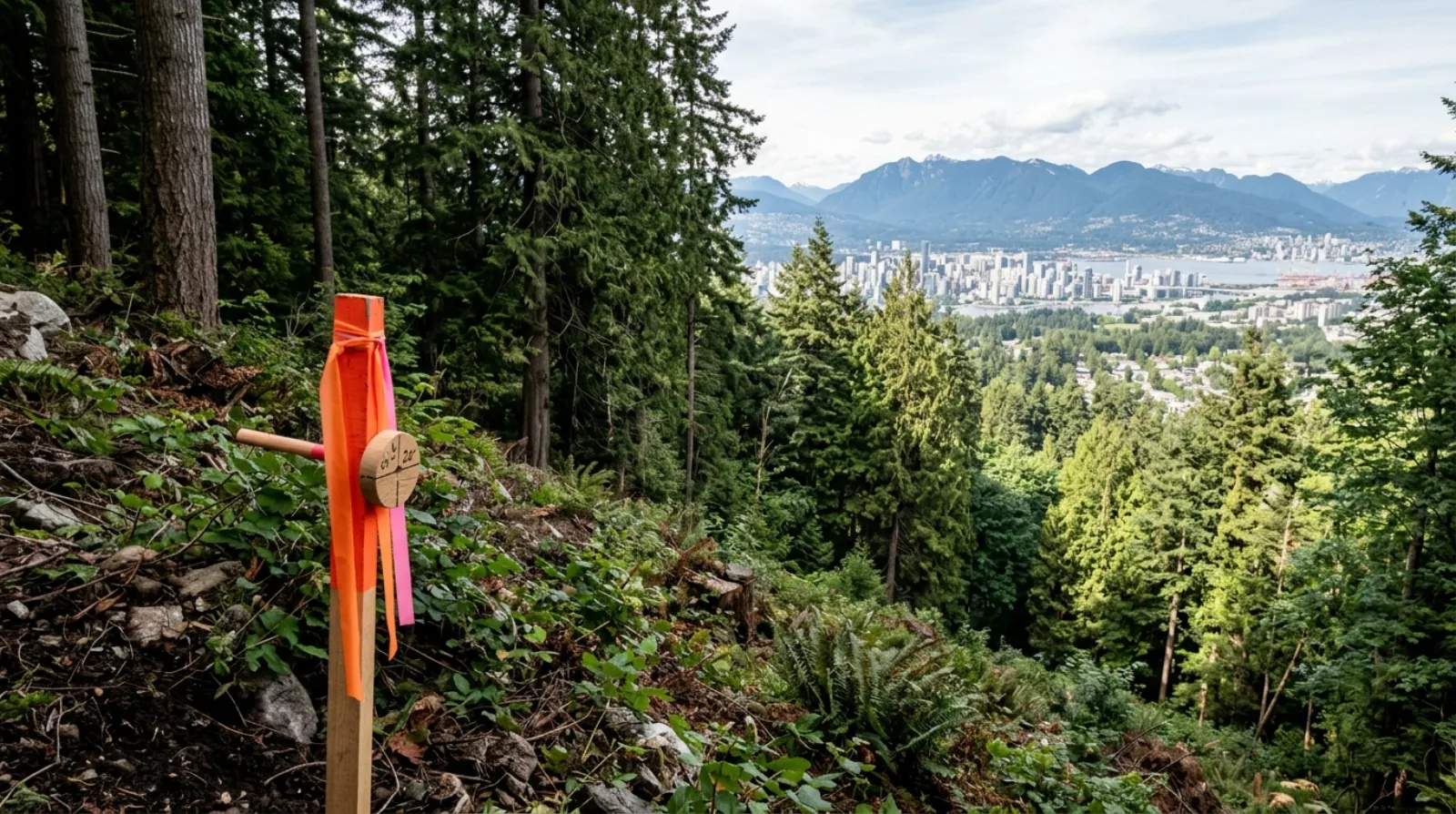
Consider what that means geographically. The District is built across a hillside, cut by creeks running down to the inlet, with a wildfire interface along much of its upper edge. Those three hazard categories are not describing a handful of unusual sites, they are describing a large share of the municipality's residential land.
Every municipality has exemptions. The District is one of the few that tells you which one is actually going to affect your lot.
What an exemption does, and what it does not
Worth being precise here, because landowners hear exempt and conclude the project is dead.
An exemption means the small-scale housing framework does not apply to that parcel. It does not mean nothing can be built. The lot is developed under whatever otherwise governs it, which on the North Shore includes the requirements of its Development Permit Area.
What is lost is the streamlined path, the ability to build additional units as of right without a discretionary approval. What remains is the ordinary development process, which on a hillside lot was always going to involve geotechnical work, drainage design, and access planning regardless of how many units were contemplated. We cover the underlying build challenges in building on a sloped or difficult lot.
Why hazard and density interact
The exemption is not municipal reluctance dressed up as caution. The conditions that make a site hazardous do not change because the province permitted more units on it.
A steep slope raises questions about how the building is founded, how surface water moves across the site, and what the excavation does to the ground above and below. A creek raises questions about setbacks, flood behaviour, and riparian protection. A wildfire interface raises questions about access for emergency vehicles, evacuation, and construction materials.
Adding units to a site intensifies every one of those. More building footprint changes drainage. More residents changes the evacuation calculation. That is the reasoning behind treating hazard parcels differently, and it is the same reasoning that makes geotechnical investigation a genuine gate on a hillside project rather than a formality.
The City and the District are not the same place
This trips up more landowners than it should, and the two municipalities genuinely differ on structure.
The City of North Vancouver created a single Low Rise Small Scale Multi-Unit Housing Zone. It defines a Frequent Transit Area as an area comprising lots wholly or partly within 400 metres of a bus stop scheduled to stop at least every 15 minutes on average, identifying the R2 and 240 routes, and removes minimum on-site parking within those areas.
The District permits up to four units, and up to six close to frequent transit, and requires one parking space per unit with a minimum of two per lot, while stating it can no longer require off-street parking for six-unit developments.
Different zoning structure, different parking rules, different exemption approach. A landowner reading City material while owning a District lot will reach wrong conclusions on all three. Our City of North Vancouver and District of North Vancouver pages are kept separate for exactly this reason.
A distance the District does not state
One gap worth flagging rather than filling. The District's fact sheet describes the six-unit case as applying close to frequent transit, without naming a distance.
Other municipalities state 400 metres, and the City of North Vancouver does so explicitly. We are not going to import that figure into the District's rules on the assumption they match, because the fact sheet does not say it. A District landowner whose project depends on the six-unit case should get the measurement confirmed by the District directly.
There is a related trap on that same page. The District's material also discusses Transit Oriented Areas at Phibbs Bus Exchange and Capilano University Bus Exchange, and Transit Oriented Areas carry their own distance figures under separate legislation. Those numbers are not the small-scale housing distance and should not be read as such. We untangle the two frameworks in the six-unit transit rule.
The one acre exemption
The exemption for lots over one acre catches people off guard because it runs opposite to intuition. A larger lot sounds like a better development site, and here it is a reason the framework does not apply.
The logic is that the small-scale framework was built for ordinary residential parcels, and a property over an acre is a different kind of proposition, more likely to be considered through a planning process than through an as-of-right permission. On the North Shore, larger parcels also correlate with the upper slopes, where the hazard exemptions are concentrated anyway.
The order to check things in
For a North Shore lot, eligibility gets confirmed before anything else, and in this order.
- Which municipality the lot is in, City or District. Everything downstream depends on it.
- Whether the parcel falls within a wildfire, creek, or slope hazard Development Permit Area.
- Lot size against the one acre threshold, and position relative to the Urban Containment Boundary.
- Servicing status, since unserviced lots are exempted.
- Any heritage designation on the property.
Five questions, all answerable by the municipality, none requiring a designer. Where the answers come back clean the project proceeds on the small-scale path. Where they do not, the honest conclusion is that a different process applies, and it is far better to know that in week one.
Frequently asked
What exemptions does the District of North Vancouver apply to small-scale housing?
The District lists lots over one acre, certain heritage designations, unserviced lots, lots outside the Urban Containment Boundary, and hazardous conditions. It states that the hazard exemption is the most significant one locally, which on a hillside municipality with creeks and wildfire interface areas is a substantial constraint on how much land is actually eligible.
How do I know if my lot is in a hazard area?
Ask the District directly, referencing its Development Permit Areas for wildfire, creek, and slope hazards. The District has recommended that parcels within those areas be identified as exempted from small-scale housing, so whether a specific parcel falls inside one of those areas is the determining question and it is answered by the municipality rather than by inspection.
How many units does the District of North Vancouver permit?
The District states the requirements typically allow larger and taller buildings with up to four units, and up to six where a lot is close to frequent transit. Its fact sheet describes the six-unit case as close to frequent transit without naming a distance, so the specific measurement should be confirmed with the District rather than assumed from another municipality's figure.
What is the parking requirement in the District of North Vancouver?
One parking space per unit, with a minimum of two spaces per lot. The District also states that it is no longer able to require off-street parking for six-unit developments, so the six-unit case is treated differently from the three and four unit cases.
Is the City of North Vancouver the same as the District?
No, they are separate municipalities with different rules. The City of North Vancouver created a single Low Rise Small Scale Multi-Unit Housing Zone and removes minimum parking within its Frequent Transit Areas, which it defines using a 400 metre distance from a stop scheduled at least every 15 minutes on average. The District takes a different approach on both zoning structure and parking, so a North Shore landowner needs to know which municipality they are in.
Why does a hazard exemption exist at all?
Because the constraints that make a site hazardous, steep slope, proximity to a creek, or wildfire interface, do not change because provincial legislation permits more units. Additional density on a site with those conditions raises questions about access, drainage, evacuation, and structural design that the hazard Development Permit Area framework exists to address.
Does an exemption mean nothing can be built?
No. It means the small-scale housing framework does not apply to that parcel, so the applicable rules are whatever otherwise governs it, including its Development Permit Area requirements. A hillside lot can still be developed, it is simply not developed under the streamlined small-scale path.
What is the Urban Containment Boundary?
It is a regional planning boundary separating land intended for urban development from land that is not. The District lists lots outside it among its exemptions, which means a parcel's position relative to that boundary is one of the first eligibility facts to confirm, alongside servicing and hazard status.
If you own a lot in North Vancouver and want eligibility confirmed against your specific address before any design money is spent, book a free consultation. On the North Shore, that first check is worth more than it is anywhere else in the region.
Written by

Acquisitions and Development
Trent Praski leads investment and development at Venture Pacific, sourcing missing-middle opportunities across Metro Vancouver and the Fraser Valley and structuring transparent homeowner and investor partnerships.
Full profile