
The hazardous materials survey applies to every building, whatever its age
Owners tell us their house is too new to need one. The WorkSafeBC regulation has no age threshold at all, and it names the owner personally alongside the employers.
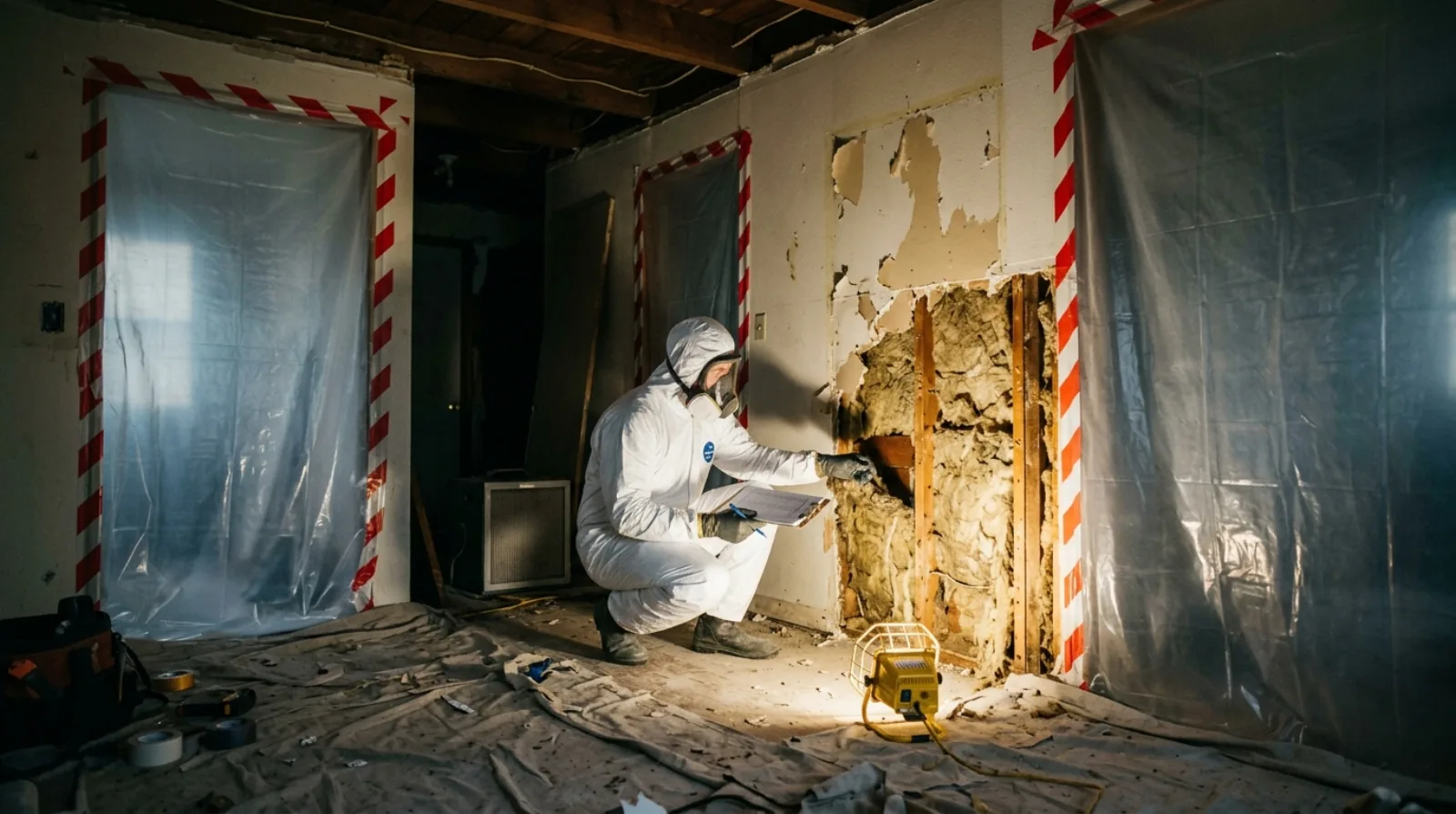
In short, WorkSafeBC OHS Regulation section 20.112 requires that before work begins on demolition or salvage of a building, or renovation of a building or structure, all employers responsible for the work and the owner must ensure a qualified person inspects the building and worksite to identify hazardous materials. The regulation contains no building age threshold. Hazardous material is defined to include asbestos-containing material, lead or other heavy metals, and toxic, flammable or explosive material. Since January 1 2024, asbestos abatement work relating to buildings requires a WorkSafeBC licence and worker certification, and identifying suspected asbestos-containing material and collecting samples falls within that definition. The City of Vancouver applies its own rules referencing buildings constructed before 1990.
There is a belief we run into on most renovation projects that is worth correcting directly, because getting it wrong exposes the owner personally.
Owners tell us their house is too new to need a hazardous materials survey. They usually have a year in mind, generally 1990. The WorkSafeBC regulation that creates the requirement contains no building age threshold at all.
What the regulation says
Before work begins on the demolition or salvage of machinery, equipment, a building or a structure, or the renovation of a building or structure, all employers responsible for that work, and the owner, must ensure that a qualified person inspects the building and the worksite to identify the hazardous materials, if any.
Three things in that sentence deserve attention.
- Before work begins. Not during, not as the demolition uncovers something.
- Demolition, salvage, or renovation. Renovation is named alongside the others, so the duty reaches ordinary renovation work.
- All employers responsible for that work, and the owner. The owner is named, not merely implied.
The regulation puts the duty on the owner alongside the contractor. Assuming your builder has it handled does not remove your name from the provision.
Where the 1990 figure comes from
The year is not invented, it is misattributed. The City of Vancouver applies its own requirements that reference buildings constructed before 1990, and that municipal rule is what people are half-remembering.
Two consequences follow. First, in Vancouver there is a municipal layer on top of the WorkSafeBC duty, with its own forms at application and completion. Second, and more important, an owner outside Vancouver, or an owner in Vancouver with a newer building, has not escaped the WorkSafeBC requirement just because the municipal age reference does not catch them. The provincial duty has no age trigger.
What is being looked for
The regulation defines hazardous material as a hazardous substance or a material containing one, including asbestos-containing material, lead or any other heavy metal, and toxic, flammable or explosive material.
Asbestos is the one everyone knows, and in Metro Vancouver's older housing stock it turns up in more places than owners expect: insulation, flooring, texture coatings, and mechanical components. Lead appears in old paint and in plumbing. The broader categories catch things like stored chemicals and fuel in a workshop or garage.
In practice surveyors look at more than that list. What we will say precisely is that those are the categories the regulation itself names, and other substances are commonly included as a matter of professional practice rather than because the regulation enumerates them.
Who can do it, and what changed
The regulation defines a qualified person by education, training and experience with the specific materials rather than by naming a credential. That framing has been overtaken in one important respect.
Since January 1 2024, asbestos abatement work relating to buildings requires a WorkSafeBC licence, and workers require certification. The statutory definition of that work includes identifying material that is or may be asbestos-containing and collecting samples, which means the survey is itself inside the licensed regime rather than sitting outside it as preliminary work.
So who you hire matters in a way it did not a few years ago. Confirming that a firm holds the required licence, and that the individual doing the work holds current certification, is a reasonable question rather than an insult.
What a real report contains
The regulation is specific about output, and it is a useful standard for judging what you receive.
It requires sampling and identification, and a written report stating the methods used, the locations of the materials including through drawings, plans or specifications, and the approximate quantity of each.
A report that lists substances without locating them on a drawing and quantifying them is not what the regulation describes, and it is not useful to the trades who have to work around the findings. Location and quantity are what turn a survey into something a project can act on.
The provision that moves your schedule
This is the part with the largest practical effect, and the one most often discovered late.
The regulation prohibits any work that may disturb the materials until they are safely contained or removed, and requires written confirmation from a qualified person.
Read as a schedule, that is a chain of dependencies: survey, then abatement where required, then written confirmation, then the work that could have disturbed the materials. Each step waits on the one before it. There is no version where demolition proceeds in parallel while abatement is arranged.
Projects that treat the survey as paperwork to be done during mobilization discover this at the worst moment, with trades scheduled and a site that cannot be touched. It belongs in pre-construction planning alongside the items in what homeowners wish they knew before renovating.
Vancouver's additional layer
In Vancouver the municipal process runs alongside the provincial duty and requires documentation at both ends: a qualified professional declaration at application, and on completion a hazardous building materials report, an inspection report meeting WorkSafeBC requirements, and a post-abatement inspection report.
The city has also changed how this is permitted, folding salvage and abatement into the demolition permit rather than issuing a separate permit for it. Because that changed recently, confirm the current process with the city rather than working from an older description, including anything you may have done on a previous project.
How this connects to the demolition decision
For an owner weighing whether to renovate or take a house down, the survey is a cost and a schedule item on both paths, since renovation is named in the regulation alongside demolition.
What differs is scope. A full demolition surveys the whole building. A renovation surveys the area affected, which can be smaller, though a discovery in one area often raises questions about others. We walk through the broader comparison in renovate or demolish, how that decision gets made.
Frequently asked
Does my house need a hazardous materials survey if it is not old?
The WorkSafeBC regulation contains no building age threshold. It requires that before work begins on demolition, salvage, or renovation, the employers responsible and the owner ensure a qualified person inspects the building and worksite to identify hazardous materials. Age thresholds that people cite generally come from a municipal rule rather than from the WorkSafeBC requirement.
Who is responsible for making sure the survey happens?
The regulation names all employers responsible for the work and the owner. That is worth reading carefully, because it places the duty on the property owner personally rather than leaving it entirely with the contractor. An owner who assumes the builder has it covered is still named in the regulation.
What counts as a hazardous material?
The regulation defines it as a hazardous substance or a material containing one, including asbestos-containing material, lead or any other heavy metal, and toxic, flammable or explosive material. Other substances are commonly surveyed for in practice, but those are the categories the regulation itself names.
Who is qualified to do the survey?
The regulation defines a qualified person by education, training and experience with the specific hazardous materials rather than by naming a single credential. Since January 1 2024, asbestos abatement work relating to buildings requires a WorkSafeBC licence, and the statutory definition of that work includes identifying material that is or may be asbestos-containing and collecting samples, so the survey itself falls inside the licensed regime.
What does the survey report have to contain?
The regulation requires sampling and identification, and a written report stating the methods used, the locations of the materials including through drawings, plans or specifications, and the approximate quantity of each. A report that names a substance without locating and quantifying it is not what the regulation describes.
Can work start while abatement is still being arranged?
Not work that may disturb the materials. The regulation prohibits it until the materials are safely contained or removed, and requires written confirmation from a qualified person. This is the provision that most often affects a construction schedule, because it can hold up the start of demolition rather than running alongside it.
What does the City of Vancouver require on top of this?
Vancouver applies its own requirements referencing buildings constructed before 1990, and requires forms and reports at both application and completion, including a qualified professional declaration and inspection reports. The city has also folded salvage and abatement into the demolition permit rather than issuing a separate permit for it. Confirm the current process with the city, since it has changed recently.
How should this be handled in a project schedule?
As a task with lead time before demolition, not as a parallel activity. The sequence is survey, then abatement where required, then written confirmation, then the work that could have disturbed the materials. Each step depends on the one before it, and compressing them is not an option the regulation allows.
If you are planning a renovation or a demolition in Metro Vancouver and want the survey and abatement sequence built into the schedule properly, book a free consultation before anything is booked to start.
Written by

Founder & President
Mark Van Ek is the founder and president of Venture Pacific, bringing more than 40 years of Metro Vancouver and the Fraser Valley construction management experience and multiple Georgie and HAVAN awards to every custom home, renovation, and multiplex project.
Full profile