
Vancouver's net-zero bonus: 19% more buildable space on your multiplex lot
Vancouver offers a 19% floor space ratio (FSR) bonus to multiplexes that meet net-zero energy standards. That bonus represents real added value, and the construction premium to earn it is smaller than most people assume.
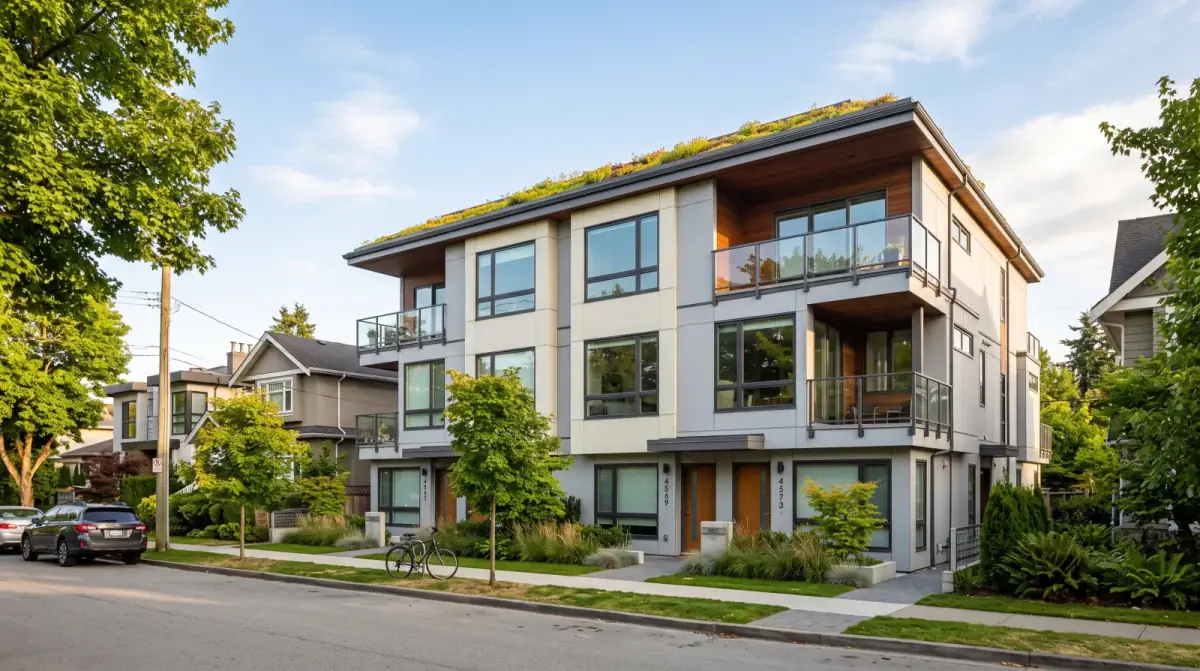
In short, Vancouver offers a 19% FSR exclusion to multiplexes that meet the net-zero energy standard (effectively Step Code 5 / Net Zero Ready). The exclusion means 19% of the building's floor area does not count against the FSR cap, producing more gross floor area within the same zoning envelope. As of June 30, 2026, the density bonus contribution requirement has been removed, improving the economics further.
Vancouver's R1-1 zoning allows a base floor space ratio for multiplexes that defines how much total floor area you can build relative to the lot size. The net-zero bonus does not raise that ratio. Instead, it excludes 19% of your building's floor area from the FSR calculation entirely, so you can build more gross floor area while technically staying within the same cap. The distinction matters because the output is real additional square footage, not a permit-application technicality.
What the 19% exclusion actually produces
When 19% of your total floor area is invisible to the FSR limit, you get more buildable space on the same lot. That space can become additional suites, larger individual units, or a combination. The value of that extra floor area depends on how units are structured and what the completed project is worth, but it's additional space that would not exist without meeting the net-zero standard.
This is not a paper benefit. On a real project, the difference between qualifying for the exclusion and not qualifying for it changes the gross floor area of the building. More floor area, when it results in an additional suite or meaningfully larger units in a Metro Vancouver and the Fraser Valley market, changes the project's total value.
What net-zero actually means under the BC Step Code
The net-zero energy standard that triggers the FSR exclusion corresponds to Step Code 5, which is the Net Zero Ready level under the BC Energy Step Code. This is a provincial standard that defines how efficiently a building uses energy, primarily through its envelope. Step Code 5 requires very high levels of insulation, very low air leakage rates, and high-performance windows. It is the most demanding step in the current framework.
The Step Code is a provincial program. Vancouver cannot set it higher or lower on its own. What Vancouver did is tie the FSR exclusion to the top step as an incentive to build beyond the minimum required level. The required Step Code level for new construction in Vancouver is lower than Step 5, the net-zero bonus is voluntary. You build to Step 5 if you want the extra floor area.
- Step Code 1 to 3: Minimum to mid-range performance. Required baseline varies by city and building type.
- Step Code 4: High performance, common in new construction.
- Step Code 5 (Net Zero Ready): Maximum performance, required to access Vancouver's 19% FSR exclusion.
The gas vote didn't remove the bonus, and doesn't affect how you earn it
After Vancouver's May 27, 2026 vote to allow gas heating again, we heard from several clients who assumed the net-zero bonus was connected to the all-electric mandate and had changed. It hasn't. The two decisions are separate. The gas vote restored optionality on fuel source. The net-zero FSR bonus is about your building envelope's energy performance.
A building with gas appliances can meet Step Code 5 if the envelope is designed correctly. Whether that's achievable depends on the specific mechanical configuration and the project's detailed energy model. It is not automatic, you need an energy modeller to run the numbers, but it is possible. The fuel-source choice does not disqualify you from the bonus.
The density bonus contribution is gone as of June 30, 2026
Separate from the FSR exclusion, Vancouver had a density bonus contribution requirement for projects that accessed certain bonus density provisions. As of June 30, 2026, that contribution requirement has been removed for multiplexes. Projects that applied before June 30 may have faced this charge; projects filed after that date do not.
This is a direct improvement to the cost stack for new multiplex applications in Vancouver. It doesn't change the FSR exclusion itself, but it removes one of the charges that used to sit alongside it. The combination of the bonus floor area and the removal of the contribution requirement makes the net-zero pathway more attractive than it was six months ago.
Strata and rental both qualify
Vancouver's R1-1 zone allows six strata units or eight rental units as of right on a standard lot. The net-zero FSR exclusion applies regardless of tenure. A six-unit strata project and an eight-unit rental project can both access the 19% exclusion if they meet the energy standard. The additional floor area the exclusion unlocks can be structured as additional units, larger units, or more generous common areas, the design team determines how the bonus space is best used given the lot.
What the construction premium actually looks like
Building to Step Code 5 costs more than building to a lower step. The premium comes from higher-performance insulation, better windows, more rigorous air barrier detailing, and the energy modelling and testing required to verify the result. We are not going to invent a dollar figure here, construction costs vary too much by lot, design, and contractor to give a number that holds across projects.
What we can say is that the premium is real and the additional floor area the exclusion unlocks is also real, and the two need to be evaluated against each other for your specific project. A proper feasibility review will run both scenarios, net-zero and standard, and show you the difference in project cost versus the difference in completed floor area and projected value. That comparison is the only way to know whether the net-zero path makes financial sense on your lot in Kitsilano, East Vancouver, or Marpole.
Most projects we've modelled where the lot has reasonable density potential find the net-zero path worth pursuing. The extra floor area is genuinely valuable in Vancouver. But there are tighter lots where the math is less clear, and on those the honest answer is that the premium doesn't earn its way back.
How the bonus interacts with strata versus rental tenure
The R1-1 zone allows up to six strata units or eight non-stratified rental units on a standard lot. When you add the net-zero FSR exclusion, the bonus floor area is available to both tenure types. For a six-unit strata project, the 19% exclusion might unlock space for an additional unit, or it might allow all six units to be meaningfully larger. For an eight-unit rental project, the exclusion provides additional gross floor area on top of the already-expanded rental unit count.
The strata path and the rental path have different financial structures: strata generates upfront sales revenue while rental generates yield over time. Which structure fits your project depends on your financial goals, your financing structure, and in many cases your partnership arrangement. The net-zero bonus interacts with each differently. We work through both scenarios in a feasibility review when the tenure decision hasn't been made yet, the bonus changes the relative economics in ways that aren't always obvious from the headline number.
Typical envelope details that get you to Step Code 5
Step Code 5 is achievable with a combination of envelope upgrades and careful energy modelling. It is not a radical departure from good construction practice, it is a disciplined version of it. Common approaches to hitting Step Code 5 on a Metro Vancouver and the Fraser Valley multiplex include triple-pane windows (or high-performance double-pane with thermally broken frames), wall insulation in the RSI 5.0 to 6.0 range depending on wall assembly, a blower-door air leakage rate well below the Step 4 target, and heat recovery ventilation (HRV or ERV) in each unit.
- Triple-pane or high-performance double-pane windows with thermally broken frames.
- Wall insulation targeting RSI 5.0 to 6.0 (R-28 to R-34 imperial), depending on assembly type.
- Continuous air barrier with blower-door-tested leakage well below 1.0 ACH50.
- HRV or ERV in each unit for controlled mechanical ventilation.
- Detailed energy modelling by a qualified energy advisor before design is locked.
These are ranges, not specifications. Your actual project will be designed by a licensed team including a mechanical engineer and an energy modeller, and the specific approach will depend on your building form, its orientation, and the mechanical systems selected. The point is that Step Code 5 is a higher-performance standard, but it is a buildable one, it does not require exotic materials or methods that Metro Vancouver and the Fraser Valley contractors are unfamiliar with.
Whether the bonus makes sense on your lot
Not every lot benefits equally from the net-zero bonus. A lot where the project is already delivering the maximum density the site can physically hold, constrained by setbacks, lot coverage limits, or tree protection, may not be able to use the additional FSR the exclusion provides. On those lots, the premium cost of reaching Step Code 5 may not be recovered in added value because the bonus floor area isn't accessible. On a less constrained lot, the bonus floor area is real additional sellable or rentable space, and the math typically works in the bonus's favour.
Our Feasibility and Equity Review models both the standard-Step-Code and net-zero scenarios as a default output when the project is in Vancouver. You see the premium cost and the additional floor area side by side, so the decision about whether to pursue the bonus is made on data, not assumption. If you're in early planning for a Vancouver multiplex and haven't yet worked through that comparison, it's one of the first questions worth putting numbers to.
Frequently asked
What exactly is an FSR exclusion vs. a bonus?
An FSR exclusion means that a portion of your building's floor area is not counted in your FSR calculation. So instead of getting a higher FSR cap, you get more actual gross floor area within the same cap, which is effectively the same outcome. In Vancouver's net-zero case, the 19% exclusion means 19% of the building's total floor area is invisible to the FSR limit, letting you build a larger building on the same lot without technically exceeding the base FSR.
Does the net-zero bonus apply to strata or rental multiplexes?
Both. The 19% FSR exclusion is tied to the energy standard the building meets, not to whether the units are sold as strata or held as rental. A six-unit strata project and a six-unit rental project both qualify for the bonus if they meet the net-zero energy standard.
Can a fourplex in an R1-1 zone qualify for the bonus?
Yes. The net-zero FSR exclusion is available to multiplexes in Vancouver's R1-1 zone regardless of the number of units, provided the project meets the net-zero energy standard. A fourplex, a six-unit strata, or an eight-unit rental project can all access the bonus if they hit the performance target.
Looking for your next multiplex opportunity? We'll help you find the right lot in the right area and build the feasibility study needed to secure a strong return. Book a free consultation to talk it through.
Written by

Real Estate Developer
Trent Praski leads investment and development at Venture Pacific, sourcing missing-middle opportunities across Metro Vancouver and the Fraser Valley and structuring transparent homeowner and investor partnerships.
Full profile