
Build to Rent vs Sell: The Multiplex Tenure Decision That Changes Your Return
You can build the same 6-unit multiplex and either sell every unit as strata or hold all of them as rental. The building is identical. The economics over the next 25 years are not.
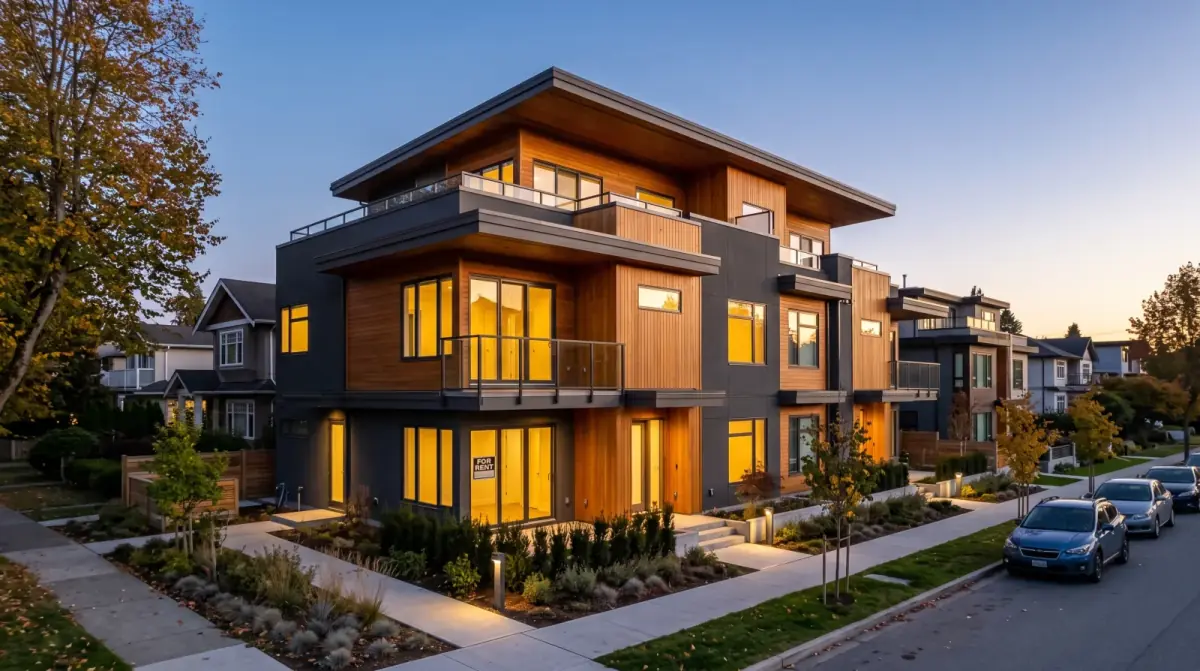
In short, This post explains how choosing between build-to-rent and strata sale changes the financial outcome of a Metro Vancouver and the Fraser Valley multiplex, covering the BTR density bonus, CMHC MLI Select eligibility, and the tax differences between the two paths. It is aimed at homeowners and investors deciding on tenure before committing to a development structure.
When a homeowner decides to develop a Metro Vancouver and the Fraser Valley lot into a multiplex, the first question is usually about the building: how many units, what size, which city permits it. That's the wrong place to start. The more consequential decision comes before the building is designed, are you building to sell or building to hold?
You can build the same 6-unit multiplex and either sell all units as strata or hold every one of them as secured rental. The building is identical: same floor plates, same construction cost, same permitting timeline. The economics over the next 25 years are not.
The strata exit: clean, taxable, complete
In a strata sale, you build and then sell each unit on the open market. The upside is clarity: you collect your profit, typically as a capital gain or business income depending on your corporate structure and intent, and the project closes. You no longer carry any risk on the asset, no vacancy, no maintenance reserves, no financing exposure after the sale.
The downside is that you've converted a land asset into cash at a single point in time. Metro Vancouver and the Fraser Valley real estate has historically continued to appreciate after a sale. The buyer of your strata unit captures that upside going forward; you don't.
Strata also carries Vancouver's density bonus contribution, up to $82,000 per unit as of 2026 for market strata projects. On a 6-unit project, that's up to $492,000 in city fees on top of the Metro Vancouver and the Fraser Valley DCC and the Development Cost Levy. It's a cost that shows up in every strata pro forma and directly reduces what's left after the project closes.
The build-to-rent path: slow start, compounding finish
In a build-to-rent model, you hold the entire building as rental property after construction. Year one cash flow is usually thin. A 6-unit multiplex in Metro Vancouver and the Fraser Valley might generate $15,000 to $18,000 per month in gross rental income at 2026 market rents, but a construction-to-permanent mortgage on a $5 million total project cost runs several thousand dollars per month before maintenance, insurance, and management.
The math changes over time. Rents in Metro Vancouver and the Fraser Valley have risen consistently over the past two decades. The mortgage balance declines with every payment. By year 10, the cash-on-cash return is materially better than year one. By year 25, if you've held through, you own a free-and-clear income-producing asset in one of Canada's tightest rental markets. That is a different kind of wealth than a single capital event.
Vancouver's BTR density bonus: two extra units and no contribution fee
Here is the detail most homeowners don't know going in. Under Vancouver's R1-1 zoning, a strata multiplex is permitted up to 6 units on a standard lot. A secured rental multiplex on the same lot, if the lot meets the size thresholds of at least 557 square metres in area and 15.1 metres of frontage, can be permitted up to 8 units.
That's two additional units, which on a 6-unit baseline is a 33 percent increase in rental income potential. On top of that, secured rental projects are fully exempt from Vancouver's density bonus contribution. The contribution that runs up to $82,000 per unit on strata projects does not apply when you commit the building to long-term rental tenure.
Two extra units plus no density bonus contribution is not a marginal difference. On a project where the strata path would carry $492,000 in density bonus fees for 6 units, the BTR path on a qualifying lot avoids that cost entirely and generates income on 8 units instead. The economics of a project that looks breakeven on strata can shift considerably when modelled as a secured rental build.
CMHC MLI Select: the BTR financing product, and its hard floor
The Canada Mortgage and Housing Corporation's MLI Select program is the benchmark financing product for purpose-built rental in Canada. For projects that qualify, it offers mortgage insurance premiums reduced by 30 percent compared to standard rates (as of July 2025), and amortization terms up to 50 years. A longer amortization lowers the annual debt payment, which directly improves early-year cash flow, the period when BTR is hardest to carry.
The critical constraint: MLI Select requires a minimum of 5 units. A 4-plex is ineligible, full stop. This is not a guideline or a preference, it is a hard program floor. If you're designing a multiplex with the intent to hold it as rental and access MLI Select financing, your project needs at least 5 units, which means your lot and zone need to support that density.
A homeowner on a lot that only supports 4 units can still hold as rental, but won't have access to the most favorable financing available. A homeowner whose lot supports 6, 7, or 8 units in a secured rental configuration is in a meaningfully better financing position from the start.
Tax considerations: different structures, different outcomes
The strata exit and the rental hold are taxed differently, and those differences compound over the life of the project. A strata sale creates a taxable event at the point of sale, whether classified as a capital gain or business income depends on your holding structure, intent, and the nature of the development activity. Your accountant and tax lawyer need to weigh in before you choose a structure, not after.
Rental income is taxed as income in the year it's earned, but it can be offset by legitimate deductions: mortgage interest, property taxes, insurance, management fees, repairs and maintenance, and capital cost allowance (depreciation). Over time, the effective tax rate on rental income can be meaningfully lower than headline rates suggest, particularly when the mortgage interest deduction is high in the early years of a loan.
This is not tax advice, and no article substitutes for a qualified accountant who knows real estate development in BC. But the structures are different in ways that matter, and the right choice depends on your personal tax situation, your corporate structure if you're developing inside a company, and your long-term financial goals.
Who chooses build-to-rent and why
Not every landowner is positioned for BTR. The investors who benefit most from it tend to share a few characteristics: they can absorb thin early-year cash flow without financial strain, they're not dependent on the project's proceeds for near-term needs, and they have a lot that qualifies for the 8-unit secured rental density under Vancouver's R1-1 rules.
Homeowners who want to remain connected to the land they grew up on, or land that has been in the family, also gravitate toward BTR. A strata sale permanently severs that connection. Holding as rental means the asset stays under your name or your family company's name, and the relationship with the property continues.
Strata is the right answer when immediate capital is the priority, when the lot doesn't qualify for the secured rental density bonus, or when the investor's tax situation makes a capital gain more attractive than rental income. Neither path is universally superior. The decision depends on your lot, your finances, and your timeline.
Tenure changes what you should actually build
The two paths produce different buildings, even when the zoning envelope is identical. A strata purchaser in Dunbar or Kerrisdale walks through the front door once and decides in about ninety seconds. So a strata building concentrates money where that decision happens: the kitchen, the primary bathroom, the entry, the finished floors. A rental owner, by contrast, is going to hold the same building for twenty-five years and pay for every repair personally.
On the rental projects our team specs, the money moves toward things a buyer never notices. Flooring that survives a tenant turnover without being replaced. Solid-core doors and hardware rated for far more cycles than a family home sees. In-suite laundry in every unit rather than a shared machine, because one broken washer in a shared room is a complaint from every household at once. Mechanical equipment, water shutoffs, and cleanouts placed where a technician can reach them from a common area instead of knocking on a tenant's door and scheduling around their work week.
Unit mix splits the same way. Rental demand across Vancouver, Burnaby, and New Westminster is deepest in one- and two-bedroom homes, and a building of smaller units usually produces more total rent than the same floor area cut into fewer large ones. Strata buyers on the west side often want three bedrooms and will pay for them. Deciding tenure after the architect has drawn the floor plans means paying to redraw them, or accepting a building that is slightly wrong for its purpose for the next quarter century.
One thing both paths share: the 2024 BC Building Code now requires every dwelling unit to have at least one living space capable of holding an indoor design temperature of no more than 26 degrees Celsius during a heat event, under Section 9.33.3.1(2), for permits applied for on or after March 8, 2024. Cooling is no longer an upgrade you can leave out of a rental building to save money. Plan the mechanical system around it from the start, because retrofitting cooling into a finished multiplex is the kind of cost that eats several years of rental margin.
What owning the building for 25 years actually involves
Strata developers hand over the keys and their exposure winds down. A build-to-rent owner becomes a landlord on the day of occupancy, and that job has real obligations attached to it.
Tenancies fall under BC's Residential Tenancy Act, which sets the maximum annual rent increase, the notice periods, and the limited grounds on which a tenancy can be ended. That matters for a pro forma. Rents on occupied suites move by the allowable increase, not by whatever the market is doing on Craigslist, and the gap between in-place rent and market rent widens the longer a good tenant stays. Most owners decide that a reliable tenant paying slightly under market is worth more than the vacancy and turnover cost of chasing the top of the market.
Then there are the capital items. A strata corporation collects contingency reserve fund contributions from every owner and commissions a depreciation report so the roof replacement in year twenty-two is somebody's plan rather than somebody's emergency. A single-owner rental building has no such mechanism. The roof, the cladding, the hot water equipment, the appliances, and eventually the windows all come out of the owner's account, on the owner's timeline. Fund a reserve from the first month of operation and treat it as a fixed expense rather than leftover cash flow.
Vacancy hits a small building disproportionately. In a six-unit multiplex, one empty suite is roughly seventeen percent of the building's gross income gone until it re-rents. A hundred-unit building absorbs that without noticing. This is the practical argument for the 8-unit secured rental density where the lot qualifies: more doors spread the risk of any single one going quiet, and they do it without adding a second roof, a second service connection, or a second set of soft costs.
The 2-5-10 home warranty applies to the building either way, covering two years on labour and materials, five years on the building envelope, and ten years on structure. On a rental hold the owner is the one making those claims, which makes it worth keeping the warranty documentation, the as-built drawings, and the commissioning reports organized from day one. We hand that package over at completion for exactly this reason.
Model both paths before you commit
The decision between strata and build-to-rent should be made before the building design is finalized, not after. Unit size, unit mix, parking layout, and lobby configuration all shift depending on whether you're selling to owner-occupants or renting to tenants. A strata buyer wants something different from a rental tenant, and a building optimized for one is not always optimal for the other.
In a feasibility review, we model both paths for your specific lot: the strata case with its density bonus fee and 6-unit cap, and the BTR case with its exemption and potential 8-unit density if the lot qualifies. The two pro formas side by side make the decision concrete rather than abstract. If you want to know which path makes more sense for your property in Vancouver, Burnaby, Richmond, or the surrounding municipalities, a free feasibility review is the right place to start.
Frequently asked
Can a secured rental multiplex in Vancouver get more units than a strata project?
Yes. Under Vancouver's R1-1 zoning, a strata multiplex is permitted up to 6 units on a standard lot. A secured rental multiplex on the same lot, if the lot meets the size thresholds of at least 557 square metres in area and 15.1 metres of frontage, can be permitted up to 8 units. That is a 33 percent increase in rental income potential on the same land.
What is the density bonus contribution and do build-to-rent projects pay it?
The density bonus contribution is a city fee applied to strata multiplex projects in Vancouver, running up to $82,000 per unit as of 2026 on market strata projects. Secured rental projects are fully exempt. On a 6-unit strata project, that exemption removes up to $492,000 in city fees from the build-to-rent path.
What is CMHC MLI Select and does it work for small multiplexes?
CMHC MLI Select is a mortgage insurance program for purpose-built rental housing, offering amortization terms up to 50 years and insurance premiums reduced by 30 percent compared to standard rates as of July 2025. It has a hard minimum of 5 units, a 4-plex is ineligible. If you are designing a multiplex for the build-to-rent path and want MLI Select financing, your project must support at least 5 units.
How is rental income from a multiplex taxed compared to a strata sale?
A strata sale creates a taxable event at the point of sale, classified as capital gain or business income depending on your structure and intent. Rental income is taxed as income in the year earned, but can be offset by mortgage interest, property taxes, insurance, management fees, and capital cost allowance. The effective tax rate on rental income varies significantly based on your personal and corporate situation. A qualified accountant familiar with BC real estate development is essential before choosing a path.
Who benefits most from the build-to-rent model?
Investors who can absorb thin early-year cash flow, are not dependent on immediate project proceeds, and own a lot that qualifies for the 8-unit secured rental density under Vancouver's R1-1 rules. Homeowners who want to keep a long-term connection to land, including family-owned properties, also benefit, because a strata sale permanently severs ownership while a rental hold keeps the asset in the family.
How does a build-to-rent multiplex get designed differently from a strata multiplex?
A build-to-rent multiplex is designed around a landlord who will own the building for decades, so the specification favours durability and maintenance access over resale showpieces. On rental projects our team pushes for surfaces that survive turnover, in-suite laundry so one machine failure does not affect several tenants, and mechanical equipment placed where a technician can reach it without entering a tenant's unit. Strata buildings weight the money differently, toward kitchens, bathrooms, and the entry sequence a buyer walks through. Unit mix also diverges: rental demand in Vancouver skews toward one- and two-bedroom homes, while strata purchasers in areas like Dunbar or Kerrisdale often want three bedrooms.
What does committing a Vancouver multiplex to secured rental tenure actually require?
Committing a Vancouver multiplex to secured rental tenure means the rental use is registered against the property title, usually through a housing agreement or covenant under the Local Government Act and the Vancouver Charter, rather than being a promise the owner can reverse later. That registration is what unlocks the additional density and the density bonus contribution exemption. It also removes the option of stratifying and selling the units individually for the term of the agreement, so the decision binds future owners of the building as well. Read the draft agreement before the rezoning or permit application is filed, because the term length and any conversion conditions are set at that stage.
What are the biggest risks in holding a Metro Vancouver multiplex as rental?
The main risks in holding a Metro Vancouver multiplex as rental are interest rate movement at mortgage renewal, capital repairs landing on the owner rather than a strata corporation, and vacancy or non-payment on a small number of doors. With six or eight units, one empty suite is a large share of the building's income, unlike a hundred-unit building where it barely registers. Tenancies are also governed by BC's Residential Tenancy Act, which sets the annual allowable rent increase and the grounds for ending a tenancy, so the income side is not fully under the owner's control. A reserve for roofing, cladding, and mechanical replacement should be funded from year one.
Looking for your next multiplex opportunity? We'll help you find the right lot in the right area and build the feasibility study needed to secure a strong return. Book a free consultation with Venture Pacific to talk it through.
Sources
- City of Vancouver, Secured Rental Housing policy (R1-1 zone)
- CMHC, MLI Select: Mortgage Loan Insurance for multi-unit rental
- Government of BC, Small-Scale Multi-Unit Housing
- City of Vancouver, Development Cost Levies and density bonus fees
- Government of BC, Residential Tenancy Act, rent increases and ending a tenancy
- BC Building Code 2024, Section 9.33.3.1(2), overheating protection
- BC Housing, 2-5-10 home warranty insurance coverage
Written by

Acquisitions and Development
Trent Praski leads investment and development at Venture Pacific, sourcing missing-middle opportunities across Metro Vancouver and the Fraser Valley and structuring transparent homeowner and investor partnerships.
Full profile