
Vancouver's R1-1 zoning: a plain-language guide for homeowners
Vancouver folded most of its single-family neighbourhoods into one zone: R1-1. Here's what it permits, what "Residential Inclusive" really means, and how the rental option changes the math.
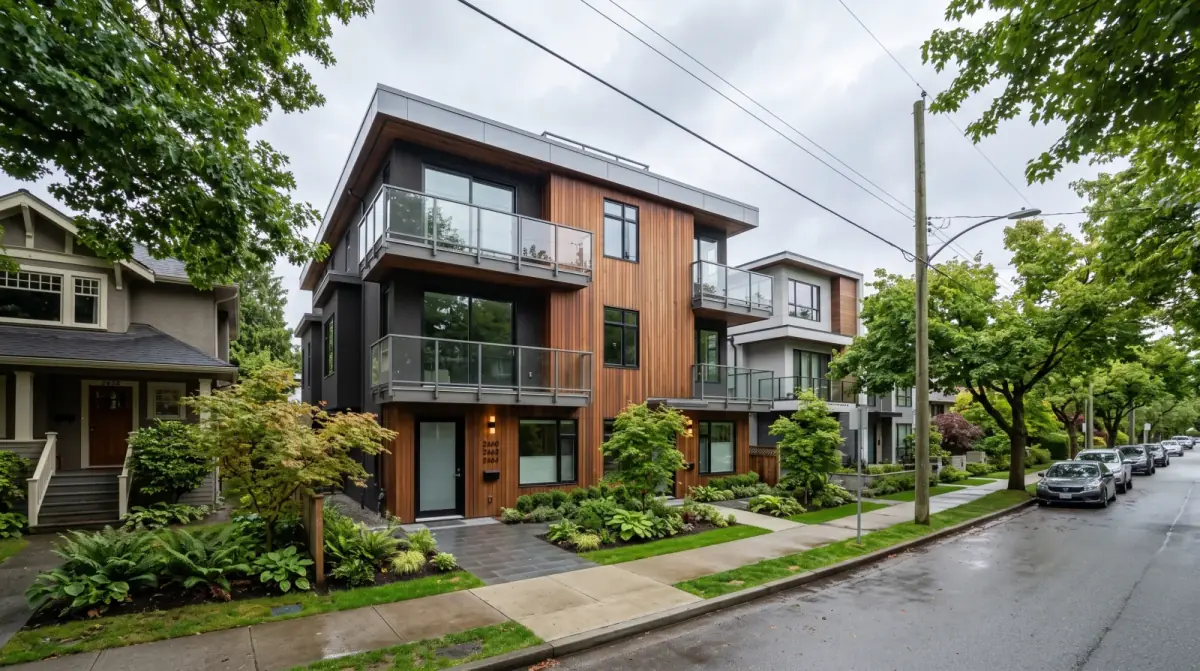
In short, Vancouver's R1-1 "Residential Inclusive" zone replaced most single-family zoning across the city. It permits three to six strata homes on a standard lot, and up to eight units when the project is secured rental.
We were standing on a 33-foot lot in Marpole with the owner when she said the thing we hear constantly: "But this is RS-1, right?" It wasn't. Her lot, like most single-family lots in Vancouver, had been folded into a new zone called R1-1 the year before. She'd owned the house for nineteen years and the rules underneath it had changed without a single letter in her mailbox.
What R1-1 replaced
Before 2024, Vancouver's single-family neighbourhoods ran on a patchwork of RS zones, RS-1, RS-5, and a dozen variations, each with its own quirks. To comply with the Province's SSMUH legislation, the city scrapped most of that patchwork and replaced it with one zone: R1-1, which it named "Residential Inclusive." The name is doing real work. The zone's entire purpose is to permit more than one home on lots that used to allow exactly one.
If you owned an RS lot in Kitsilano, Dunbar, Sunset, or Killarney, it's almost certainly R1-1 now. The conversion happened by bylaw, citywide, on the city's timeline, not yours.
This wasn't a Vancouver-only idea. The Province required every municipality over a certain size to open its single-family zones to small multi-unit housing. Most BC lots must now allow three to four homes, and lots near frequent transit must allow six. Vancouver's answer was R1-1. Burnaby's answer was to collapse its twelve residential districts into one R1 small-scale multi-unit district that came into effect on July 1, 2024. Same provincial pressure, different local plumbing, which is why the zone name and the fine print change the moment you cross a city line.
How many homes R1-1 actually permits
On a standard lot, R1-1 permits up to six strata-titled homes. That's the headline number, and it's a long way from "one house plus a suite." The form can be a triplex, fourplex, or small multiplex, sometimes with a coach house, depending on how the units stack on your particular lot.
Then there's the rental lever. If you build the project as secured rental housing instead of strata-titled homes for sale, R1-1 allows up to eight units. That's two additional homes the zone hands you in exchange for keeping them as long-term rental rather than selling them off individually. It is one of the most consequential choices in the whole project, and most homeowners don't know it exists until we raise it.
Strata or rental isn't just a unit-count question. It changes how the project is financed, how a GP/LP partnership is structured, how the homes are managed after completion, and how anyone eventually gets their capital back out. We walk landowners through that fork early, because reversing it after drawings are underway is expensive.
What "Residential Inclusive" is really trying to do
The word "inclusive" in the zone name isn't marketing. It signals the policy goal behind the whole change: get more homes onto land that already has roads, sewers, schools, and transit around it, without waiting years for a rezoning on each lot. Vancouver spent decades allowing exactly one household on most of its residential land. R1-1 is the city admitting that a single house on a lot near a bus route, a park, and a shopping street is a poor use of some of the best-serviced land in the region.
For a homeowner, the practical effect is simple. The default has flipped. Under the old RS zones, the base right was one house and the burden was on you to justify anything more. Under R1-1, the base right is a multiplex, and the question becomes how many homes your lot can hold well, not whether you're allowed more than one at all. That flip is the reason a Marpole or a Renfrew-Collingwood lot that made no development sense in 2020 can pencil in 2026.
The permitted-use shift that saves the most time
Under the old RS zoning, putting multiple strata homes on a Vancouver lot meant a rezoning: a discretionary process with public hearings and no guaranteed outcome. R1-1 made multiplex housing a permitted use. For a project that conforms to the zone, that erases the rezoning entirely, you go to a building permit.
We don't undersell what that's worth. A rezoning could add a year and meaningful uncertainty to a project; a homeowner could spend real money on drawings only to have council say no. Removing that step is the single biggest reason multiplex projects in Vancouver pencil today that didn't five years ago. It doesn't make the building permit trivial, design, code, and Step Code review are still real work, but the discretionary "will they even allow it" risk is largely gone.
There's still a process, and it's worth naming it plainly. A conforming R1-1 multiplex typically moves through a development permit and then a building permit, rather than through a rezoning hearing. Vancouver has been standing up a faster combined track for smaller multiplex projects to shorten that path. "Permitted use" means the city isn't asking whether your homes should be allowed to exist. It's checking that your drawings meet the rules. That's a fundamentally more predictable posture to build against, but it isn't a rubber stamp.
What R1-1 does not hand you
A permitted use is not a buildable plan. R1-1 sets a maximum unit count, but the building envelope, height, setbacks, lot coverage, and floor space ratio, decides how much of that count your lot can physically achieve. A narrow Mount Pleasant lot and a wide Dunbar lot both sit in R1-1, and they produce very different projects.
The zone also doesn't touch the BC Building Code or the BC Energy Step Code. Fire separations between the homes, exiting, structure, and the energy envelope all still apply, and on a six-home multiplex they shape the design heavily. Older Vancouver lots add their own complications: heavy rain exposure that demands proper rainscreen detailing, soft or sloped soils that drive foundation cost, and servicing that was sized for one house. None of that shows up in the zoning text.
It's worth separating the two kinds of rules a multiplex answers to, because homeowners tend to blur them:
- Zoning rules, set by the city, in the R1-1 district schedule: how many homes, how tall, how far from the property lines, how much floor area. These decide the shape and the count.
- Building rules, set by the Province, in the BC Building Code and BC Energy Step Code: fire separation between homes, exiting, structure, and energy performance. These decide how the building actually gets constructed and inspected.
- A project can be fully permitted under R1-1 and still fail if the design ignores the envelope or the Step Code. Passing zoning is the start of the work, not the end of it.
Servicing, trees, and the constraints hiding on your lot
Here's where a lot of R1-1 optimism meets reality. Your lot was serviced for one house, one water connection, one sewer lateral, one electrical supply. Six homes need more, and upgrading the connections in an older Vancouver neighbourhood can be one of the least glamorous and most expensive line items in the whole project. It rarely shows up in a homeowner's mental math, and it can quietly reshape whether the top-end unit count is worth chasing.
Trees are the other quiet constraint. Vancouver protects mature trees, and a couple of well-placed ones can pull a fourplex layout in a direction you didn't plan. Easements, a shared driveway, a utility right-of-way, a drainage line crossing the back of the lot, can carve out buildable area before a single wall is drawn. On a recent read of a Grandview-Woodland lot, the owner assumed a clean six-home site; a rear easement and a protected tree at the corner meant the honest answer was four homes done well rather than six done badly.
None of this is a reason to walk away. It's the reason to look before you commit. The lots that disappoint are the ones where someone anchored on the six-home headline and never checked the servicing, the trees, or the slope.
Frequent transit and why your neighbour's limit may differ
The provincial rules layer a transit bonus on top of the base unit counts. On most lots, the SSMUH floor is three to four homes; on lots near frequent transit, bus or rail service running at least every fifteen minutes through the day, the floor rises to six, provided the lot is over roughly 280 square metres. That's a real dividing line, and it can put two neighbours on different unit limits despite identical-looking houses.
In Vancouver this matters less than in some cities, because R1-1's own multiplex allowances already reach six strata or eight rental across the zone. But the transit logic is exactly why Burnaby lots near SkyTrain can reach six homes while a similar Burnaby lot a few blocks away tops out lower, and it's why we always check the transit overlay before quoting anyone a ceiling. The zoning map alone won't tell you which side of that line your lot sits on.
R1-1 across Vancouver's neighbourhoods
Because R1-1 is a single citywide zone, the interesting differences show up at the neighbourhood level, where lot patterns were set generations ago. Kitsilano and parts of Mount Pleasant carry a lot of narrow, deep lots, great depth for stacking homes front to back, but width that forces careful unit layout. Dunbar and Kerrisdale run wider, which tends to lay units out more comfortably and reach the upper end of the zone more often. Marpole and Sunset have a healthy mix of standard lots that developed well under the old RS zones and now read cleanly under R1-1.
Grandview-Woodland and Renfrew-Collingwood add slope and older servicing to the picture, which is neither good nor bad on its own, it just means the feasibility work has to be honest about foundations and connections rather than assuming a flat, clean site. The point isn't that any neighbourhood is off-limits under R1-1. It's that the same zone lands differently on a wide Dunbar corner than on a narrow, sloped Grandview lot, and a homeowner who only reads the citywide maximum will misjudge their own property in either direction.
How R1-1 compares to the rest of Metro Vancouver and the Fraser Valley
If you own in Vancouver, R1-1 is your zone. But many of the homeowners we work with also own or are weighing lots elsewhere in the region, and the comparison is instructive. Burnaby didn't create an R1-1; it consolidated its residential districts into a single R1 small-scale multi-unit district that permits three or four homes by lot size and up to six near frequent transit. Richmond wrote its own small-scale rules on top of a floodplain that shapes everything through required building heights above grade. New Westminster and Coquitlam each adapted their bylaws to the same provincial floor in their own way.
The through-line is the Province's SSMUH requirement, three to four homes on most lots, six near frequent transit, but every city dressed it differently. So "R1-1" is genuinely Vancouver-specific language. Quote it in Burnaby or Richmond and you'll get a blank look, even though the underlying policy that forced the change is the same one. When a homeowner asks us to compare a Vancouver lot against a Burnaby one, half the work is translating between two zoning vocabularies that describe closely related rules.
Reading your own lot under R1-1
Two lots one block apart can produce different projects under identical zoning. Width matters, a wider lot lays out units more efficiently. Corner lots, lane access, slope, and existing trees all push the design around. The strata-versus-rental decision then sets the ceiling. None of this is visible from the zoning map alone; it comes from reading your specific parcel against the bylaw.
We tell owners to hold two numbers in their head at once: the zone's maximum, and their lot's realistic maximum. The gap between those two is where good and bad projects separate. A wide corner lot in Dunbar with lane access might genuinely reach the top of the zone. A narrow, sloped, tree-encumbered lot in Mount Pleasant might do its best work at four homes. Both are R1-1. Only one of them is a six-home site.
The zoning is uniform across Vancouver. The buildable result never is. R1-1 tells you what's allowed; your lot tells you what's wise., Venture Pacific
That reading is exactly what a Feasibility & Equity Review delivers. We take your address, confirm what R1-1 permits on your lot, model the realistic unit count under the envelope rules, and show how a GP/LP partnership could pair your land with construction capital. If a rezoning would genuinely unlock more, we'll say so, but for most R1-1 lots the win is building the permitted multiplex quickly and predictably rather than chasing a bigger, slower one. If you want a first look before any meeting, run the property through our multiplex calculator; it returns the permitted range so you walk into the conversation already knowing roughly what R1-1 put on the table, whether the lot is in Vancouver or across the water in Burnaby.
Frequently asked
What does R1-1 stand for in Vancouver?
R1-1 is Vancouver's "Residential Inclusive" zone, created in 2024 to replace most of the old RS single-family districts. It permits multiplex housing, three to six strata homes, on lots that previously allowed only a house and a basement suite.
How many homes can I build under R1-1?
Most standard lots can hold up to six strata-titled homes. If you build the project as secured rental rather than strata, the zone allows up to eight units. The exact number your lot supports depends on its size and the building envelope rules.
Do I still need a rezoning in R1-1?
Usually not. Multiplex housing is a permitted use in R1-1, so a conforming project goes to a building permit rather than a rezoning hearing. That's the biggest practical change from the old RS zoning across neighbourhoods like Kitsilano and Renfrew-Collingwood.
Is R1-1 the same everywhere in Vancouver?
The zone is city-wide, but lot sizes and conditions vary a lot by neighbourhood. A wide Dunbar lot, a narrow Mount Pleasant lot, and a sloped Grandview-Woodland lot each produce different projects under the same rules. The zoning is uniform; the buildable result is not.
Does R1-1 apply in Burnaby and Richmond too?
No, R1-1 is Vancouver's own zone name. Burnaby collapsed its dozen residential districts into a single R1 small-scale multi-unit district, and Richmond and other Metro Vancouver and the Fraser Valley cities wrote their own versions. They all follow the same provincial SSMUH floor of three to four homes per lot, but the zone names, unit ceilings, and design rules differ city by city.
What's the difference between a strata and a secured-rental multiplex in R1-1?
A strata multiplex divides the building into individually titled homes you can sell one by one, and R1-1 caps that at six on a standard lot. A secured-rental multiplex keeps the homes as long-term rental under one owner and, in exchange, R1-1 lets you build up to eight. The choice sets your unit count, your financing, and how anyone eventually recovers their capital.
Do I need a development permit for an R1-1 multiplex in Vancouver?
Most conforming multiplexes go through Vancouver's development-permit and then building-permit review rather than a rezoning. The city has been rolling out a faster combined process for smaller multiplex projects. A conforming design still has to clear zoning, BC Building Code, and BC Energy Step Code review, so "permitted" is not the same as "automatic."
How do I find out how many homes my specific Vancouver lot supports?
You read your exact parcel against the R1-1 rules, lot width, depth, coverage, height, and floor space ratio, rather than the city-wide maximum. A Feasibility & Equity Review confirms the permitted use, models the realistic unit count under the envelope, and shows how a partnership could pair your land with construction capital. Two lots a block apart in Marpole can land on different numbers.
Wondering what your lot could become? Book a free consultation to find out how many units you could build on your property, whether it's a feasible project, and how our GP/LP partnership structure works.
Written by

Real Estate Developer
Trent Praski leads investment and development at Venture Pacific, sourcing missing-middle opportunities across Metro Vancouver and the Fraser Valley and structuring transparent homeowner and investor partnerships.
Full profile