
Vancouver multiplex fees in 2026: DCL, DCC, and what the June 30 deadline meant
Every Vancouver multiplex project faces a stack of city-collected fees before construction starts: a Development Cost Levy, a Density Bonus contribution (now removed), and permit charges. Knowing what each one is, and how the June 30, 2026 deadline changed the math, is part of building a real pro forma.
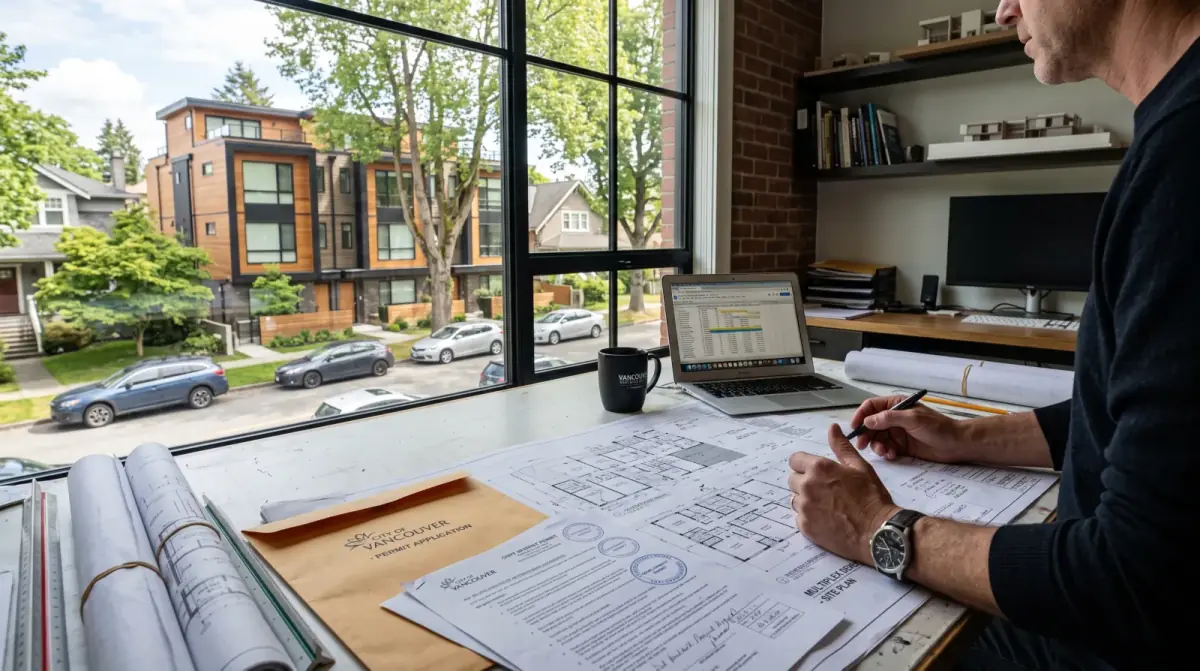
In short, Vancouver multiplex projects face several city-collected fees: the Development Cost Levy (DCL), the now-removed density bonus contribution, and building permit charges. As of June 30, 2026, Vancouver removed the density bonus contribution requirement for multiplexes. Six BC cities cut multiplex fees in 2026. Using BC Housing's pre-approved designs can reduce permit fees and save architecture costs.
Building a multiplex in Vancouver means paying several layers of city-collected charges before construction can start. Each one has a different purpose, a different calculation method, and a different stage in the project timeline when it becomes due. Treating them as a single undifferentiated "city fees" line in your pro forma is one of the more reliable ways to get the cost stack wrong.
The Development Cost Levy: what it funds and how it's calculated
The Development Cost Levy, usually called the DCL, is Vancouver's infrastructure charge. It funds the city systems that a new building draws on: parks, drainage and sewers, transportation infrastructure, and a share of affordable housing. The DCL is collected before the building permit is issued, which means it's a real cash requirement at a specific stage in the project timeline.
Rates are not uniform across the city. Vancouver publishes DCL rate schedules that vary by the geographic area where your lot sits and the type of housing you're building. A multiplex on a lot in the Grandview-Woodland area is not charged the same rate as an identical project in Marpole or the Cambie corridor. Check the current schedule on vancouver.ca, rates are updated periodically, so any figure from a year ago should be treated as a starting point, not a confirmed number. The City of Vancouver's DCL page is the authoritative source.
The density bonus contribution: what it was and what changed on June 30
Vancouver's base R1-1 zoning allows a defined amount of floor space on a residential lot. The city offered the option to access additional density above that base, what the city called the voluntary density bonus, in exchange for either a cash contribution or the inclusion of affordable units. That cash payment was the density bonus contribution.
As of June 30, 2026, Vancouver removed the density bonus contribution requirement for multiplexes. The before/after is clean: applications submitted before that date may have been subject to the charge; applications submitted after June 30 are not. If your project was already in the application queue before that deadline, confirm with your permit consultant which rules apply to your file, the transition rules depend on when your application was formally accepted by the city.
For projects applying now, the removal is a direct improvement to the cost stack. It is not a small adjustment on a multi-unit project, the contribution was calculated as a share of the value of the additional density accessed. Removing it changes the financial case for pursuing bonus density, including the net-zero FSR exclusion.
Building permit fees and how pre-approved designs change them
Vancouver's building permit fee for a new multiplex is based on the project's construction value. It is a separate charge from the DCL and is collected at the building permit stage. For a multi-unit project, this fee is material, not negligible.
Projects using BC Housing's standardized multiplex design concepts qualify for a streamlined review process and reduced permit fees. The reason is structural: a pre-reviewed design concept gives Vancouver's building department a starting point that has already been assessed for code compliance at a conceptual level. Less staff review time means lower fees, and faster processing. BC Housing's free designs can save approximately $30,000 to $50,000 in architecture fees compared to a fully custom design, and the reduced permit fees add further savings.
Vancouver isn't the only city that moved on fees in 2026
Vancouver's June 30 density bonus removal was part of a broader pattern. Six BC cities cut multiplex-related fees in 2026: Surrey, Vancouver, Metro Vancouver and the Fraser Valley (which rolled back some DCL charges), Victoria, Port Moody, and Kelowna. The direction is clear, municipal governments are trying to reduce the upfront cost stack on small-scale multi-unit housing to make more projects viable.
- Surrey: Multiplex fee cuts in 2026.
- Vancouver: Density bonus contribution removed as of June 30, 2026.
- Metro Vancouver and the Fraser Valley: DCL rollback on certain multiplex projects.
- Victoria: Multiplex fee reductions in 2026.
- Port Moody: Multiplex fee reductions in 2026.
- Kelowna: Multiplex fee reductions in 2026.
If you're comparing a lot in Vancouver against a lot in Surrey or another Metro Vancouver and the Fraser Valley municipality, the fee stack is now one of the inputs worth comparing directly. Two lots at similar land prices can have meaningfully different all-in development costs depending on which city's fee schedule applies.
DCC: the regional charge that sometimes gets confused with the DCL
Separate from Vancouver's DCL is the Development Cost Charge, often called the DCC, which is collected by Metro Vancouver and the Fraser Valley or in some cases by the municipality itself to fund regional infrastructure like water mains and regional sewers. In some cities the DCC and DCL are collected together; in others they're separate line items. For a Vancouver multiplex, both charges can apply, and the distinction matters when you're building a precise pro forma. Always confirm which charges apply to your specific project with your permit consultant, the terminology is similar enough that the two are frequently conflated in informal discussions.
Building the fee picture before you commit to a site
The time to understand the full city-fee stack is before you finalize a lot purchase or a partnership agreement, not after. A Vancouver multiplex project's fee total, DCL, permit fees, and any other applicable charges, is a real number in the pro forma, and that number affects whether the project works financially at a given land price.
The good news is that the 2026 changes, density bonus contribution removed, pre-approved design fee savings available, have improved the cost picture for new applications. The work is to confirm exactly which of those improvements apply to your project, at your site, under your application timeline. That's a specific exercise, not a general estimate.
How the Vancouver fee stack compares to Burnaby and Richmond
A project in Burnaby or Richmond carries a different fee structure than an identical project in Vancouver. Burnaby does not have an equivalent to Vancouver's DCL, it has its own Development Cost Charge (DCC) rate schedule, which is applied per dwelling unit for residential development. Richmond's RSM zone introduces its own permit and servicing fees. For a homeowner comparing a Vancouver lot against a Burnaby or Richmond option, the fee column in the pro forma is one of the meaningful differences.
Metro Vancouver and the Fraser Valley, the regional government, also collects a regional DCC on new residential development in most member municipalities. This is separate from the city-level DCL or DCC, and is collected alongside the city charge at the building permit stage. Metro Vancouver and the Fraser Valley's DCC funds regional water, sewer, drainage, and housing reserve. The exact Metro DCC rate depends on the municipality and the type of dwelling unit.
When fees become due in the project timeline
City-collected fees are not paid at one point in the project, they are sequenced through the development process. Understanding when each fee falls due helps with cash flow planning on a project that may span 18 to 24 months from lot purchase to occupancy.
- Development permit stage (where applicable): Some municipalities collect a development permit application fee before a building permit is issued. In Vancouver, most R1-1 multiplex applications go directly to a building permit without a development permit, so this stage may not apply.
- Building permit stage: The DCL is collected by the City of Vancouver at this point. This is also when Metro Vancouver and the Fraser Valley's regional DCC is typically collected. For a multi-unit project, both can represent significant upfront cash before construction begins.
- Building permit fees: Also collected at the permit stage, based on the project's construction value as submitted. Projects using BC Housing's pre-approved designs qualify for reduced fees at this stage.
- Occupancy permit stage: Some charges, particularly for servicing connections, are collected when occupancy is granted. Confirm with your permit consultant which charges fall here versus at building permit.
One number that matters: the all-in city fee total
For a real pro forma, the number that matters is not each individual fee in isolation but the total city-collected charge per unit, the DCL, building permit fees, and any other applicable charges added together and divided by the number of homes you're building. That per-unit number sits alongside construction cost per unit and land cost per unit as the three primary pro forma inputs. Getting it right requires current rate schedules, not estimates from a year-old article.
Our Feasibility and Equity Review includes a current city-fee calculation for your specific lot, using the schedules in effect at the time of the review. If the fee landscape has changed, as it did on June 30, 2026, the numbers in the review reflect the current rules. That specificity is the difference between a pro forma that helps you make a decision and one that gives you false confidence. The fee stack on a Vancouver multiplex has real effects on whether a project is financially worth doing, and those effects belong in the analysis before you commit to a site.
Frequently asked
What is the DCL and who charges it?
The Development Cost Levy (DCL) is a charge collected by the City of Vancouver before a building permit is issued. It funds city infrastructure, parks, drainage, transportation, and affordable housing. Rates depend on where in the city your lot sits and what type of housing you're building. Current rates are published at vancouver.ca and change periodically, so always pull the current schedule when building a pro forma.
What was the density bonus contribution and is it gone?
The density bonus contribution was an additional charge for projects that accessed Vancouver's voluntary density bonus, extra density above the base zoning in exchange for a fee or affordable units. The City removed this requirement for multiplexes as of June 30, 2026. New applications filed after that date do not need to pay it. If your project application was submitted before June 30, you may still have been subject to the old rules, check with your permit consultant.
Do pre-approved BC Housing designs reduce city fees?
Yes. Projects using BC Housing's standardized multiplex designs qualify for a streamlined permit review process and lower building permit fees. The designs are free to use and can also save approximately $30,000 to $50,000 in architecture fees compared to a fully custom design. The designs still need site-specific amendments from a licensed designer before a permit can be issued.
Wondering what your lot could become? Book a free consultation to find out how many units you could build on your property, whether it's a feasible project, and how our GP/LP partnership structure works.
Written by
Real Estate Developer
Trent Praski leads investment and development at Venture Pacific, sourcing missing-middle opportunities across Metro Vancouver and the Fraser Valley and structuring transparent homeowner and investor partnerships.
Full profile