
Strata or rental: choosing the tenure for your multiplex
Sell the homes as strata lots, or hold them and rent? The tenure you choose shapes everything from how many homes you can build to how the project makes money. Here's how to think it through.
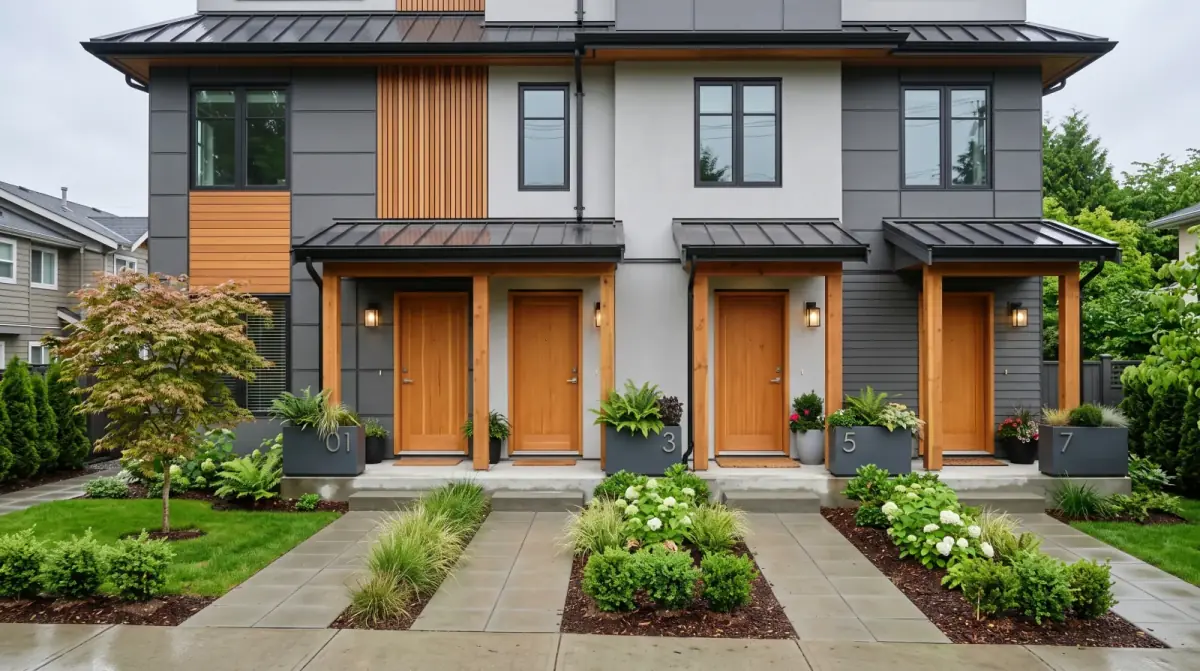
In short, Choosing strata (selling homes individually) or rental (holding and renting them) is one of the biggest decisions in a multiplex project. In Vancouver's R1-1 zone the choice changes the permitted unit count, up to 6 homes as strata, or up to 8 where all are non-stratified and secured as rental. Tenure also drives how and when the project earns money, the financing, the GP/LP partnership structure, and the design itself. The right choice depends on the owner's goals, the lot, and the city.
Two owners came to us in the same month with nearly identical lots, one in Vancouver and one in Burnaby. One wanted their capital back as soon as the project finished so they could move on; the other wanted a long-term income asset to pass to their children. Same kind of lot, opposite goals. They ended up building different projects, one strata, one rental, and both were right. That is the heart of the tenure decision: it is less about which option is better and more about what you actually want from your land.
Tenure is the legal form your finished homes take. There are two main paths for a multiplex. You can sell the homes as strata lots, each one its own legally separate property, like a townhouse or condo, owned and sold individually. Or you can hold the homes under single ownership and rent them to tenants. The choice sounds administrative. It is actually one of the most consequential decisions in the whole project, and it is worth making deliberately rather than by default.
What strata and rental actually mean
Strata tenure divides the building into individually titled homes. Each becomes its own property that can be sold to a separate buyer, with shared elements, the roof, the grounds, common structures, managed collectively through a strata corporation. This is how most townhouse and condo ownership works in British Columbia. For a developer, strata typically means building the homes and then selling them off, returning the invested capital through those sales.
Rental tenure keeps the homes under one ownership. Rather than selling them, you lease them to tenants and hold the building as a long-term asset. The capital stays invested in the property, and the return comes as rental income over time plus whatever long-term appreciation the asset earns. Some cities also recognize “secured rental,” where the homes are committed to remaining rental for a defined period in exchange for development advantages, more on that below, because in Vancouver it changes the math directly.
What “stratifying” actually involves under BC law
It helps to know what the strata path really is, because it is a legal act with real steps, not just a label. Under BC's Strata Property Act, land is subdivided into two or more strata lots by depositing a strata plan at a land title office. In plain terms: the surveyor and lawyer prepare a plan that carves the finished building into individual homes, and when the land title office accepts it, each home becomes its own separately titled property.
Two things happen on that deposit. First, the registrar issues a new indefeasible title for each strata lot, that is the legal document a buyer's ownership rests on. Second, each of those titles carries a share of the common property, and a strata corporation comes into being to manage the parts everyone shares, from the roof to the driveway. Owners cannot deal with their share of the common property separately from their home; the two travel together. This is the machinery that lets four, six, or eight homes on one former single-family lot be sold to eight different families.
Rental skips all of that. There is no strata plan, no subdivision of the building into separate titles, no strata corporation. The lot stays one property under one owner, and the homes within it are leased. That structural difference, many titles versus one, is what sits underneath every other consequence in this article.
Tenure can change how many homes you can build
Here is the surprise that catches most owners off guard: in Vancouver, your tenure choice affects how many homes you are allowed to build. The R1-1 zone is the clearest example in Metro Vancouver and the Fraser Valley. On a standard lot it permits up to six homes when they will be sold as strata, but up to eight homes where every unit is non-stratified and secured as rental tenure. Those extra two homes are not a rounding error, they can be a quarter more density on the same piece of land.
The bonus is not only about unit count. It comes with more permitted floor area. Vancouver's multiplex rules cap the floor space ratio, the ratio of built floor area to lot size, at 1.0, and the higher end of that range is tied to the secured-rental path rather than the strata path. So choosing rental in R1-1 can unlock both more homes and more square footage to build them in. Strata buys you saleable, individually owned homes; secured rental buys you scale. That is a genuine fork, not a preference.
This turns tenure from a back-end financial decision into a front-end design and capacity decision. If rental allows more homes and more floor area, the entire project, its size, its layout, its economics, can hinge on which path you take. That is why we raise tenure early, before the design is locked, rather than treating it as something to settle after the building is drawn. The provincial Small-Scale Multi-Unit Housing rules set the floor for what every lot must allow; the strata-versus-rental incentives a city layers on top are what lift the practical number.
When tenure can change your unit count from six to eight, it stops being a financing footnote and becomes one of the first design questions you have to answer.
One caution comes with the bonus, and we always say it plainly: the extra homes in R1-1 are conditional on the units staying non-stratified and secured as rental. You generally cannot take the eight-home version, build it, and then stratify and sell the homes off a few years later. The higher count is the reward for keeping them rental. If retaining the option to sell individual homes matters to you, that trade-off deserves a hard look before you commit, not after.
How the money behaves differently
The two tenures earn in fundamentally different rhythms, and this is usually what owners weigh most heavily. We will describe the pattern without inventing any figures, because the real numbers depend entirely on your lot, your market, and your costs.
Strata returns capital relatively soon. You build the homes, sell them, and the proceeds come back around the time the project completes. That suits an owner who wants to realize the value of their land and move on, or who does not want to be a long-term landlord. The trade-off is that once the homes are sold, the upside is realized and gone, you have captured the value at sale and no longer hold the asset.
Rental works the opposite way. The capital stays tied up in the building, and the return arrives gradually as rental income, alongside the long-term value of holding real estate in a city like Vancouver. That suits an owner who wants an income-producing asset and is comfortable being a landlord, or having one managed on their behalf. The trade-off is patience: your capital is committed for the long haul rather than freed at completion. And with eight homes rather than six on the secured-rental path, there is simply more income-producing building to hold.
Tenure changes the financing, not just the payout
There is a second money difference that owners rarely see coming, and it lives in how the project is funded rather than how it pays out. A strata project is usually built on construction financing, short-term lending drawn down as the building goes up and repaid from unit sales soon after completion. The lender's exit is the sale of the homes. When the last home closes, the construction loan is gone and so is the debt.
A rental project has no sale to repay the construction loan, so it has to carry into something longer. Typically that means moving from construction financing into a longer-term mortgage on the finished, tenanted building. The lender is now underwriting an income stream over years rather than a set of sales over months. That is a different financing structure with a different timeline and different terms, and it belongs in the plan from the outset, not discovered halfway through. We size and sequence the financing to the tenure, because a rental building financed as if it were a strata build is a problem waiting to surface.
How tenure shapes the GP/LP partnership
For owners who work with us through our general-partner / limited-partner structure, tenure also shapes the partnership itself. As a reminder of how that model works: the landowner contributes the land as equity, the land is their stake in the project, and we act as the general partner managing the development. Profits and risks are shared according to the agreement.
A strata project and a rental project structure that partnership differently because they earn differently. A strata path tends to crystallize value at sale, which suits a partnership designed to share proceeds when the homes are sold and then wind down. A rental path keeps the asset and its income in play over years, which suits a partnership built around long-term shared ownership and cash flow. Neither is inherently better; they simply match different owner goals. We design the partnership terms around the tenure and the owner's intentions, not the other way around. If you want to understand the mechanics on their own, our note on the GP/LP partnership model for landowners walks through how the land-as-equity stake works.
Design follows tenure too
Tenure even reaches into the drawings. Homes built to sell as strata are often detailed to appeal to individual buyers, distinct identities, the finishes and features purchasers look for, clear separation between homes. Homes built to hold and rent are detailed for durability, ease of maintenance, and consistent operation across the building, because the owner lives with the consequences of every material choice for years.
These are not enormous differences, but they are real, and they are far cheaper to get right at the design stage than to retrofit later. Deciding tenure early lets the design serve the chosen path from the first sketch instead of compromising between two it can never fully satisfy. It matters more on the secured-rental path, too, where you may be laying out eight homes rather than six on the same footprint.
A few questions worth answering first
Before any drawings begin, it helps to sit with a handful of honest questions. Do you want your capital back near the end of the project, or are you comfortable leaving it invested for years? Do you want to be done once the homes are built, or are you open to being a long-term owner, or having the asset managed on your behalf? Does your city offer a meaningful advantage, such as the extra homes in Vancouver's R1-1 zone, for choosing rental, and is that advantage worth more to you than keeping the option to sell?
There are no right answers to these, only honest ones. An owner planning to fund a retirement may value capital returned at completion. An owner thinking across generations may value a held, income-producing building more highly even if it ties up their land for the long term. The tenure decision is really a way of putting those personal priorities into a form the project can be built around.
Tenure shapes the experience too, not just the finances. One practical point owners sometimes overlook is that the two paths feel different to live through. A strata project has a clear finish line, the homes are completed, sold, and the chapter closes. A rental project has no such tidy ending; once the homes are built and occupied, the owner steps into a long relationship with the building as an operating asset, with tenants, maintenance, and management to think about over years.
Neither rhythm is better, but they suit different temperaments and different stages of life. Part of choosing tenure well is being honest about which kind of involvement you actually want. In our GP/LP partnerships we can carry much of the ongoing management on a rental path, but the owner is still choosing, at the outset, between a project that ends and a project that continues. That is a meaningful choice, and worth making with eyes open.
Strata closes a chapter; rental opens a long one. Knowing which you want is half of choosing your tenure.
So which should you choose?
There is no universal answer, and anyone who gives you one without studying your situation is guessing. The right tenure depends on three things together: what you want from your land, capital back soon, or a long-term income asset; what your lot and your city allow, including Vancouver's up-to-eight rental bonus in R1-1; and how the partnership and financing are best structured around those goals. In Vancouver the rental bonus may tip the scale; in Burnaby or Coquitlam the rules differ and the calculation changes with them.
The owners who handle this well are the ones who decide what they actually want before the design begins, then let the tenure, the unit count, the financing, and the drawings all line up behind that decision. The ones who struggle are usually the ones who left tenure undecided until it was expensive to change.
If you are weighing strata against rental for your lot, our Feasibility & Equity Review models both paths against your specific property, including the extra homes your city may allow for secured rental, and shows how each one would shape the homes, the timeline, the money, and the partnership. Deciding tenure with real numbers in front of you, rather than a hunch, is one of the most valuable early moves you can make.
Frequently asked
What is the difference between strata and rental tenure?
Strata means each home becomes its own legally separate property that can be sold individually, like a townhouse or condo. Rental means the homes stay under single ownership and are leased to tenants. In Vancouver, the choice can even affect how many homes you are allowed to build.
Can I build more homes if I choose rental in Vancouver?
Yes, in the R1-1 zone. Vancouver permits up to six homes when they can be sold as strata, but up to eight where all of them are non-stratified and secured as rental. The extra two homes come with a higher permitted floor space ratio, so rental can genuinely change the capacity of the lot, it is worth confirming for your specific address in Vancouver or Burnaby.
What does it mean to “stratify” a multiplex?
Stratifying means depositing a strata plan at the land title office, which under BC's Strata Property Act subdivides the building into separately titled homes. Each home gets its own indefeasible title plus a share of the common property, and a strata corporation is created to manage the parts everyone shares. Only then can the homes be sold to individual buyers.
Which tenure makes more financial sense?
It depends on your goals. Strata typically returns capital sooner through sales, while rental builds long-term value and income but ties up the asset for years. Neither is universally better, the right answer depends on the owner, the lot, and how the partnership is structured.
Can I sell the units in a secured-rental multiplex after it's built?
Not freely, if you took the secured-rental route. The higher unit count and floor space in Vancouver's R1-1 zone come with a condition that the homes stay non-stratified and secured as rental, so you generally can't stratify and sell them off individually afterward. That is the trade you accept for the extra homes, and it is one to weigh before you commit.
Does tenure change how the project is financed?
It does. A strata project is usually built on construction financing that gets repaid from unit sales soon after completion, so the lending is short-term. A rental project is held, so it typically moves from construction financing into longer-term mortgage financing on the finished building, a different structure with a different timeline. We factor that into the plan before drawings begin.
Can I mix strata and rental homes in one Burnaby multiplex?
Sometimes, but city rules decide what's allowed, and the incentives usually push you to pick a lane. Vancouver's rental bonus, for instance, requires all the homes to be secured rental to earn the extra units, so a mix would forfeit that advantage. In Burnaby the rules differ again, which is exactly why we check tenure city by city before designing anything.
Wondering what your lot could become? Book a free consultation to find out how many units you could build on your property, whether it's a feasible project, and how our GP/LP partnership structure works.
Written by

Real Estate Developer
Trent Praski leads investment and development at Venture Pacific, sourcing missing-middle opportunities across Metro Vancouver and the Fraser Valley and structuring transparent homeowner and investor partnerships.
Full profile