
SSMUH explained: what Bill 44 means for your Metro Vancouver and the Fraser Valley lot
Bill 44 forced every Metro Vancouver and the Fraser Valley city to allow multiple homes on lots that used to permit one. Here's what the legislation actually requires, and where it stops short of a green light.
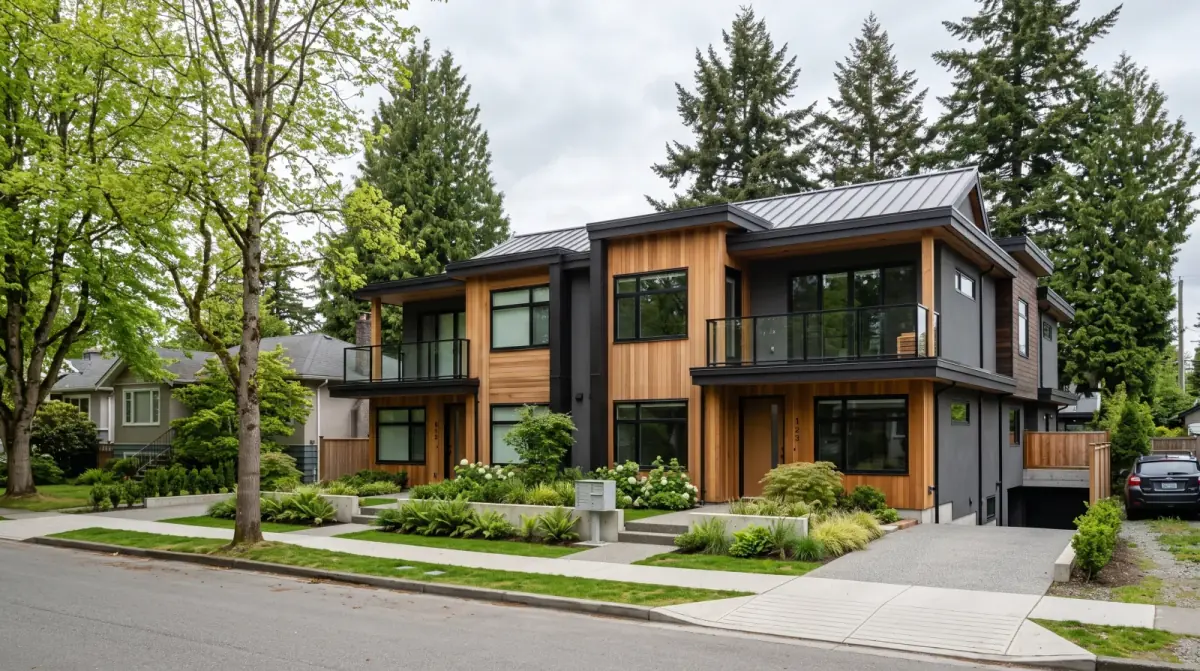
In short, Bill 44 is the BC law behind Small-Scale Multi-Unit Housing (SSMUH). It requires most Metro Vancouver and the Fraser Valley municipalities to allow at least three to four homes on a standard residential lot, and six near frequent transit, without a rezoning.
A homeowner in Renfrew-Collingwood called us last spring holding a printout of a news article. The headline said BC had "legalized fourplexes everywhere." He wanted to know when his could start. We had to slow him down, not because the article was wrong, but because the distance between what the law permits and what his lot could build was wider than he expected. That gap is the whole story of Bill 44.
What Bill 44 is, in one paragraph
In late 2023 the Province of British Columbia passed Bill 44, the Housing Statutes (Residential Development) Amendment Act. It requires local governments to permit Small-Scale Multi-Unit Housing, SSMUH, on lots previously zoned for single-family or duplex use. Through 2024 and into 2025, municipalities across Metro Vancouver and the Fraser Valley rewrote their zoning bylaws to comply. The legislation didn't design anyone's building. It told cities they could no longer say "one house only" on a standard residential lot.
That is the part worth sitting with. For decades, adding even a second strata home to a Vancouver lot meant a rezoning, public hearings, council discretion, months of uncertainty. Bill 44 made the multiplex a permitted use. You apply for a building permit, not for permission to change the zone.
The minimums the Province actually set
The Province didn't leave unit counts to each council's mood. It set province-wide minimums that municipalities must allow, tied to two things: how big the lot is, and how close it sits to frequent transit.
- Lots of 280 m² (about 3,014 sq ft) or smaller: at least 3 units.
- Lots larger than 280 m²: at least 4 units.
- Larger lots within roughly 400 m of a frequent-transit stop: at least 6 units.
Read "at least" carefully. These are floors. A city can permit more, Vancouver's R1-1 zone allows up to six strata homes, and up to eight when the project is secured rental. The minimum is what the Province forces; the maximum is what your municipality chose to offer on top.
The 400-metre transit measurement trips people up. It's a walking-distance test to a stop on a frequent network, not a straight line on a map, and the eligible routes are defined by the regional transit authority. We've seen two lots on the same Burnaby block land on opposite sides of that line. One qualified for six units; the neighbour didn't. If transit proximity is your whole thesis, verify the stop's status before you build a plan around it.
Why the 280-square-metre line matters more than it looks
That 280 m² threshold is doing quiet work in the background of almost every SSMUH project. A standard Vancouver lot, the classic 33-foot frontage running back 120 feet, sits well over 280 m², which puts it in the four-unit band before you factor in transit. Trim that lot, or work with a genuinely small parcel in an older part of Sunset or Marpole, and you can fall into the three-unit band instead. One home of difference, decided by a number most owners have never measured on their own property.
We measure it early for a reason. The unit count sets everything downstream: how the building massing works, whether a project pencils, how the equity in a partnership gets divided. A homeowner who assumes four homes and discovers the lot is a hair under the line has to redraw the whole plan. Pull your lot area off the title or the assessment before you assume a band, the province's floor keys off the real square-metre figure, not the rough size in your head.
Where the legislation deliberately stops
Bill 44 sets how many homes a city must allow. It says almost nothing about whether your specific lot can physically hold them. That's the line where most homeowner-led projects either get real or fall apart.
The law doesn't touch the BC Building Code. Fire separations between units, exiting, and structural requirements all still apply, and on a tight infill lot they shape the design more than the zoning does. It doesn't waive the BC Energy Step Code, your multiplex still has to hit the envelope and airtightness targets the code demands, which drives real cost into walls and mechanical systems. And it doesn't conjure servicing capacity out of nowhere. Water, sanitary, and electrical service to an older Marpole or Sunset lot was sized for one house; adding four or six homes can mean upgrades the legislation never mentions.
Setbacks, height, lot coverage, and parking still come from the municipal bylaw. The Province pushed the unit count up but left the building envelope to each city, which is why a fourplex in Vancouver's R1-1 looks different from a fourplex on a comparable Richmond RSM lot. The number of doors is provincial. The shape of the box is local.
There's also the exception list. The Province let cities hold back SSMUH on land with genuine constraints, heritage designation, floodplain and hazard areas, and neighbourhoods where the sewer or water main can't yet carry the added load. Richmond phased in Steveston later because of ongoing sewer work; New Westminster gave Queensborough a longer runway for the same reason. If your lot sits in one of those pockets, the headline rule and your actual rule may not match, and that's worth confirming before you fall in love with a plan.
How Metro Vancouver and the Fraser Valley cities wrote it differently
Same law, different bylaws. Vancouver created the R1-1 "Residential Inclusive" zone, folding most of the old single-family areas into one zone that permits three to six strata homes and up to eight secured rental units. Burnaby rolled its version into an R1 district that allows three to four units, rising to six near frequent transit. Richmond updated its RSM sub-zones, RSM/S, RSM/M, RSM/L and RSM/XL, and rezoned roughly 27,000 single-family and duplex lots in one move. The Province set the floor; each council decided the form, the design guidelines, and how much above the floor to go.
The Tri-Cities and New Westminster wrote their own versions too, and the differences are practical, not cosmetic. Coquitlam adopted its SSMUH zoning in June 2025 and, because none of its bus stops currently meet the province's frequent-service test, its lots top out at the four-unit band rather than six for now. New Westminster ran its rollout through an Infill Housing Program, pre-zoning thousands of low-density lots, some for up to four homes, others for up to six, so owners can go straight to a permit on eligible property. Two cities, two paths to the same provincial floor.
For a landowner, that means "what can I build?" has no single answer across the region. The same 33-foot lot produces a different project in Vancouver than in Burnaby, because the two cities made different choices about height, coverage, and unit mix. You can't port a Kitsilano plan onto a Coquitlam lot and assume it lands.
What "permitted outright" changes about the timeline
The practical prize in Bill 44 isn't just more homes, it's the removal of the rezoning. That single change reshapes how a project moves. Under the old rules, a Vancouver landowner who wanted three or four homes faced a discretionary process: reports to council, a public hearing, neighbours speaking for and against, and an outcome no one could promise until the vote. Months could pass before you knew whether you were allowed to build at all, and a "no" sent you back to the start.
With the multiplex as a permitted use, that whole layer drops away for a standard lot. You still need a building permit, and the city still reviews your drawings against the zoning and the BC Building Code, that review is real and it takes time. But you're no longer asking permission to change the rules; you're demonstrating that your design meets rules that already apply. The uncertainty moves from "will they let me?" to "does my plan comply?", a very different question to build a project around.
We say this carefully, because "no rezoning" gets heard as "no process." There's still a permit queue, still design work, still engineering, still servicing review. What's gone is the political risk. For a homeowner weighing whether to develop, that shift, from a discretionary yes to a procedural one, is often the difference that makes the whole thing worth starting.
Rental, strata, and why the tenure choice can add units
Bill 44 set the floor for how many homes must be allowed, but several Metro Vancouver and the Fraser Valley cities layered a further incentive on top: build the homes as secured rental instead of strata, and you may be allowed more of them. Vancouver's R1-1 is the clearest example, up to six strata homes, but up to eight when the units are locked in as rental. The Province wanted the added density to produce rental supply, and the cities built that preference into their bylaws.
For a landowner, that turns tenure into an early design decision, not an afterthought. Strata lets you sell the finished homes individually; secured rental keeps them as a held, income-producing asset and, in some zones, unlocks a larger building. Neither is automatically better, it depends on what you want the project to do for you, and on how a GP/LP partnership would structure the outcome. But it's worth knowing before drawings start, because the unit count and the tenure are linked, and changing your mind late is expensive.
The word that keeps getting lost: permitted, not required
One thing gets blurred in almost every conversation we have. Bill 44 makes a multiplex permitted, it does not make it required. Nobody is forcing you to redevelop. Both Richmond and Coquitlam say this plainly in their own materials: the new zoning lets you add homes, but you can keep your house and your yard untouched indefinitely if that's what you want.
We raise this because the choice is genuinely open, and it's worth making on purpose rather than by drift. Some owners want the income and the density their lot can now carry. Some want to hold. Some sit in the middle, curious what the land could become, not ready to commit. The zoning doesn't push you in any direction. It just widens the menu from "keep or sell" to include "develop, in partnership, and keep a stake."
The servicing question the law never answers
Here's the constraint that catches the most homeowners off guard, because nothing in the legislation warns them about it. Bill 44 raised the permitted unit count, but the pipes and wires under the street didn't get bigger the day it passed. An older lot in Marpole, Sunset, or a mid-century Coquitlam subdivision was serviced for a single house, one water connection, one sanitary lateral, an electrical service sized for one household's load. Put four or six homes on that lot and you may be asking the existing infrastructure to do several times the work it was built for.
Sometimes the upgrade is minor. Sometimes it means a new, larger water service, a reworked sanitary connection, or an electrical upgrade that has to be coordinated with the utility, and on a few sites, the constraint runs deeper than the lot, into a main that the city hasn't yet upsized. That's exactly why places like Richmond's Steveston and New Westminster's Queensborough were phased in later: the zoning was ready before the sewer capacity was. The Province set the unit floor; it didn't fund anyone's pipe.
None of this shows up on a zoning map, and none of it is a reason not to build, it's a reason to find out early. A servicing check belongs at the front of a feasibility review, not as a surprise mid-permit, because it can move a project's cost and its schedule more than almost any design choice you'll make.
What this means before you spend a dollar on drawings
Bill 44 changed the answer to "is a multiplex allowed here?" from a maybe into a usually-yes. It did not change the answer to "is a multiplex worth building on this lot?" That second question depends on the lot's dimensions, slope and soils, servicing, the unit count your zone permits, the partnership structure, and the Step Code level your city enforces, none of which the legislation decides for you.
Before anyone draws a floor plan, the move is a Feasibility & Equity Review: we read your actual zoning, test how many homes your lot can realistically carry, and lay out how a GP/LP partnership would put your land and an investor's capital to work. The legislation opened the door. Feasibility tells you whether to walk through it, and you can start by running your address through our multiplex calculator to see the permitted range before we ever meet.
Frequently asked
What does SSMUH actually stand for?
SSMUH is Small-Scale Multi-Unit Housing, the Province of BC's name for duplexes, triplexes, fourplexes, and small multiplexes on lots that used to allow only a single-family home or duplex. Bill 44 is the legislation that made municipalities permit it.
Does Bill 44 guarantee I can build a fourplex on my Vancouver lot?
It guarantees the zoning allows the units, but not that your specific lot will physically fit four homes that meet setbacks, parking, and the BC Building Code. In Vancouver, the R1-1 zone sets the form; whether your lot works is a feasibility question, not a zoning one.
Does Bill 44 remove the need for a rezoning?
For most standard lots in Vancouver, Burnaby, and Richmond, yes, the multiplex use is now permitted outright, so you go straight to a building permit instead of a public rezoning hearing. Larger or unusual sites can still need a rezoning or development permit depending on the city.
Are heritage and character lots exempt from SSMUH?
Some are. The Province let municipalities carve out limited exceptions for heritage-designated properties and certain hazard or floodplain lands. A character home in a Vancouver or New Westminster heritage area may face extra steps, so confirm the property's status before assuming the standard rules apply.
How does the 280-square-metre lot threshold decide my unit count under SSMUH?
The Province set 280 m² (about 3,014 sq ft) as the line. Lots at or under 280 m² must be allowed at least three units; lots larger than 280 m² must be allowed at least four; and larger lots within about 400 m of a frequent-transit stop must be allowed at least six. Your city can permit more on top of these floors, but it can't offer less.
Does Bill 44 apply the same way in Coquitlam and Richmond as in Vancouver?
The provincial floors are the same everywhere, but the local bylaws differ. Coquitlam adopted its SSMUH zoning in June 2025 and currently has no bus stops that meet the frequent-service test, so its six-unit provision doesn't apply yet. Richmond created four RSM sub-zones and rezoned roughly 27,000 lots. Same law, different form rules city to city.
Why do two neighbouring lots in Burnaby sometimes get different unit limits?
The six-unit bonus depends on being within roughly 400 m walking distance of a bus stop the Province has prescribed as frequent-service transit. That's a walking-path measurement to a specific eligible stop, not a straight line. One lot can fall inside the radius and its neighbour just outside, so one qualifies for six units and the other for four.
Does SSMUH override the BC Building Code or the Energy Step Code?
No. Bill 44 changes how many homes the zoning must allow, but every unit still has to meet the BC Building Code for fire separation, exiting, and structure, and hit the BC Energy Step Code envelope targets your city enforces. Those requirements often shape a tight infill design more than the zoning does.
Wondering what your lot could become? Book a free consultation to find out how many units you could build on your property, whether it's a feasible project, and how our GP/LP partnership structure works.
Sources
- Government of BC, Small-scale multi-unit housing
- Shape Your City Vancouver, Multiplexes / R1-1
- City of Burnaby, SSMUH zoning now in effect
- City of Richmond, Provincial housing legislation changes (RSM zoning)
- City of Coquitlam, Small-scale multi-unit housing
- City of New Westminster, Small-scale multi-unit housing
- BC Energy Step Code
Written by

Real Estate Developer
Trent Praski leads investment and development at Venture Pacific, sourcing missing-middle opportunities across Metro Vancouver and the Fraser Valley and structuring transparent homeowner and investor partnerships.
Full profile