
Questions to ask before developing your Metro Vancouver and the Fraser Valley lot
Before you sign anything to develop your lot into a multiplex, there are questions that separate a sound partnership from a costly mistake. Here are the ones we'd ask.
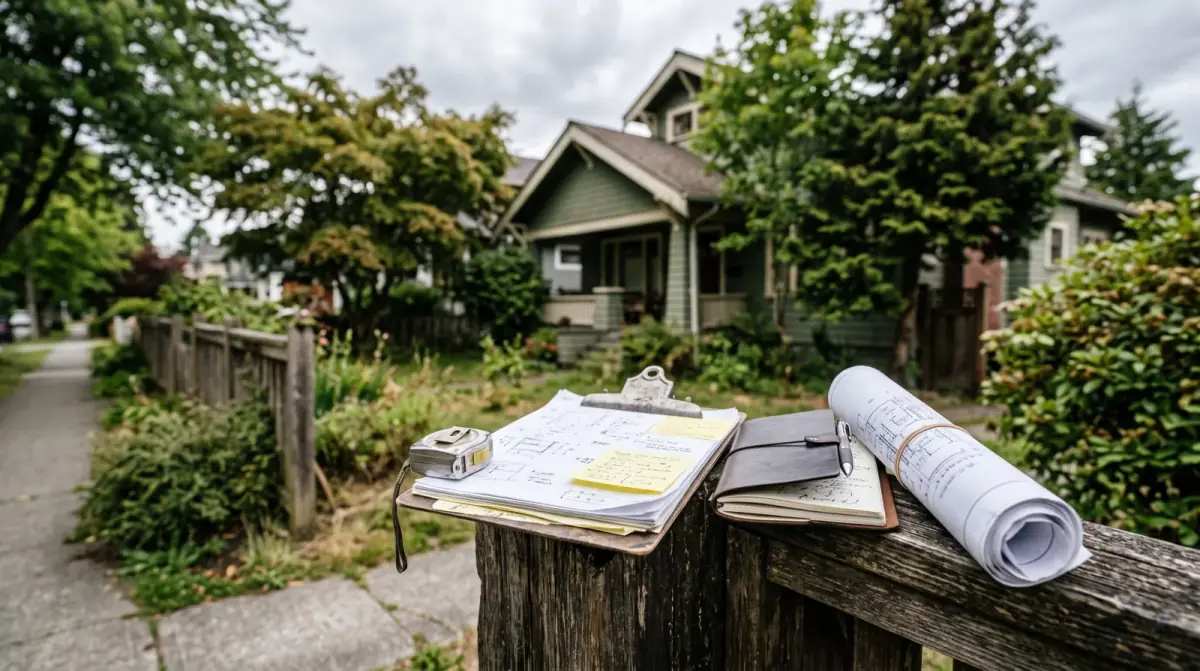
In short, Before partnering to develop a lot into a multiplex in Metro Vancouver and the Fraser Valley, a homeowner should ask whether the lot is genuinely feasible, how the GP/LP partnership assigns risk and equity, whether the builder is licensed and registered for 2-5-10 warranty, what happens if costs rise or the market shifts, how long the project realistically takes, who makes decisions, and what the exit looks like. The questions that go unasked are the ones that cause problems later. SSMUH rules may permit three, four, or six units, but 'allowed' is not the same as 'feasible.'
A homeowner sat across from us recently with a lot in Dunbar, a teardown-era house, and a folder of notes. The notes weren't about countertops or unit layouts. They were questions, sharp ones, about risk and money and what happens if things go sideways. That's exactly the person we want to work with, because the questions that go unasked at the start are the ones that turn into problems later.
Developing the lot you've lived on for years is one of the biggest financial moves most people ever make, and it runs for a couple of years with real money and your family home tied up in it. Here are the questions we'd want you to ask, of us, and of anyone else you're considering partnering with. None of them are hostile. The good developers welcome every one, because a landowner who understands the deal is an easier partner to work with when a project hits its hard stretch, and every Metro Vancouver and the Fraser Valley project has one.
Is the lot actually feasible, or just technically allowed?
These are two different questions, and people conflate them constantly. BC's SSMUH rules mean most Metro Vancouver and the Fraser Valley lots must now allow at least three or four units, six near frequent transit. But "allowed" isn't "feasible." A narrow lot, an awkward shape, soft soil, a slope, an undersized water and sewer connection, or a tree you can't touch can all shrink what's buildable or pile on cost.
Feasibility is the question of whether a multiplex on your specific lot makes financial sense after every cost is accounted for, not whether the zoning technically permits units. The honest answer for some lots is that the numbers don't work, and a developer worth partnering with will tell you that before you've spent anything. That's what a proper feasibility review, or pro forma, is for.
Can you show me the pro forma for my lot, not a template?
There is a difference between a developer telling you a project makes sense and a developer showing you why. Ask to see the feasibility review or pro forma built for your actual property, your lot dimensions, your setbacks, your servicing, your neighbourhood's comparable values, not a generic example from another site. A quick calculator or a lot-size rule of thumb is a fine starting point, but it is not a study of your ground.
When you read it, look for the assumptions. What did they assume about the number of homes, the construction cost drivers, the market value of the finished units? Are those assumptions grounded in your specific lot, or borrowed from an average? A pro forma that only works if every variable lands perfectly is telling you something. This is exactly the ground our Feasibility & Equity Review is built to cover, and it is why we lead with it rather than with a drawing.
How does the partnership structure assign risk?
If you're contributing your lot to a development partnership, you need to understand exactly how that partnership is built. We use a GP/LP structure, general partner and limited partner. The limited partners contribute capital or, in your case, the lot. The general partner runs the project and carries the operational responsibility.
The questions to press on: where does my lot equity sit in the stack? Who carries the construction risk? If the project goes over budget, who absorbs it? How do draws work, and at what milestones? None of this should be fuzzy. We tell landowners up front who carries which risk and where their equity sits, and it's all in the agreement before anyone contributes anything. If a developer can't explain their structure plainly, that's an answer in itself.
What is my land actually worth in this deal?
This is the question homeowners are often shyest about, and it matters more than almost any other. When you contribute your lot as equity, that land is your stake, so how is its value being recognized inside the partnership? Be wary of anyone who answers with a single confident number before they have studied the site, the market, and the finished project. Land value in a development deal is not the same as a quick assessment figure or a recent sale down the street; it depends on what the lot can produce and what the finished homes are worth.
What you want is not a promise but a method. Ask how the land equity is weighed against the cost of building and the projected value of the finished units, and how the proceeds are split once the project sells or rents. A developer who walks you through that reasoning, rather than waving a number at you, is showing you how they think. The same lot can support very different deals in Vancouver versus Surrey, because the land values and the local markets are different, and an honest structure reflects that instead of papering over it.
Is the builder licensed, and have you checked yourself?
Anyone building a new multiplex for sale in BC has to be a licensed residential builder, and the home has to be registered for 2-5-10 warranty coverage. BC Housing runs a public New Homes Registry where you can look up whether a home was built by a licensed builder and whether it carries warranty insurance, along with the warranty provider.
Don't take a developer's word for it, look it up yourself. It takes a few minutes and it costs nothing. We point every partner to that registry, because verifying the builder is the single clearest protection a homeowner has, and the willingness to be checked is a good sign on its own. A licensed builder in Vancouver or Coquitlam has a public record; ask to see it.
What happens if costs rise or the market shifts?
Every development carries this risk, and a partnership that pretends otherwise is hiding something. Lumber pricing moves. Trade availability in Metro Vancouver and the Fraser Valley tightens and loosens. The resale market for a finished multiplex in 2026 isn't guaranteed to look the same when the project completes. These are real variables, not edge cases.
So ask directly: what's the plan if construction costs run over the pro forma? What if the market for the finished units softens? Is there contingency in the budget, and who controls it? A developer who has run dozens of Lower Mainland projects has lived through cost swings and should be able to walk you through how the structure handles them. Honest answers about downside are more reassuring than promises that everything will be fine.
How long will this really take?
Owners almost always underestimate the calendar. A multiplex moves through distinct stages, feasibility, design, permitting, construction, and completion, and each one takes real time. Permitting is often the slowest stretch, and it does not move at the same pace in every city: a Vancouver R1-1 project, a Burnaby R1 project, and a Richmond RSM project each have their own review process and their own queue.
Ask for a realistic schedule for your specific municipality, with the stages broken out, and ask what tends to cause delay. A developer who quotes you an unusually fast, tidy timeline is either new to the region or telling you what you want to hear. The honest version has some slack in it for the permit conditions and site surprises that show up on most projects. If you want the stage-by-stage picture, our journal walks through a single-family-lot-to-fourplex timeline in detail.
Who makes the decisions when something comes up?
A multiplex build generates dozens of decisions, a soil surprise during excavation, a long-lead window, a finish substitution, a permit condition from the city. Someone has to make those calls, and the project stalls if it's unclear who. In a GP/LP structure the general partner runs the project day to day, but you should understand which decisions are theirs to make and which loop you in.
Clarity here prevents the friction that wrecks partnerships. You don't want to be consulted on every screw, and you don't want to be surprised by a material change to your own building. Settle the decision-making boundaries up front so neither of you is guessing mid-project. A good agreement names which choices need your sign-off, a change that affects the unit you plan to keep, a budget swing past a set threshold, and which ones the general partner simply makes and reports. Get that line drawn before a shovel is in the ground, not after the first surprise, because a surprise is exactly when an unclear boundary turns into a dispute.
What does the exit look like?
Finally, think past completion. Are you keeping a unit and living in the finished building in your old Dunbar neighbourhood? Selling your share? Holding units as rental? The structure of the deal should match what you actually want at the end, and that should be clear before you start, not negotiated under pressure once the building is up.
Different goals point to different project structures, so your answer shapes the whole plan. A homeowner who wants to stay in a new unit needs a different deal than one who wants to cash out. Name the outcome you want early.
If you've got your own folder of questions and a Metro Vancouver and the Fraser Valley lot you're weighing, that's the right place to start. A Feasibility & Equity Review is built to answer exactly these questions for your specific property, feasibility, structure, risk, timeline, and where your equity sits. Bring us the hard questions, whether your lot is in Vancouver, Burnaby, or anywhere else across the region, and we'll give you straight answers before you commit to anything.
Frequently asked
What's the first question to ask before developing my lot?
Whether the lot is genuinely feasible, not whether the zoning allows units, but whether a multiplex on that specific Vancouver or Burnaby lot makes financial sense after every cost. SSMUH rules may permit four units, but lot shape, servicing, slope, and the market determine whether the project actually works. A feasibility review answers that before you commit.
How do I check that a developer's builder is legitimate?
BC Housing runs a public New Homes Registry showing whether a home was built by a licensed residential builder and whether it carries warranty insurance. Anyone building a new multiplex for sale in BC must be licensed. Look the builder up before signing anything, it's free and it's the clearest signal of whether you're dealing with a real operator.
What should the partnership agreement spell out?
Who carries which risk, how your lot equity sits in the project, how draws and decisions work, and what happens if costs rise or the market shifts. In a GP/LP structure the limited partners contribute the lot or capital and the general partner runs the project, and the agreement should make every one of those roles explicit before anyone contributes anything.
What documents should I ask to see before I sign?
At minimum the feasibility review or pro forma for your specific lot, the draft partnership agreement, proof of the builder's licence and warranty registration, and the project schedule. If a developer in Vancouver or Coquitlam can show you all four without hesitation, that's a good sign. If any of them is vague or missing, slow down and ask why.
How do I know if the number of units in the plan is realistic?
Ask whether the unit count came from a building envelope study or just from the lot size. The provincial rules and a quick calculator tell you the ceiling, but setbacks, height limits, trees, and access often make the real number one below the maximum. On a Vancouver R1-1 lot a plan for six homes should be backed by a layout that shows six homes actually fit and sell, not just that the zoning permits them.
How long does developing my lot into a multiplex usually take?
Longer than most owners expect, feasibility, design, permitting, and construction each take real time, and permitting in Metro Vancouver and the Fraser Valley can be the slowest stretch. Ask the developer for a realistic schedule for your city, since a Vancouver R1-1 project and a Richmond RSM project don't move at the same pace. A plan that promises an unusually fast timeline is a reason to ask harder questions, not to relax.
Wondering what your lot could become? Book a free consultation to find out how many units you could build on your property, whether it's a feasible project, and how our GP/LP partnership structure works.
Written by
Real Estate Developer
Trent Praski leads investment and development at Venture Pacific, sourcing missing-middle opportunities across Metro Vancouver and the Fraser Valley and structuring transparent homeowner and investor partnerships.
Full profile