
New Westminster and Coquitlam: SSMUH across the eastern suburbs
The same provincial housing law that reshaped Vancouver landed in New Westminster and Coquitlam too. Here is how two very different eastern cities translated it into local rules, including one detail about Coquitlam's transit that surprises almost every owner.
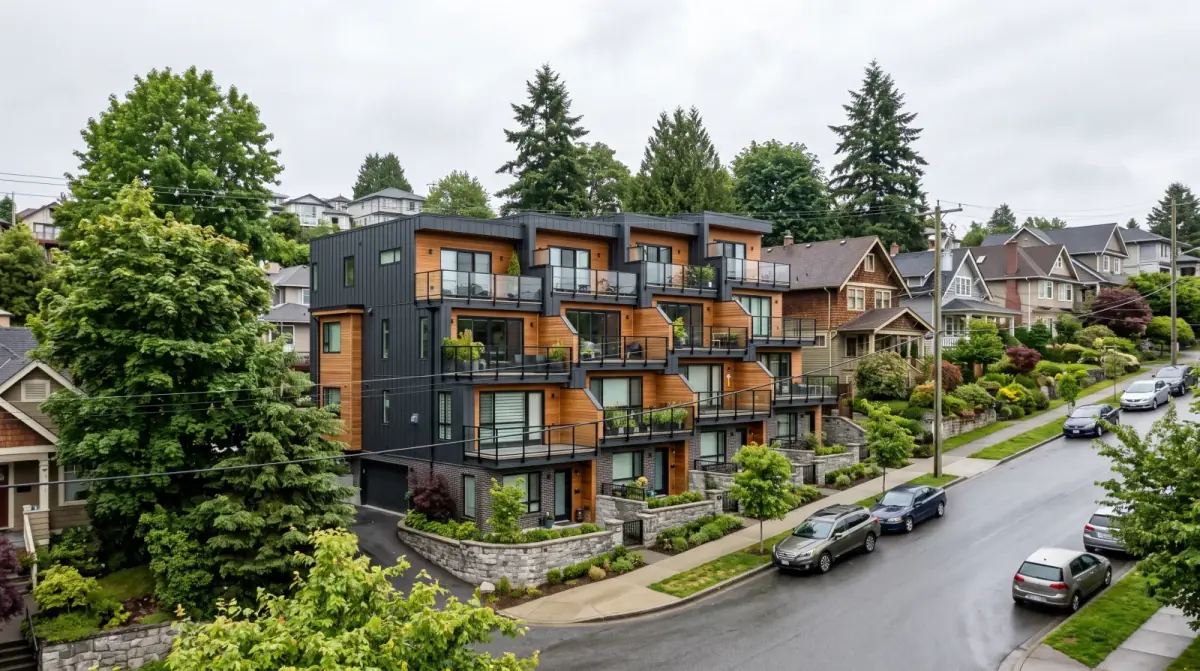
In short, New Westminster and Coquitlam both adopted British Columbia's Small-Scale Multi-Unit Housing rules, allowing three to four homes on most former single-family lots. New Westminster's June 2026 Infill Housing Program pre-zones properties as RGO-A (up to four units) or RGO-B (up to six), while Coquitlam adopted its bylaw in June 2025 but currently has no bus stops meeting the frequent-transit test, so the six-unit provision does not yet apply there. Terrain and transit coverage change how a multiplex gets built in each city.
Stand on a New Westminster street and you can usually see the Fraser River below you, because the city tilts toward it. Drive twenty minutes east to Coquitlam and the land flattens out into wide postwar lots, many of them a short walk from a SkyTrain station. Two cities, two landscapes, and, since the province changed the rules, the same basic permission to build small multi-unit housing on lots that used to allow a single house.
British Columbia's Small-Scale Multi-Unit Housing law did not stop at Vancouver. It reached every municipality, and New Westminster and Coquitlam both adopted it, on different timelines and in different forms. For a homeowner east of the city, that means the opportunity is genuinely there. How it plays out, though, depends heavily on which of these two cities you are in, what your lot looks like, and a few pieces of fine print that most owners never hear about.
The same floor, set by the province
Both cities work from the same provincial minimums. A lot of 280 square metres or smaller must allow at least three homes. A larger lot must allow at least four. And a larger lot within roughly 400 metres of frequent transit must allow at least six. These are the floors every Metro Vancouver and the Fraser Valley municipality had to meet, including these two.
Past that shared floor, each city wrote its own bylaw, its own setbacks, height limits, parking expectations and design guidelines, and in New Westminster's case its own zone names. So a fourplex in Coquitlam and a fourplex in New Westminster start from the same unit math but end up shaped by different local rules. The headline number travels across city lines; the design details, and sometimes even that sixth unit, do not.
Coquitlam: flat land, and a transit catch almost nobody expects
Coquitlam adopted its SSMUH zoning changes in June 2025, and its older neighbourhoods gave us a lot of flat, regular lots, which is close to ideal for multiplex design. On flat land, units arrange cleanly, parking is straightforward, and each home can get its own entrance and a piece of usable outdoor space without the building fighting the grade. On paper, Coquitlam looks like the easy city to build in.
Here is the catch, and it's the one owners get wrong most often. The six-unit bonus is not triggered by being near a SkyTrain station, it's triggered by frequent bus service, a stop running about every 15 minutes through the day. And Coquitlam has stated that it currently has no bus stops meeting the provincial criteria for frequent service. So even along the Evergreen extension, most Coquitlam lots top out at four units today, not six. We've had to correct that assumption more than once, because the SkyTrain line is right there and it feels like it should count. Under the way the rule is written, right now, it doesn't.
That can shift if service levels change, which is exactly why we check the current transit designation for a specific address instead of eyeballing the map. But planning a six-unit Coquitlam project on the assumption that a nearby station qualifies you is a good way to design a building the bylaw won't permit. Four is the number to build around on most Coquitlam lots as things stand.
New Westminster: RGO-A, RGO-B, and density on a hillside
New Westminster took a different route and a later one. It adopted its Infill Housing Program in June 2026 and pre-zoned properties into two categories: RGO-A, which permits up to four units, and RGO-B, which permits up to six. So in New Westminster the question isn't only how big your lot is, it's which category the city assigned your property. That designation sets your ceiling before design even starts, and it's the first thing we look up on a New Westminster address.
New Westminster is also one of the oldest cities in the region, and it shows in the street grid: compact lots, walkable blocks, real neighbourhood character, and slope. A lot of the city runs downhill toward the river, and that slope is the defining design factor for a multiplex here.
Building on a grade is not a problem to avoid; it is a condition to design with. Units can step down the slope, parking can tuck into the lower portion of the site, and a well-handled hillside building often feels more interesting than a flat-lot equivalent. But it takes deliberate engineering. Foundations cost more, access has to be worked out carefully, and a design lifted straight from a flat Coquitlam lot will not drop onto a New Westminster hillside unchanged.
One more piece of New Westminster fine print: Queensborough was left out of the June 2026 program. The city said it needs to study whether the water and sewer there can carry more housing, and it holds a provincial extension with a compliance deadline of May 4, 2029. If your lot is in Queensborough, you're on a different clock than the rest of the city, and that belongs in the conversation early.
- Coquitlam, flatter lots and simpler layouts, but currently no qualifying frequent-transit stops, so most lots cap at four units.
- New Westminster, RGO-A (up to four units) or RGO-B (up to six), assigned lot by lot, on compact, character, often-sloped land.
- Both, three to four homes on most lots as a baseline, set by the province off the 280-square-metre line.
- Both, local setbacks, height and design rules layered on top of the shared minimums.
Why "frequent transit" decides so much
The phrase "frequent transit" is not casual language, and Coquitlam's situation shows why it matters. It points to a specific service standard, corridors where buses run often enough, all day, to count under the housing rules, anchored in TransLink's Frequent Transit Network. When a lot falls within roughly 400 metres of a stop that meets that standard, the higher unit minimum can apply. When no stop meets it, as Coquitlam currently reports, the bonus simply isn't available, SkyTrain or not.
This is why Coquitlam and New Westminster behave differently lot by lot, and why neither behaves like Vancouver. Transit coverage, service frequency and how each city drew its designations all vary. Two neighbours on the same street can end up with different permitted unit counts. We measure it precisely against the current designations rather than assuming distance to the nearest station settles it, because the difference is worth real money.
Parking, and where the two cities quietly differ
Parking is one place the provincial push toward gentler requirements shows up unevenly. New Westminster, for instance, removes off-street parking minimums for its six-unit RGO-B category, the lots pre-zoned for the higher count near frequent transit. That doesn't mean parking disappears from the design; it means the number of stalls becomes a design and market decision rather than a fixed bylaw minimum. On a tight, sloped New Westminster lot, that flexibility can be the difference between a workable layout and a cramped one.
Coquitlam's flatter lots make parking mechanically easier to place, but with most Coquitlam sites capped at four units, the calculus is different, fewer homes, simpler access, and no six-unit parking relief to lean on. We work the parking layout alongside the unit count in both cities, because a plan that ignores where the cars go tends to lose a unit late in design, which is the worst time to lose one.
The building itself is provincial, the ground isn't
Owners comparing these two cities sometimes assume the buildings will differ as much as the sites do. Mostly they won't. Both cities build to the BC Energy Step Code, the provincial standard that ratchets up energy performance over time, better-sealed walls, good windows, and mechanical systems chosen with the energy target in mind. That standard is set provincially, so a New Westminster multiplex and a Coquitlam multiplex share the same wall physics. What differs is the ground: Coquitlam's flat, easy lots versus New Westminster's grades. Design to the site, budget to the code.
Reading your specific lot
If you own a lot in either city, the useful question is not "what does the law allow" in general, it is "what does my lot allow," once slope, the current transit designation, lot area and the local bylaw (including New Westminster's RGO category) are all accounted for. Those factors can swing a project meaningfully in both directions.
We have learned not to trust citywide averages on these eastern lots. New Westminster's hills and RGO split, and Coquitlam's transit fine print, create too much variation between neighbouring properties. The only reliable read comes from putting your actual parcel against the actual rules as they stand this year.
Where to start
The practical next step is a Feasibility & Equity Review on your specific address. We confirm the local bylaw for New Westminster or Coquitlam, look up your RGO category or Coquitlam zone, check the current frequent-transit designation rather than assuming a nearby station qualifies, factor in slope and lot area, and give you an honest unit count along with the equity already sitting in your land. If that points to a project worth pursuing, our Development Strategy & Permitting work takes the design through the city's process. You can also try the multiplex calculator for a first estimate before we meet. Both cities opened the door; a clear read on your own lot, and on the fine print, tells you how far through it you can walk.
Frequently asked
Do New Westminster and Coquitlam follow the same housing rules as Vancouver?
They follow the same provincial framework. BC's Small-Scale Multi-Unit Housing law set minimums that every municipality, including New Westminster and Coquitlam, had to adopt. Each city then wrote its own local bylaw, so setbacks, height and design details vary, and even the zone names differ, with New Westminster using RGO-A and RGO-B categories that Vancouver and Coquitlam don't share.
How many homes can I build in Coquitlam?
On most former single-family lots, three homes on a lot of 280 square metres or smaller and four on a larger lot, with no rezoning. Coquitlam adopted its SSMUH bylaw in June 2025. The six-unit frequent-transit bonus is written into the provincial framework, but Coquitlam has stated it currently has no bus stops that meet the provincial frequent-service test, so in practice most Coquitlam lots top out at four.
Why doesn't the six-unit transit bonus apply in Coquitlam yet?
The provincial six-unit rule is tied to frequent bus service, a stop running about every 15 minutes through the day, not simply to being near a SkyTrain station. Coquitlam has said none of its bus stops currently meet that provincial frequent-service standard, so the six-unit minimum isn't triggered on its lots as things stand. That can change if service levels change, which is exactly why we check the current transit designation rather than assuming a SkyTrain nearby unlocks six homes.
What are New Westminster's RGO-A and RGO-B zones?
They're the two infill categories New Westminster created when it adopted its Infill Housing Program in June 2026. RGO-A permits up to four units on a property; RGO-B permits up to six. The city pre-zoned properties into one category or the other, so which zone your lot carries decides your ceiling before you draw a thing.
Why does New Westminster's terrain matter for a multiplex?
New Westminster is famously hilly, with steep streets running down toward the Fraser River. Slope affects foundations, parking access and how units step down a site. A multiplex design that works on a flat lot often needs real rework on a New Westminster grade, which is why we assess terrain early.
Is my New Westminster lot covered, or is any area excluded?
Most of the mainland was pre-zoned under the June 2026 Infill Housing Program, but Queensborough was left out for now. The city has said it needs to study whether the water and sewer systems there can support more housing, and it received a provincial extension with a compliance deadline of May 4, 2029. So a Queensborough lot is on a different clock than the rest of the city.
Which city is easier to build in?
Neither is simply easier; they are different. Coquitlam offers more flat, regular land but currently caps most lots at four units, while New Westminster offers tight, walkable, character neighbourhoods with more slope and an RGO-B path to six units on pre-zoned lots. The right answer depends on your specific lot, which is what a Feasibility & Equity Review is for.
Does the 280 square metre lot size threshold matter in these cities?
Yes, in both. The provincial floor sets three units on a lot of 280 square metres or smaller and four on a larger lot, and New Westminster and Coquitlam carry that line into their bylaws. A lot a few metres either side of 280 can gain or lose a home, so we pull the registered lot area before quoting any unit count in either city.
Wondering what your lot could become? Book a free consultation to find out how many units you could build on your property, whether it's a feasible project, and how our GP/LP partnership structure works.
Written by

Real Estate Developer
Trent Praski leads investment and development at Venture Pacific, sourcing missing-middle opportunities across Metro Vancouver and the Fraser Valley and structuring transparent homeowner and investor partnerships.
Full profile