
How Much Does It Cost to Build a Multiplex in Vancouver? (2026 Guide)
Most homeowners who ask about building a multiplex think about the cost of construction. That's only part of the bill. Here's a plain breakdown of what a triplex, fourplex, or sixplex actually costs to build in Metro Vancouver and the Fraser Valley in 2026, from hard construction to city fees to the total all-in number.
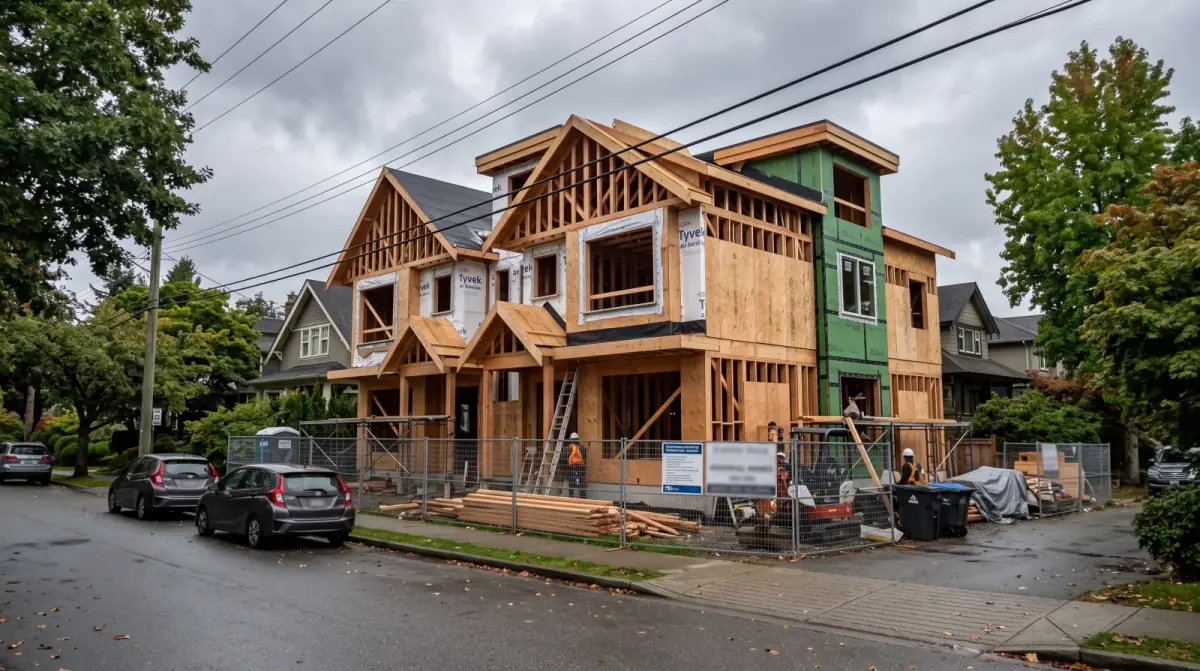
In short, A plain-language breakdown of what it costs to build a triplex, fourplex, or sixplex in Metro Vancouver and the Fraser Valley in 2026. Covers hard construction costs per square foot for wood-frame builds, soft costs (design, engineering, architecture), the city fee stack (DCL, Metro Vancouver and the Fraser Valley DCC, density bonus contribution), a comparison table by project type, the strata vs. build-to-rent decision, and the main variables that move the total number. Written for homeowners considering whether to develop their lot.
The question comes up in almost every first conversation with a homeowner who is sitting on a lot in Vancouver, Burnaby, or Richmond: how much does it cost to build a multiplex? The honest answer is that "cost" is four separate numbers that land at different stages of the project, and most people are only thinking about one of them.
The surprise isn't that a multiplex is expensive, in Metro Vancouver and the Fraser Valley, everyone expects that. The surprise is the gap between what people call construction cost and what the project actually costs before the first unit is sold or rented. That gap is made up of soft costs, city fees, and financing, and in 2026, the city fee stack in particular is large enough to change whether a project pencils out. Here is what each piece looks like.
Hard construction cost: what you're actually building
Hard construction cost is the labour and materials, framing, concrete, roofing, windows, mechanicals, finishes, and everything else that turns an approved set of drawings into a building. For a mid-range wood-frame multiplex in Metro Vancouver and the Fraser Valley in 2026, that runs roughly $400 to $450 per square foot. Premium finishes, complex sites, or buildings targeting a higher step of the BC Energy Step Code push the number toward $450 to $500 per square foot and above.
To put that in context: a four-unit project where each unit runs 1,400 to 2,000 square feet of finished floor area carries a hard construction cost somewhere between roughly $2.2 million and $3.6 million, depending on the build spec and the site. Those ranges are real, not padded, and they can widen further based on what's below grade. Confirm current rates with a contractor before drawing any conclusions about your specific project.
Soft costs: design, engineering, and the paper trail
Before the excavator arrives, a significant amount of money goes toward the drawings and studies that make the project legal and buildable. Architectural design, structural engineering, civil engineering for the site servicing, a geotechnical report (required on most sites), surveys, energy modelling, and permit application packages, all of this is a real cost that lands before construction financing is typically available.
As a working estimate, budget 7 to 12 percent of your hard construction cost for soft costs. On a $3 million construction contract, that's $210,000 to $360,000 in professional fees and pre-construction work. Simpler projects on straightforward lots run toward the lower end. Sites with slopes, heritage overlays, soil complexity, or city review conditions run toward the higher end.
City fees: the stack that catches people off guard
The fee stack is where most first-time developers experience sticker shock. There are three main pieces in Vancouver, and the total can run $200,000 to $320,000 or more depending on the lot, the number of units, the city, and whether you plan to strata or hold as rental.
The first piece is the Vancouver Development Cost Levy, or DCL. As of 2026, the general rate in Vancouver is approximately $49.88 per square metre of gross floor area, confirm the current rate for your specific property type and neighbourhood at the city before relying on any figure you read online.
The second piece is the Metro Vancouver and the Fraser Valley Development Cost Charge, or DCC. This is a regional charge paid per unit and is separate from the city's DCL. The rate in 2026 is approximately $29,197 per unit. That number matters especially right now: Metro Vancouver and the Fraser Valley's DCC is scheduled to increase by a total of roughly 56 percent between 2025 and 2027 in phased steps. A project that gets its building permit in 2026 locks in the current rate; a project that waits faces a meaningfully higher charge. This is the last window before the next step up.
The third piece is the Vancouver density bonus contribution, which applies to strata projects only. For a multiplex being built to sell as individual strata units, the contribution can be up to $82,000 per unit as of 2026. This is the charge that makes the strata-versus-rental decision so financially significant. Secured rental projects, where the units are legally committed to long-term rental, are exempt from the density bonus contribution entirely.
Triplex, fourplex, or sixplex: rough all-in ranges
The table below gives approximate all-in cost ranges excluding land, based on mid-range wood-frame construction in Metro Vancouver and the Fraser Valley in 2026. These figures layer hard construction, soft costs, and the city fee stack described above. They are ranges, not quotes, the spread reflects real variation in site conditions, finish level, unit sizes, and city chosen.
- Triplex (3 units, approx. 1,400 to 1,800 sq ft per unit): All-in roughly $1.8M to $2.5M. Needs a standard-sized lot; often works on lots where a fourplex is physically tight. Rental income potential: $7,500 to $10,500/month combined.
- Fourplex (4 units, approx. 1,400 to 2,000 sq ft per unit): All-in roughly $2.8M to $3.8M. The most common SSMUH project type in Metro Vancouver and the Fraser Valley on a standard 33- to 50-foot lot. Rental income potential: $10,000 to $14,000/month combined.
- Sixplex (6 units, approx. 900 to 1,400 sq ft per unit): All-in roughly $3.8M to $5.2M. Typically requires a larger lot or transit-adjacent location that unlocks the 6-unit density under SSMUH. Rental income potential: $13,500 to $18,000/month combined.
Income estimates assume market rents in Metro Vancouver and the Fraser Valley as of mid-2026 for two- and three-bedroom units. Verify against current comparable listings in your specific neighbourhood before relying on them for any financial projection.
Strata vs. Build-to-rent: two different financial outcomes
The choice between building to sell as strata or holding as rental changes the economics of a Metro Vancouver and the Fraser Valley multiplex in more ways than most landowners expect.
Strata is a single capital event. You build, you sell the units at market value, you pay the applicable taxes on the gain, and the project is complete. The return is realized up front. The density bonus contribution in Vancouver, up to $82,000 per unit, applies to strata projects.
Build-to-rent is a long-term hold. You carry the property, collect rental income, and the equity compounds over time as the mortgage is paid down and the property appreciates. The density bonus contribution does not apply to secured rental projects in Vancouver, which reduces the fee stack meaningfully. There is also a specific build-to-rent incentive in Vancouver's zoning: projects on certain lot types can unlock eight units (instead of the standard six) when the tenure is secured rental. That extra density can change whether a project makes sense on a marginal lot.
Neither option is automatically better, they serve different financial goals. A landowner who needs capital now is better served by strata. One who can hold, has a tax situation that favours income over gains, and wants to compound equity over ten or twenty years may come out ahead with a rental hold. The right answer depends on your specific situation, and it's worth working through with an accountant who knows real estate before you commit to a structure.
What moves the total cost most
After walking through a lot of these numbers, a few variables stand out as the ones that actually swing the budget.
- Lot size and complexity: A flat, well-serviced lot on standard soil costs less to prepare than a sloped, underdrained lot with aging utility connections. The difference can be $100,000 or more before framing starts.
- Unit count: More units spread some fixed costs but add servicing, parking, and code requirements that partially offset the gain. The right unit count for your lot is a design question, not just a zoning one.
- Finish level: Rental-grade interiors and premium strata finishes are not the same budget. Both can be correct for the intended exit.
- City chosen: Fee structures, DCL rates, and specific zoning requirements differ between Vancouver, Burnaby, Richmond, and Surrey. The same project on a similar lot can carry a different fee stack depending on where it sits.
- Strata versus rental: As described above, tenure choice affects both the fee stack (density bonus contribution) and the potential density (6 vs. 8 units in Vancouver secured rental scenarios).
Get a real number for your lot
The figures in this guide give you a frame of reference, a way to think about whether a multiplex on your lot is in the right ballpark before spending anything. They are not a substitute for a property-specific feasibility review that looks at your actual lot dimensions, your city's current fee schedule, your site conditions, and the unit count that physically fits your envelope.
We have completed a fourplex on one lot in Richmond, four three-bedroom townhomes, and we work through this same cost analysis on every project we take on. The numbers are only useful when they're attached to a real piece of ground. If you want to know what a multiplex would actually cost on your lot in Vancouver, Burnaby, Richmond, or the surrounding cities, a free feasibility review is the right starting point. We'll tell you what we see, including if the numbers don't work.
Frequently asked
How much does it cost to build a fourplex in Vancouver in 2026?
A mid-range wood-frame fourplex in Vancouver runs roughly $2.8M to $3.6M all-in, excluding land. That covers hard construction, soft costs like design and engineering, and the city fee stack, DCL, Metro Vancouver and the Fraser Valley DCC, and any applicable contributions. The range is wide because lot conditions, finish level, and whether you strata or hold for rent all move the number. A property-specific feasibility review gives you a real figure.
What are development cost levies (DCL) in Vancouver?
DCL stands for Development Cost Levy, a city charge per square metre of floor area, collected at building permit. In Vancouver the general rate is approximately $49.88/m² as of 2026, though rates vary by area. It funds city infrastructure like parks, childcare, and transportation. Metro Vancouver and the Fraser Valley also charges its own DCC (Development Cost Charge) per unit, which is separate.
Is the density bonus contribution required for a fourplex?
In Vancouver, the density bonus contribution applies to strata projects, units you plan to sell. Secured rental projects are exempt. As of 2026 it can reach up to $82,000 per unit for strata, which is a significant cost variable. This is one reason holding a project as build-to-rent changes the economics substantially.
Will Metro Vancouver and the Fraser Valley's DCC go up soon?
Yes. Metro Vancouver and the Fraser Valley's DCC is scheduled to increase by a total of roughly 56% between 2025 and 2027, in phased steps. The 2026 rate is approximately $29,197 per unit. Projects that secure a building permit in 2026 lock in the current rate. Once the next scheduled increase takes effect in 2027, that line of the budget rises meaningfully.
Does strata or build-to-rent make more financial sense for a multiplex?
They serve different goals. Strata gives you a lump sum at completion, you pay taxes on the gain and move on. Build-to-rent means ongoing rental income, the property continues to appreciate, and you are exempt from Vancouver's density bonus contribution on secured rental projects (which can save up to $82,000 per unit). The right choice depends on your financial position, tax situation, and whether you want income or a capital event. A GP/LP partnership can structure either path.
What are soft costs in a multiplex build?
Soft costs are everything that isn't construction labour and materials. They cover architectural design, structural and civil engineering drawings, geotechnical reports, surveying, permit applications, and development management. As a rough guide, budget 7 to 12% of your hard construction cost for soft costs, more if the site is complex or the city's review process requires extra studies.
Wondering what your lot could become? Book a free consultation to find out how many units you could build on your property, whether it's a feasible project, and how our GP/LP partnership structure works.
Written by
Real Estate Developer
Trent Praski leads investment and development at Venture Pacific, sourcing missing-middle opportunities across Metro Vancouver and the Fraser Valley and structuring transparent homeowner and investor partnerships.
Full profile