
Building for Two Generations: Multiplexes and Multigenerational Living in Metro Vancouver and the Fraser Valley
Surrey alone has nearly one in ten households living across two generations under one roof. A multiplex built under Bill 44 is now the most practical way to make that work, separate legal units, separate front doors, separate lives that stay connected.
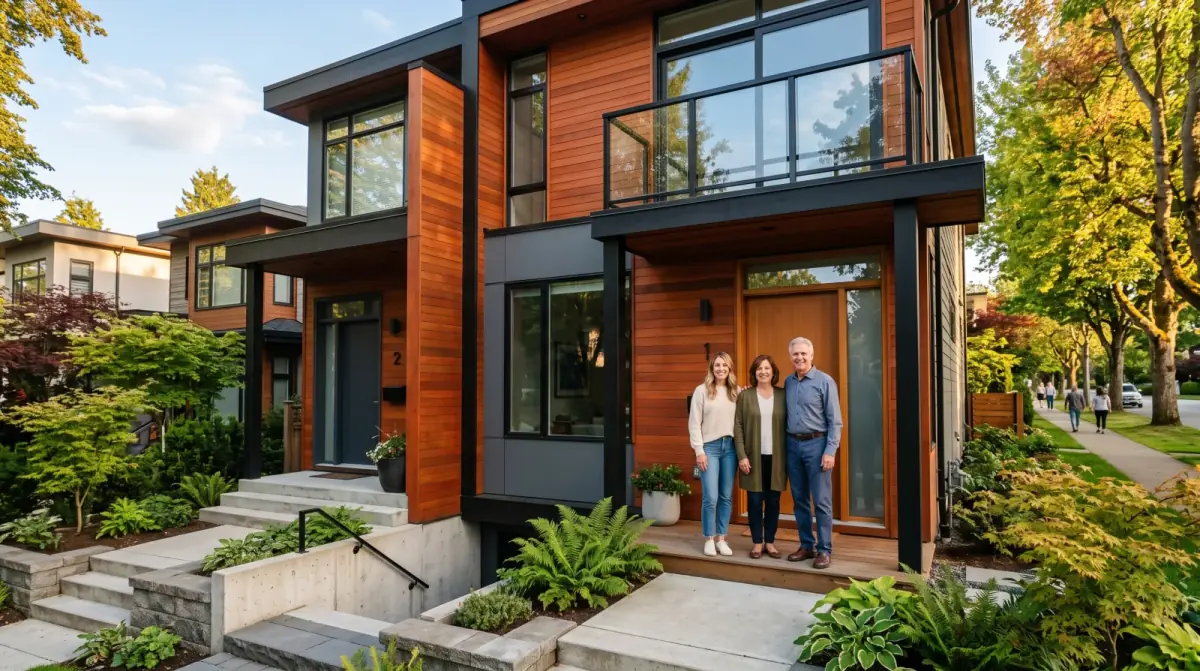
In short, This post explains how Metro Vancouver and the Fraser Valley families can use a multiplex, permitted under BC's Bill 44 / SSMUH legislation, to house two generations on one lot with fully separate legal titles, entrances, and financing. It covers the design decisions that protect family relationships, the GP/LP partnership structure, the Multigenerational Home Renovation Tax Credit, CMHC multi-unit mortgage rules, and the co-ownership legal infrastructure families need before construction begins.
There's a particular conversation that happens in a lot of Metro Vancouver and the Fraser Valley families, usually triggered by something practical: an aging parent who needs more support, an adult child who can't afford to buy in the same city, a caregiving need that's arrived earlier than expected. The question is always some version of the same thing, how do we stay close without making each other miserable?
For most of the past few decades, the realistic options were limited: move in together and share space in ways that strain even good relationships, or live far enough apart that the practical help is hard to deliver. A basement suite was a workaround, not a real answer. The privacy wasn't there. The separate legal ownership wasn't there.
That has changed. BC's Bill 44, the legislation behind what the province calls Small-Scale Multi-Unit Housing, or SSMUH, now requires most Metro Vancouver and the Fraser Valley municipalities to allow three to six homes on a standard residential lot, as a matter of right, without a public rezoning process. A multiplex is no longer a workaround. It's the purpose-built answer for exactly this situation: two generations, one lot, fully separate homes.
Surrey currently has the highest rate of multigenerational households in Metro Vancouver and the Fraser Valley, about 9.6 percent of households include multiple generations living together. That figure reflects real demand: families navigating the cost of housing, caregiving needs, and cultural traditions that have always placed value on proximity. What's changed is that those families now have a legal and financial structure that makes the arrangement work on their own terms.
What multigenerational actually looks like in a multiplex
A multigenerational multiplex doesn't need a special designation. It's a standard two-, three-, or four-unit building where the ownership and occupancy is organized around family. The physical design, though, matters enormously.
The most important design decision is also the most counterintuitive: separate front doors matter more than almost anything else. More than soundproofing, more than unit size, more than how the kitchen is laid out. A shared entry point, even a shared foyer, creates a daily reminder that the boundary between households isn't real. Separate entrances create that boundary physically, which means it doesn't have to be negotiated verbally every day.
- Separate entrances on different faces of the building, or at minimum clearly distinct entries with no shared lobby
- Sound separation between floors and walls that meets or exceeds BC Building Code minimums, worth specifying explicitly with your architect
- Accessible design in the unit intended for older family members: wider doorways, no-step entry, and a bathroom with grab bar blocking in the walls even if you don't install the bars at the start
- Separate laundry where the floor plan allows it, shared laundry is a friction point that compounds over time
- Separate mailboxes, separate utility meters where feasible, separate civic addresses where the municipality allows it
Unit sizing can also be designed around the family's actual situation. A common arrangement is one larger unit, three bedrooms, full kitchen, accessible bathroom, for the elder generation, with smaller two-bedroom units that can be rented to non-family tenants if the family's needs change over time. This gives the building flexibility without locking anyone into an arrangement that stops working.
The architecture is the governance
There's a phrase that comes up in conversations about multigenerational housing design: a shared front door is a marriage; separate doors are a neighbourhood. It sounds like a joke, but it's an accurate description of how physical design shapes daily life.
When families move into arrangements where the physical boundary between homes isn't clear, the invisible rules, who knocks before entering, whether Sunday dinners are expected, how caregiving is divided, have to be negotiated repeatedly. The friction accumulates. Arrangements that start with the best intentions can sour within a few years, not because the family didn't get along, but because the space didn't give them enough separation to maintain goodwill.
Good multigenerational design removes those decisions from the daily agenda. The separate entrance says, without anyone having to say it out loud, that each household has its own life. Visits are visits. Help is help. It's not proximity by default, it's proximity by choice.
How the partnership structure works for a family project
The GP/LP partnership model that Venture Pacific uses is well-suited to multigenerational family projects, because it maps naturally onto how families actually hold different kinds of assets.
In a typical family development scenario, the elder generation owns the land. That land equity is their contribution to the project. The adult children may contribute capital, take on financing, or both. The developer, acting as the General Partner, carries the construction risk and manages the development process. The landowner family is the Limited Partner, with defined rights and protections, not exposed to the day-to-day decisions and liabilities of construction.
At completion, the building is stratified. Each unit receives its own legal title under the Strata Property Act. That means each family member can hold a mortgage on their own unit independently, no joint financing required, no one person's credit profile carrying the whole building. The elder generation's unit is theirs outright. The adult children's unit is theirs to finance on their own terms.
This structure also handles one of the most difficult conversations in family real estate: what happens if one party wants to sell, or if the financial situation changes. Separate legal titles mean each unit can be dealt with independently. The co-ownership agreement fills in the remaining governance.
The Multigenerational Home Renovation Tax Credit
For families who are not ready for a full development project, or whose lot doesn't support a multiplex, there is a federal tax tool worth knowing about. The Multigenerational Home Renovation Tax Credit, called the MHRTC, is a refundable tax credit at 15 percent on up to $50,000 of eligible renovation costs, for a maximum credit of $7,500. It applies when a homeowner creates a self-contained secondary suite for a family member who is either 65 or older, or an adult with a qualifying disability.
The MHRTC applies to renovation projects creating a secondary suite, not to new multiplex construction. It's a different tool for a different situation. But for families where the primary goal is creating a suite for an aging parent within the existing home, it's a meaningful offset on what is typically a $60,000 to $120,000 renovation.
How CMHC mortgage rules help family projects qualify
One practical obstacle for families considering a multiplex is financing the construction. The combined cost of a Metro Vancouver and the Fraser Valley multiplex, land plus construction plus soft costs and fees, can be substantial, and qualifying income doesn't always stretch far enough under conventional mortgage rules.
CMHC's multi-unit mortgage programs now allow up to 50 percent of projected rental income from non-owner units in a multiplex to be added to the borrower's qualifying income. For a fourplex where the family occupies one unit and rents the other three at current Metro Vancouver and the Fraser Valley market rents, that addition can represent $3,500 to $5,000 per month in additional qualifying income, depending on unit sizes and the neighbourhood. That can change the borrowing math in a real way.
The specific income documentation requirements and program eligibility details change over time. Confirm the current CMHC rules with a mortgage broker who works regularly with multi-unit residential files before planning around a specific number.
Legal infrastructure: the co-ownership agreement
Separate strata titles solve most of the legal complexity in a multigenerational multiplex. But there are decisions the Strata Property Act doesn't make for you, and those decisions need to be documented before construction starts, not after.
A co-ownership agreement between family members should cover, at minimum: ownership percentages in the partnership during the development phase; how construction cost overruns are shared; a dispute resolution mechanism that doesn't require going to court immediately; buyout provisions that define how one party can acquire the other's interest, and at what price; and what happens if one party wants to sell their unit to someone outside the family.
This is not optional paperwork. Family relationships and business relationships are both strained by ambiguity, and a multi-million-dollar development is very much a business relationship, regardless of how well everyone gets along. A real estate lawyer with experience in co-ownership structures can draft this agreement in a day or two. It costs a fraction of what a dispute costs later.
Find out what your lot can support
If your family is having this conversation, whether it's driven by an aging parent, an adult child who can't afford to buy nearby, a cultural tradition of extended family living, or simply the practical math of Metro Vancouver and the Fraser Valley real estate, the starting point is understanding what your specific lot can actually support.
Venture Pacific offers a free feasibility review for homeowners. We'll look at your lot dimensions, the applicable zoning under SSMUH, how many units physically fit within the city's setback and height rules, and whether the partnership structure makes financial sense for your family's situation. We'll also tell you if it doesn't, not every lot works, and not every family situation fits this model.
If it does work, you'll leave the review with a clear picture of what's possible and what the path forward looks like. That's a conversation worth having before you make any other decisions.
Frequently asked
Can a multiplex work for multigenerational living in Metro Vancouver and the Fraser Valley?
Yes. Under BC's Bill 44 / SSMUH legislation, most Metro Vancouver and the Fraser Valley residential lots now allow three to six separate legal homes without a rezoning. Each unit has its own strata title, its own front door, and its own mortgage, which means two generations can live on the same lot while maintaining fully separate legal and financial households.
What is the Multigenerational Home Renovation Tax Credit (MHRTC)?
The MHRTC is a federal tax credit at 15 percent on up to $50,000 of eligible renovation costs, for a maximum credit of $7,500. It applies when a homeowner creates a self-contained secondary suite for a family member who is 65 or older, or an adult with a qualifying disability. It applies to renovation projects only, not to new multiplex construction.
How do separate strata titles protect each family member?
With separate strata titles, each family member holds legal ownership of their own unit. That means each person can finance their unit independently, sell their unit separately if circumstances change, and is not legally exposed to the other family members' finances. A co-ownership agreement fills in governance decisions that the Strata Property Act does not address.
What does CMHC allow for rental income on a multi-unit family mortgage?
CMHC's multi-unit mortgage programs allow up to 50 percent of projected rental income from non-owner units to be added to the borrower's qualifying income. For a fourplex where the family occupies one unit and rents three others, that addition can represent $3,500 to $5,000 per month in additional qualifying income at 2026 Metro Vancouver and the Fraser Valley market rents, which can meaningfully expand what the family can borrow.
Why do separate entrances matter more than soundproofing in a multigenerational multiplex?
A shared entrance creates a daily reminder that the boundary between households is unclear. Separate front doors define each household's autonomy without requiring daily negotiation. Soundproofing matters, and should meet BC Building Code minimums, but it's the entrance configuration that shapes whether the arrangement sustains itself long-term.
Wondering what your lot could become? Book a free consultation to find out how many units you could build on your property, whether it's a feasible project, and how our GP/LP partnership structure works.
Written by

Real Estate Developer
Trent Praski leads investment and development at Venture Pacific, sourcing missing-middle opportunities across Metro Vancouver and the Fraser Valley and structuring transparent homeowner and investor partnerships.
Full profile