
What "missing middle" housing means for Metro Vancouver and the Fraser Valley
"Missing middle" is the housing that sits between a single house and an apartment tower. Here's why Metro Vancouver and the Fraser Valley lost it for decades, and what it looks like coming back to ordinary lots.
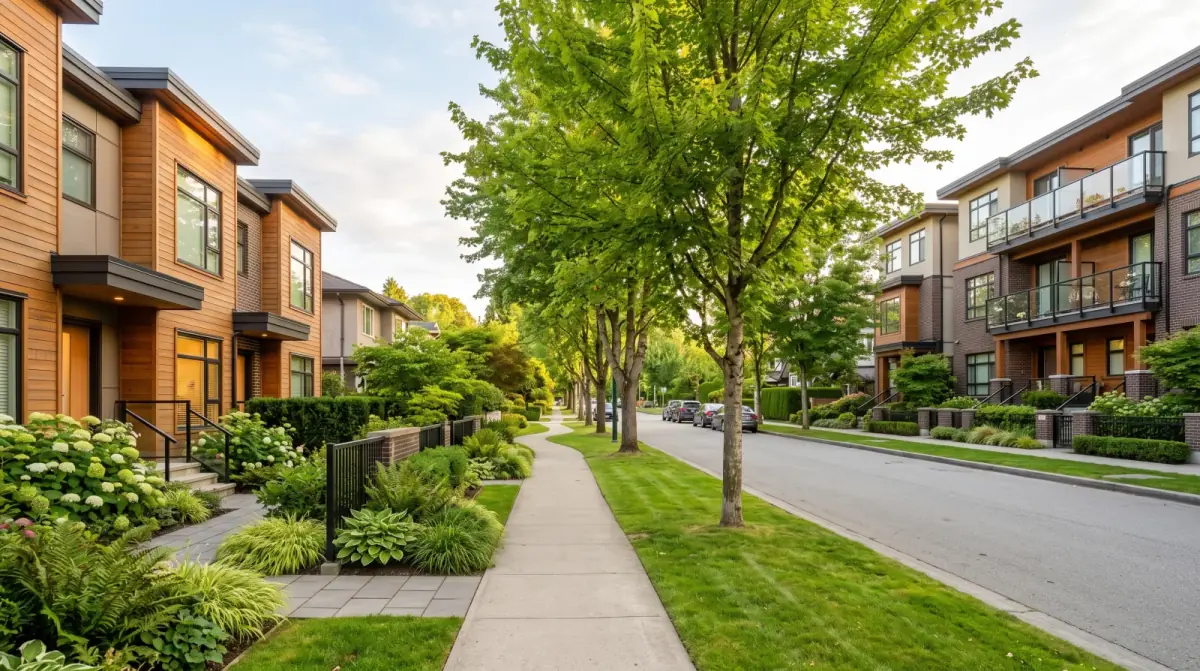
In short, "Missing middle" housing is the range of homes between a single-family house and an apartment tower: duplexes, triplexes, fourplexes, and townhomes. BC's SSMUH rules brought this housing type back to ordinary Metro Vancouver and the Fraser Valley lots after decades of single-family zoning excluded it.
Walk a few blocks of Mount Pleasant and you'll pass duplexes and small three-home walk-ups built a century ago, sitting comfortably between the single houses. Nobody thinks they're out of place. Yet for most of the years since, it was effectively illegal to build another one of them. That contradiction, common on the street, banned on paper, is what people mean by the "missing middle."
The band of housing nobody could build
Missing middle housing is the range that sits between a detached house and an apartment building: duplexes, triplexes, fourplexes, small multiplexes, and townhomes. In Metro Vancouver and the Fraser Valley it almost always means ground-oriented homes, places with their own front door and a connection to the street, on a standard residential lot. Not a tower. Not a single house on a big lot. The homes in between.
The phrase describes a gap. For roughly two generations, Metro Vancouver and the Fraser Valley cities zoned most residential land for one detached house. If a developer wanted anything denser, the path ran through a rezoning, which usually only made financial sense at apartment scale. So the region built houses and it built towers, and the gentle-density homes in the middle quietly disappeared from new construction.
Why it went missing
This wasn't an accident of taste. It was zoning. Through the mid-twentieth century, single-family-only zoning spread across Vancouver, Burnaby, and their neighbours, locking huge areas of the region into one home per lot. A duplex on an RS lot needed special permission; a fourplex was unthinkable without a full rezoning. The rules didn't ban the buildings outright, they made them so hard to approve that almost no one tried.
The effect compounded over decades. As land values climbed, the only thing that penciled on an expensive single-family lot was a large single-family house. The missing middle wasn't unpopular or unworkable. It was, in most of Metro Vancouver and the Fraser Valley, simply not allowed.
And the loss wasn't only in what got built. It was in who could afford to live where. A young family that wanted a ground-floor home with a yard near good schools in Kerrisdale or Dunbar had two realistic choices: a detached house priced out of reach, or a condo a transit ride away. The rung of the ladder in between, a townhome, a unit in a fourplex, had been zoned off the market. That absence is the part that made "missing middle" more than a planning term.
What brought it back
BC's Small-Scale Multi-Unit Housing rules removed the rule that caused the gap. By requiring municipalities to permit three to four homes on a standard lot, six near frequent transit, as a matter of right, the Province made the missing middle legal to build again without a rezoning. Vancouver delivered it through the R1-1 zone; Burnaby through its R1 district; Richmond through updated RSM sub-zones. The names differ, the effect is the same: the band of housing that had been zoned out is back in.
That's the piece worth holding onto. The missing middle isn't a new building type someone invented. It's an old, ordinary one that the region stopped permitting and has now started permitting again.
The same idea, city by city
Once you look past the shared provincial floor, each Metro Vancouver and the Fraser Valley city brought the missing middle back in its own way, and the differences matter to what your lot can actually become. Richmond made one of the broadest moves in the region, rezoning roughly 27,000 single-family and duplex lots into new RSM sub-zones in a single step, so most owners there woke up to multiplex-eligible land without lifting a finger.
New Westminster ran its version through an Infill Housing Program, pre-zoning thousands of low-density lots, some for up to four homes, others for up to six near transit, so eligible owners can head straight to a permit. Coquitlam adopted its rules in 2025 and, for now, tops out at four units on most lots because none of its bus stops yet meet the province's frequent-service test. Three cities, three shapes, one underlying idea: the housing between a house and a tower is legal again.
For a landowner the practical takeaway is that the missing middle doesn't look identical from lot to lot. A Renfrew-Collingwood fourplex, a New Westminster infill row, and a Richmond RSM project all sit in the same band of housing but play by different local form rules on height, coverage, and setbacks.
What it looks like on a real Metro Vancouver and the Fraser Valley lot
On the ground, the missing middle is undramatic, which is the point. Picture a standard Renfrew-Collingwood lot that held one aging house. In its place: a fourplex, or a small row of townhomes, three to four front doors instead of one, at a height and scale the street already recognizes. From the sidewalk it reads as a slightly larger house, not as an apartment block dropped onto the block.
That's why "gentle density" gets used alongside "missing middle." The homes add real housing supply without overwhelming the neighbourhood's ground-oriented feel. A family can own a townhome with its own yard near the same schools and shops where the only other option used to be a detached house they couldn't afford or a condo a transit ride away. In Burnaby's transit-served areas, the same logic puts more homes within walking distance of frequent service, exactly where the Province aimed the bonus unit counts.
The forms vary more than most people picture. A duplex splits one house-shaped building into two homes. A courtyard fourplex arranges four around shared open space. A rear-yard infill keeps a home at the front and adds units behind, off the lane. A townhome row runs three or four attached homes across the lot, each with its own door. Which one fits comes down to the lot's width, its access, and where the servicing can reach, not to a preference picked off a menu.
Why gentle density is easier on a street than people fear
The word most people reach for when they hear "more homes on my block" is traffic, or shadow, or parking. Those worries are real, but the missing middle is built precisely to keep them small. A fourplex holds four households on land that already sat inside a residential neighbourhood, at a building height, usually three storeys, that the surrounding houses already reach. It doesn't tower over its neighbours or cast the shadow of an apartment slab. That's why the cities wrote their SSMUH rules around form, not just unit count.
Look at how Coquitlam and New Westminster framed their own bylaws and you see the intent plainly: the new homes are meant to stay compatible in scale with the single-family and duplex houses already on the street. Ground-oriented, house-shaped, their own front doors. The density is in the number of households, not in the size of the box. A block of Renfrew-Collingwood that swaps a few aging houses for fourplexes over a decade doesn't become a different neighbourhood, it becomes a slightly fuller version of the one that's there.
We've walked plenty of these streets with owners who expected a fight from the block and found the opposite. When the finished building reads as a large house rather than a small apartment, most of the objection evaporates, because the thing people picture, a mid-rise dropped onto a quiet lane, isn't what the missing middle actually delivers.
What it means for the people who live in these homes
There's a demand side to this that gets lost in the zoning talk. The missing middle brings back a kind of home that had almost vanished from the new-build market: a ground-oriented place with its own entrance and often a bit of yard, at a size and price point between a condo and a detached house. For a family that wanted to stay in Kitsilano or near the SkyTrain in Burnaby but couldn't reach a house, a townhome in a small multiplex is the rung of the ladder that had been missing.
That matters to a landowner too, not just to a buyer. Homes people actually want to live in are homes that hold their value and lease or sell without a struggle. The missing middle isn't a compromise product, it's the housing type the region under-built for a generation, which is part of why the demand for it is real rather than theoretical.
Why it matters to a landowner specifically
For a homeowner, the missing middle isn't urban-planning theory. It's a change in what your lot is permitted to become. A property that could legally hold one house can now, in most of Metro Vancouver and the Fraser Valley, hold three, four, or more homes, which changes what the land is worth and what you can do with it short of selling.
It also reframes the choice. The old options were keep the house or sell the lot. Missing-middle zoning adds a third: develop the lot yourself, in partnership, and keep a stake in the finished homes. That's the structure we build around, a GP/LP partnership where a homeowner contributes the land and an investor contributes capital, and the developer runs the project. The zoning made it possible; the partnership makes it doable without you carrying the whole thing alone.
The missing middle isn't a change to your neighbourhood so much as a change to your options, the land you already own can now hold homes it wasn't allowed to hold last year.
The trade-offs nobody puts on the brochure
We'd be doing a landowner a disservice if we made the missing middle sound like free money. Adding three or four homes where there was one is a real development project, with real complexity, and it's worth naming the hard parts. The building has to meet the full BC Building Code, fire separation between units, exiting, structure, which is more demanding than a single house. It has to hit the BC Energy Step Code envelope your city enforces, which drives cost into walls, windows, and mechanical systems. And on a tight lot, those requirements can push back on the very unit count the zoning allows.
There's also the ownership structure to sort out. Selling four strata homes means creating a strata corporation; holding them as rental means becoming a landlord, or partnering with someone who'll manage that. Neither is hard, but neither is automatic, and both change the shape of the project and the money. A duplex on a Dunbar lot and a six-unit building near a Burnaby SkyTrain station are both "missing middle," but they are not the same undertaking, and pretending they are is how people get surprised.
We raise the trade-offs on purpose. The homeowners who do well with a missing-middle project are the ones who went in knowing what it involved, not the ones who were sold a headline. The zoning genuinely reopened the option. Whether it's the right option for your lot is a question worth answering honestly before anyone commits.
Finding out what your middle looks like
Every lot turns the missing middle into a different building. Width, access, slope, servicing, and the unit count your specific zone permits all shape what's actually buildable, and none of it shows on a zoning map. The general idea is regional; the answer is lot by lot.
We start most of these the same way: pull the real lot area, read the actual zone the city assigned it, check what the servicing can carry, and count the homes the site can genuinely hold rather than the number a headline promised. That's the honest floor a project gets built on. A wide Grandview-Woodland lot with lane access invites a different form than a narrow New Westminster infill parcel, and the feasibility work is where that difference stops being abstract.
A Feasibility & Equity Review turns the concept into your numbers: what your lot can hold, which missing-middle form fits it, and how a GP/LP partnership would put your land and an investor's capital to work building it. Run your address through our multiplex calculator first to see the permitted range, then we'll show you what the missing middle looks like on your particular Vancouver or Burnaby lot.
Frequently asked
What counts as "missing middle" housing?
Duplexes, triplexes, fourplexes, small multiplexes, and townhomes, anything that holds more than one or two homes but stays smaller than an apartment building. In Metro Vancouver and the Fraser Valley it usually means ground-oriented homes on a standard residential lot in neighbourhoods like Mount Pleasant or Renfrew-Collingwood.
Why is it called "missing"?
Because decades of single-family zoning made it effectively illegal to build. Cities allowed houses and they allowed towers, but the gentle-density homes in between vanished from new construction. BC's SSMUH rules are bringing that middle range back to ordinary lots.
Is missing middle housing the same as a multiplex?
A multiplex is one type of missing-middle housing. The term "missing middle" covers the whole range, duplex through townhome, while "multiplex" usually means a single building split into three to six homes. All multiplexes are missing middle; not all missing middle is a multiplex.
Which neighbourhoods in Metro Vancouver and the Fraser Valley suit missing middle housing best?
On established single-family streets near shops, schools, and transit, exactly the lots that BC's rules reopened. Areas like Vancouver's Grandview-Woodland and Burnaby's transit-served neighbourhoods suit it well, because the homes add density without changing the street's ground-oriented character.
How many missing-middle homes can I put on a standard Vancouver or Richmond lot?
The provincial floor is three to four homes on a standard lot, and up to six on a larger lot within about 400 m of frequent transit. Vancouver delivers that through the R1-1 zone; Richmond rezoned roughly 27,000 lots into its RSM sub-zones to do the same. The exact number your lot can carry still depends on its size, width, and servicing.
Is missing-middle density a big change for a single-family street in Coquitlam or New Westminster?
Usually less than people expect. Missing-middle homes are ground-oriented and stay at roughly house scale, often three storeys, so a fourplex reads as a slightly larger house, not a tower. Coquitlam and New Westminster both wrote their SSMUH rules to keep the new homes compatible with the form of existing single-family and duplex neighbourhoods.
Does building missing-middle housing mean I have to tear down my existing home?
Not necessarily. Bill 44 permits the added homes but doesn't require you to redevelop, and some infill forms let you keep an existing house while adding units around or behind it. Richmond and Coquitlam both state plainly that no owner is obligated to build, whether a teardown makes sense is a feasibility question specific to your lot.
Why does missing-middle housing matter to a homeowner and not just a developer?
Because it changes what your lot is permitted to become, and therefore what it's worth and what you can do with it short of selling. A property that legally held one house can now, across most of Metro Vancouver and the Fraser Valley, hold three, four, or more homes. That reopens a middle option between keeping the house and selling the land: developing it in partnership and keeping a stake.
Wondering what your lot could become? Book a free consultation to find out how many units you could build on your property, whether it's a feasible project, and how our GP/LP partnership structure works.
Sources
- Government of BC, Small-scale multi-unit housing
- Shape Your City Vancouver, Multiplexes / R1-1
- CMHC, Housing information
- City of Burnaby, SSMUH zoning now in effect
- City of Richmond, Provincial housing legislation changes (RSM zoning)
- City of New Westminster, Small-scale multi-unit housing
- City of Coquitlam, Small-scale multi-unit housing
Written by
Real Estate Developer
Trent Praski leads investment and development at Venture Pacific, sourcing missing-middle opportunities across Metro Vancouver and the Fraser Valley and structuring transparent homeowner and investor partnerships.
Full profile