
Funding a multiplex: equity and construction financing explained
Building several homes where one stood costs more than most owners expect, and the money arrives in stages, not all at once. Here's how equity and construction financing fund a Metro Vancouver and the Fraser Valley multiplex, explained in plain language.
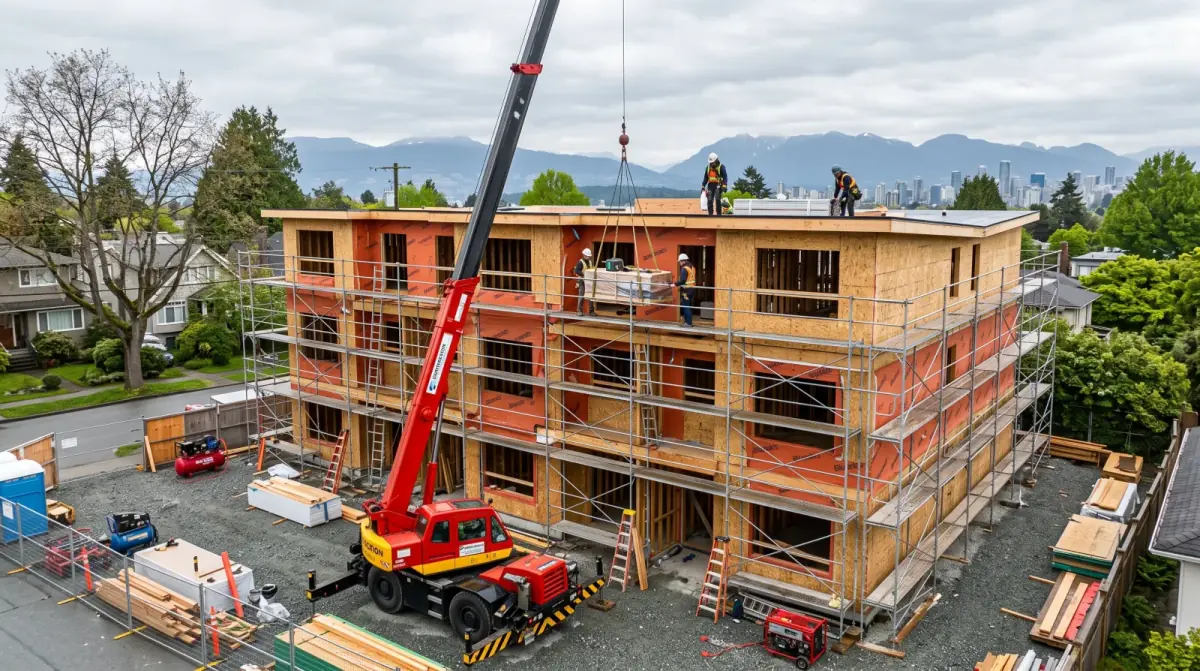
In short, Funding a multiplex combines equity (often including the landowner's lot contributed as equity) with construction financing that is released in stages, or draws, as the build progresses. Understanding the capital stack, pre-construction soft costs, the builders lien holdback, and how a construction loan is serviced helps a Metro Vancouver and the Fraser Valley landowner or investor plan a multiplex realistically without a single fabricated figure.
Ask a homeowner what stops them from building a multiplex, and money comes up fast, but usually in the wrong shape. Most picture a single, terrifying number they'd have to produce before anything happens, as if the entire cost of several homes had to sit in their bank account on day one. That's not how development financing works, and the gap between that fear and the reality is where a lot of good projects stall before they start.
The truth is more manageable. A multiplex is funded by a combination of sources, the money arrives in stages tied to progress, and the lot you already own usually does a great deal of the work. Understanding how the pieces fit lets a Metro Vancouver and the Fraser Valley landowner or investor plan from facts instead of dread.
The two halves: equity and debt
Almost every development is funded by two broad ingredients. The first is equity, the value put into the project up front by the people who own a share of it. The second is debt, usually a construction loan borrowed from a lender and repaid when the project is sold or refinanced. Together, these layers are often called the capital stack.
Lenders don't finance the whole cost; they expect meaningful equity in the project first, because that equity absorbs the early risk and gives everyone confidence the project is real. The balance is then borrowed. The proportion of each varies by project, but the principle is constant: equity goes in first, debt fills the rest, and the equity is what's at work before any loan is drawn.
You'll hear this proportion described in ratios, how much a lender will advance against the cost to build, or against the finished value. We won't attach numbers to those ratios here, because they move with the project, the lender, and the market. What's worth carrying away is the shape: the equity is the cushion the lender wants to see before it commits, and the more of it a project has, the more comfortable the debt side becomes. A landowner who contributes a valuable lot is bringing exactly that cushion.
Where the land fits, equity you may already have
Here's the part that surprises landowners most. In Metro Vancouver and the Fraser Valley, the lot is frequently the single most valuable component of a multiplex project. That means a landowner often already holds a large share of the equity a project needs, in the form of the land itself.
When land is contributed to a project as equity rather than sold for cash, its value becomes part of the capital stack. This is exactly how a landowner can participate in a development without writing a large cash cheque: the lot does the heavy lifting on the equity side. In a general-partner / limited-partner structure, contributing the land as equity is frequently the mechanism that lets the owner stay in the project and share in the result. The land isn't just where the building goes, it's a substantial part of how the building gets funded.
In Metro Vancouver and the Fraser Valley, the lot is often the biggest single piece of the equity. The land you own is already part of the funding.
Soft costs come before hard costs, and before any loan
Development spending splits into two families, and the order they arrive in matters as much as the amounts. Hard costs are the physical building: excavation, foundation, framing, the building envelope, mechanical systems, finishes, the visible construction. Soft costs are everything that surrounds it: architectural and engineering design, energy modelling, surveys, geotechnical work, legal fees, insurance, municipal permit and development charges, and financing costs.
The awkward reality is that a meaningful share of the soft costs has to be spent first, before a shovel touches the ground and usually before a construction loan is even in place. A lender generally won't release construction funds until the project is designed, permitted, and ready to build, which means the work that gets it to that point is funded by equity.
- Survey and feasibility work to confirm what the lot can actually hold.
- Architectural and engineering design to produce permit and construction drawings.
- Energy modelling and the consultants the BC Building Code and Energy Step Code require.
- Permit application costs and municipal development charges.
- Legal work to set up the partnership and the financing.
Planning for this early stage, rather than assuming the loan covers everything from day one, is part of building a realistic financial picture for a Vancouver or Burnaby multiplex. Owners who skip it are often the ones who get surprised, because the first real cheques get written well before the fun part of construction begins.
Construction financing arrives in draws
The borrowed portion, the construction loan, works differently from a mortgage on a finished home. It isn't handed over as one lump sum at the start. Instead it's released in portions, called draws, as the project reaches defined milestones: completing the foundation, finishing the framing, reaching lock-up, and so on.
Each draw is typically confirmed before it's released, often with an inspection or a quantity-surveyor report verifying the work is actually done. This protects the lender by tying the money to real, visible progress, and it keeps the financing in step with the build rather than ahead of it. For the project, it means cash flow has to be managed carefully across the construction timeline, because expenses and draws don't always line up to the day. Trades expect to be paid on their schedule; the draw arrives on the lender's. Bridging that gap is part of running a build well.
The draw schedule and the builders lien holdback
Two mechanics sit underneath the draws and quietly shape a project's cash flow, and both deserve a plain explanation because they catch first-time developers off guard. The first is the draw schedule, the agreed map of which milestones release which portions of the loan. It's negotiated up front with the lender and it turns the abstract idea of "money released in stages" into a concrete sequence everyone can plan around.
The second is the builders lien holdback. Under the BC Builders Lien Act, the party paying on a construction contract must hold back a portion of each payment and release it only after a set period once the work is complete. The Act sets that holdback at ten percent, and it exists to protect the trades and suppliers who did the work in case they aren't paid. For financing, the point is that a slice of every payment isn't paid out immediately, it's retained and released later, so the project's cash flow and its draw schedule have to account for it rather than treating that money as already spent.
None of this is exotic, but it's the kind of detail that separates a plan that survives contact with a real Metro Vancouver and the Fraser Valley build from one that unravels in month three. The holdback isn't a fee or a loss, it's money that flows on a delay, and a competent draw schedule is built with that delay in mind from the start.
Servicing the loan: paying for time
A construction loan carries a cost for as long as it's outstanding. From the first draw to the day the finished homes sell or refinance, the project is paying to borrow, and that cost grows with the calendar. This is why a project's schedule and its financing are really the same conversation: every extra month of permitting or construction is another month of carrying the loan.
It's also why timeline discipline is a financial decision, not just a scheduling one. Permitting timelines genuinely vary across Metro Vancouver and the Fraser Valley, a project in Vancouver, one in Coquitlam, and one in Richmond can move at different speeds through their respective processes. A plan that assumes everything goes fast is understating its own carrying cost. We'd rather build a schedule that respects the real pace of the municipality and finance against that than pretend approvals happen overnight.
How a partnership changes the financing picture
For a landowner who doesn't want to arrange financing, manage draws, and carry the lender relationship alone, a development partnership changes the picture considerably. In a general-partner / limited-partner arrangement, the developer takes on the active responsibility for assembling the capital stack and managing the construction financing, while the landowner contributes the lot as equity.
This means the landowner isn't personally sourcing a construction loan or tracking every draw, the developer, as general partner, runs that machinery, including the draw schedule and the holdback administration. Risk and proceeds are shared according to the partnership agreement set at the start. For many owners, not having to become a borrower and construction-finance manager is as valuable as the financial outcome itself.
Building a realistic picture before you commit
Financing isn't the obstacle most people fear; it's a structure that, once understood, makes a multiplex genuinely achievable for a landowner who couldn't fund several homes in cash. The keys are knowing that equity and debt work together, that your land is likely a major part of the equity, that soft costs land before any loan does, that the loan arrives in draws against milestones, and that the holdback and carrying cost shape the cash flow throughout.
If you're weighing a multiplex in Metro Vancouver and the Fraser Valley, the right starting point is a clear-eyed look at the numbers for your specific lot. Our Feasibility & Equity Review establishes what your land contributes to a project and how the financing could be structured, so you can see, before committing to anything, exactly how a build on your property would be funded and what your role in it would be. That's the difference between a plan built on facts and one built on the fear of a number that never actually had to appear all at once.
Frequently asked
How is building a multiplex paid for?
Most projects combine two sources: equity, which is the money or value put in up front, and construction financing, which is borrowed and released in stages as the build progresses. The land itself can count as equity if it's contributed to the project rather than sold. The mix of the two is what's often called the capital stack.
What is a construction draw?
A construction loan usually isn't handed over in one lump. It's released in portions, draws, as the project hits defined milestones, like completing the foundation or framing. Each draw is typically confirmed before it's released, which protects the lender and keeps the financing tied to real progress on the Metro Vancouver and the Fraser Valley site.
Does my land count toward the equity I need?
Often, yes. In Vancouver and across Metro Vancouver and the Fraser Valley, the lot is usually the most valuable asset in a multiplex project, and its value can serve as a significant part of the equity. In a partnership structure, contributing the land as equity is frequently how a landowner participates without writing a large cash cheque.
What is the difference between soft costs and hard costs?
Hard costs are the physical building, excavation, foundation, framing, envelope, mechanical, and finishes. Soft costs are everything around it: design, engineering, permits, legal, insurance, and financing fees. On a Vancouver or Burnaby multiplex, a chunk of the soft costs has to be spent before a construction loan is even in place, which is why equity carries the early stage.
Why does a construction loan get released in stages instead of all at once?
Because the lender is financing work that doesn't exist yet, so it releases money only as the work gets built and verified. Each draw is usually tied to a milestone, foundation, framing, lock-up, and confirmed by an inspection or report before it's advanced. This keeps the loan in step with real progress on the site and protects everyone from paying for work that hasn't happened.
What is the builders lien holdback and does it affect financing?
Under the BC Builders Lien Act, a percentage of each payment on a construction contract is held back and released only after a set period once the work is complete. It exists to protect trades and suppliers who haven't been paid. It matters for financing because that held-back money has to be accounted for in the project's cash flow and draw schedule, not treated as if it's already spent.
Do I need to have all the money before starting a Metro Vancouver and the Fraser Valley multiplex?
No, and that assumption stops good projects before they begin. You need the equity, which your land often supplies most of, plus a lender willing to finance the balance and release it in draws as the build progresses. The full cost of several homes never has to sit in one account on day one; the structure is designed to fund the project over time.
How does a GP/LP partnership change who arranges the financing?
In a general-partner / limited-partner structure, the developer as general partner assembles the capital stack, sources the construction loan, and manages the draws, while the landowner or investor contributes equity, often the lot itself. For many Vancouver landowners, not having to personally become a borrower and construction-finance manager is as valuable as the financial result.
Written by
Real Estate Developer
Trent Praski leads investment and development at Venture Pacific, sourcing missing-middle opportunities across Metro Vancouver and the Fraser Valley and structuring transparent homeowner and investor partnerships.
Full profile