
Frequent transit areas: how transit unlocks more homes on your lot
Being within 400 metres of a prescribed bus stop can raise the homes your lot is allowed to hold from four to six under BC's housing rules. Here is what "frequent transit" precisely means, where the transit-oriented tier goes even further, and how to tell if your lot qualifies.
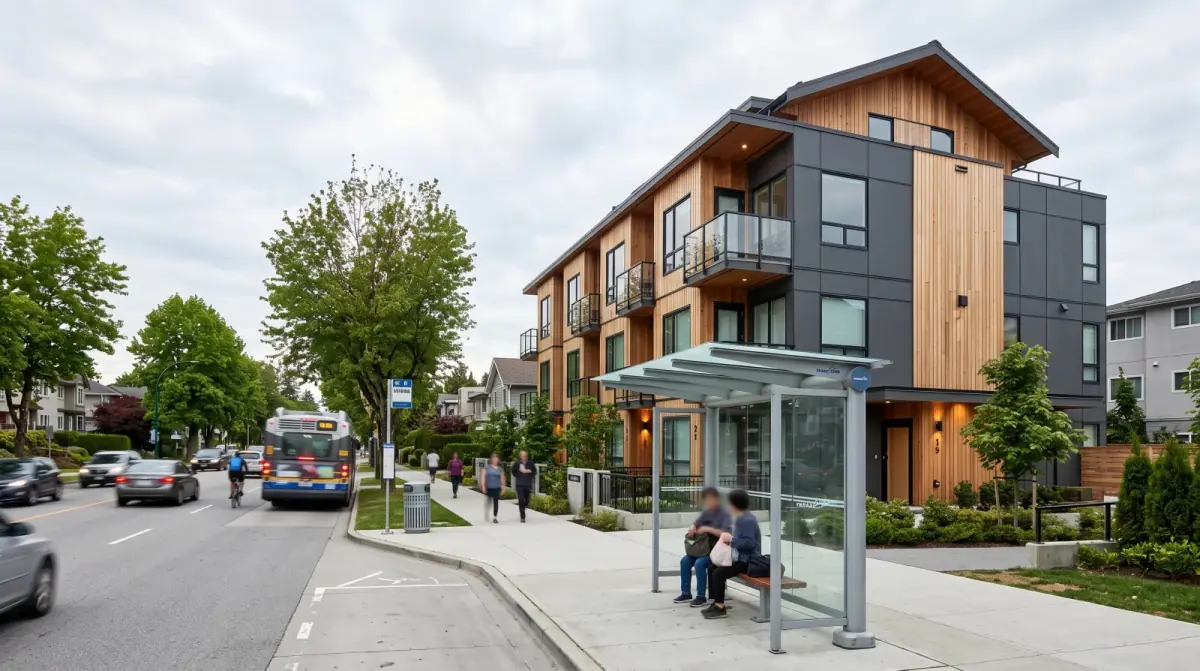
In short, Under BC's Small-Scale Multi-Unit Housing rules, a lot larger than 281 square metres within 400 metres of a prescribed bus stop must be allowed at least six homes instead of four. The province defines a prescribed bus stop as one served at least every 15 minutes on average between 7 a.m. and 7 p.m. weekdays and 10 a.m. to 6 p.m. weekends, and near frequent transit a city cannot require off-street parking for the units needed to reach six. A separate transit-oriented area tier around SkyTrain stations and bus exchanges allows still higher density.
There is a measurement we take on almost every lot before we draw anything, and it has nothing to do with the lot's dimensions. It is the straight-line distance to the nearest prescribed bus stop. On the right property, that one number is the difference between being allowed four homes and being allowed six, and almost no homeowner knows which side of the line they are on.
British Columbia's housing rules tie unit count partly to transit, and they do it with a specific, measurable test rather than a vague sense of being "close to the bus." Understanding that test is one of the most financially useful things a lot owner in Vancouver, Burnaby or anywhere in Metro Vancouver and the Fraser Valley can do, because the upside is real and the edge is sharp.
What the rule actually says
The province set tiered minimums for small-scale housing. A lot of 280 square metres or smaller must allow at least three homes. A larger lot must allow at least four. And a larger lot within 400 metres of a prescribed bus stop must allow at least six. That last tier is the transit bonus, and it is where proximity to a station or major bus line pays off directly.
Going from four homes to six is not a rounding adjustment. It is a 50 percent increase in the number of households a single lot can support, achieved without changing the lot at all, only by recognizing where it sits. In a city like Vancouver, where each home carries real value, that jump can reshape whether a project pencils out.
"Frequent transit" is a precise definition, not a feeling
The phrase that does the heavy lifting is "frequent transit," and the province spells it out. A prescribed bus stop is one served by at least one bus route scheduled to stop at least every 15 minutes, on average, between 7 a.m. And 7 p.m. Monday to Friday and 10 a.m. To 6 p.m. On Saturdays and Sundays. That standard maps closely onto TransLink's Frequent Transit Network, SkyTrain lines, bus exchanges, the major B-Line routes and the busiest trunk corridors all clear it.
What does not qualify is an ordinary local bus that comes every half hour or only at rush hour. A stop right outside your door does not help if the route it serves does not meet the 15-minute test all day. This catches people out: the bus they can see from the porch may not be the bus the rule cares about. The service standard, not the nearest stop, is what counts.
Four hundred metres is a hard line
The provincial policy manual sets the prescribed distance from a bus stop at 400 metres, roughly a five-minute walk. It is an edge, not a gradient. You are either inside the band or you are not. There is no partial credit for being 450 metres away.
That sharpness produces a situation we see constantly: two neighbouring lots, identical in size, with different permitted unit counts because one falls inside the band and the other falls just outside. On one Vancouver block we measured exactly this, a few dozen metres separating a six-home lot from a four-home lot. From the sidewalk the two properties look the same. On paper they are not, and no amount of intuition reveals which is which.
One thing to hold in mind: the six-unit tier only applies to lots larger than 281 square metres. A small lot inside the transit band still tops out at the standard minimums. So the transit test is really two tests, distance and lot size, and both have to land.
How we measure it
Because the line is sharp and the stakes are high, we measure the distance precisely rather than estimating. That means identifying which nearby routes actually meet the 15-minute service standard, finding the relevant stops, and measuring the real distance from your lot to those stops, not a rough guess off a map.
- Confirm which nearby routes meet the province's 15-minute service standard, not every bus qualifies.
- Locate the relevant prescribed stops on those qualifying routes.
- Measure the actual distance from your lot to the nearest qualifying stop.
- Compare against the 400-metre threshold, and confirm the lot is over 281 square metres, to lock in the six-unit tier.
It is a small piece of work with an outsized payoff. Getting it wrong in either direction is costly: assume you qualify when you do not and your whole plan is built on a unit count the city will not grant; assume you do not qualify when you do and you leave two homes' worth of value on the table.
Why the sixth home changes the whole pro forma
The extra two homes near transit do more than add doors. They change how the fixed costs of a project are shared. A lot has to be acquired, serviced, excavated and connected whether it holds four homes or six, and a lot of the design and approvals work is close to the same either way. Spreading those fixed costs across six homes rather than four is what makes the transit tier so valuable, it is not just more revenue, it is a better ratio of shared cost per home.
That said, the sixth home is rarely free. Fitting six units onto a standard Vancouver or Burnaby lot instead of four usually means a tighter layout, more structure, and in some cities a condition attached to one of the units. We do not put dollar figures on any of this from the sidewalk, the real numbers come out of a feasibility model that reads the specific lot, its servicing, its slope and its zoning together. But the direction is clear: the transit tier tends to improve the economics, not just the headcount, which is exactly why the 400-metre measurement is worth getting right on day one.
Near transit, the city can't force parking on you
The higher unit minimum is the headline, but the transit rules carry a second advantage that matters just as much on a tight lot. The province bars a city from requiring off-street parking or loading spaces for the homes needed to reach the six-unit minimum near frequent transit. This is not a soft encouragement, it is a hard limit on what the city can demand.
Less required parking means more of the lot can go to the homes and their outdoor space instead of to driveways and stalls. On a standard Vancouver or Burnaby lot, that flexibility can be the difference between a cramped six-plex and a livable one. You can still choose to build parking where the market wants it, but the choice is yours, not the zoning bylaw's.
Transit-oriented areas: a stronger tier again
There is a level above the six-unit rule, and owners near rapid transit should know it exists. The province also designates transit-oriented areas, mapped zones around SkyTrain stations, bus exchanges and rail stations where cities must permit higher density than the small-scale six-unit minimum. If your lot sits inside one of these, the transit-oriented rules take over and the small-scale multiplex numbers are no longer the ceiling.
This matters most near the Expo, Millennium and Canada lines, and near the busiest exchanges in Burnaby, Coquitlam and Richmond. A lot 350 metres from a SkyTrain station might qualify for six homes under the frequent-transit rule and considerably more under a transit-oriented designation. The two regimes are separate, and confusing them leads to plans built on the wrong number. We check both for every lot, the 400-metre small-scale band and any transit-oriented designation, before we call a unit count final.
Near transit, three things move at once: the unit minimum, the parking the city can demand, and whether a transit-oriented tier applies. Miss one and the plan is built on the wrong number., Venture Pacific
A few lots are carved out no matter how close the bus is
Proximity to transit does not override every other rule. The province exempts certain parcels from the small-scale requirements regardless of location, lots not connected to both a water and a sewer system, parcels larger than 4,050 square metres, heritage-protected land, and land in the Agricultural Land Reserve. A lot can be 200 metres from a SkyTrain station and still fall into one of these categories.
We flag this because a homeowner who reads only the transit rule can talk themselves into a unit count the site will never support. The transit test is powerful, but it is one gate among several. Confirming the lot is even eligible comes first.
Find out if your lot qualifies
If your lot is anywhere near a SkyTrain station or a major bus corridor, the transit question is worth answering before you make any other decision about the property. The fastest way is a Feasibility & Equity Review: we measure your lot against the prescribed-stop standard, confirm which unit tier applies, check for any transit-oriented designation, factor in the parking flexibility, and translate all of it into a realistic number of homes and the equity already in your land. You can also run our multiplex calculator for a quick first read, or see how the rules land on the ground on our Vancouver, Burnaby and Richmond area pages. When a lot falls inside that 400-metre band, the difference is too large to leave to guesswork, measure it, and build the plan on the real number.
Frequently asked
What counts as a "prescribed bus stop" under the housing rules?
The province defines it precisely: a stop served by at least one bus route scheduled to stop at least every 15 minutes on average, between 7 a.m. and 7 p.m. Monday to Friday and 10 a.m. to 6 p.m. on weekends. SkyTrain stations, bus exchanges and major B-Line corridors clear that bar. An occasional local bus that comes every half hour does not, even if the stop is right outside your lot.
How close to transit does my lot need to be?
The provincial manual sets the prescribed distance from a bus stop at 400 metres, about a five-minute walk. A lot inside that band, if it is larger than 281 square metres, must be allowed at least six homes instead of the standard four. That is a meaningful jump in a city like Vancouver or Burnaby where each home carries real value.
Can two neighbours in Vancouver have different unit limits?
Yes, and it happens often. The 400-metre distance is a hard edge, not a gradient. One lot can fall inside the band and qualify for six homes while the next-door lot falls just outside and is held to four. We measure the exact distance for each parcel rather than guessing from the nearest station.
Do I still have to build parking if my lot is near frequent transit?
Not for the homes that get you to the six-unit minimum. The province bars a city from requiring off-street parking or loading for the units needed to reach six near frequent transit. You can still choose to build parking, but the city cannot force it on those units, which frees up lot area for the homes themselves.
Is a transit-oriented area the same as being near frequent transit?
No, it is a separate, stronger tier. A transit-oriented area is a mapped zone around a SkyTrain station, bus exchange or rail station where provincial rules require higher density than the six-unit small-scale minimum. If your lot sits in one of those areas, the transit-oriented rules take over and the numbers get larger. We check both the 400-metre band and any transit-oriented designation for every lot.
Does the six-unit tier apply to every lot near a SkyTrain station in Burnaby?
Only lots larger than 281 square metres qualify for the six-unit tier, and the lot has to be within 400 metres of a qualifying stop. Some lots close to Burnaby's SkyTrain stations sit inside a transit-oriented area instead, which carries its own higher-density rules. We sort out which regime a specific lot falls under before drawing anything.
Are lots near transit ever exempt from SSMUH housing rules?
A few lots are carved out regardless of transit, parcels not connected to both water and sewer, lots over 4,050 square metres, heritage-protected land and land in the Agricultural Land Reserve are treated differently under the provincial rules. Transit proximity does not override those exemptions. That is one more reason we confirm a lot's status before promising a unit count.
Wondering what your lot could become? Book a free consultation to find out how many units you could build on your property, whether it's a feasible project, and how our GP/LP partnership structure works.
Written by

Real Estate Developer
Trent Praski leads investment and development at Venture Pacific, sourcing missing-middle opportunities across Metro Vancouver and the Fraser Valley and structuring transparent homeowner and investor partnerships.
Full profile