
Build to Rent vs Sell: The Multiplex Tenure Decision That Changes Your Return
You can build the same 6-unit multiplex and either sell every unit as strata or hold all of them as rental. The building is identical. The economics over the next 25 years are not.
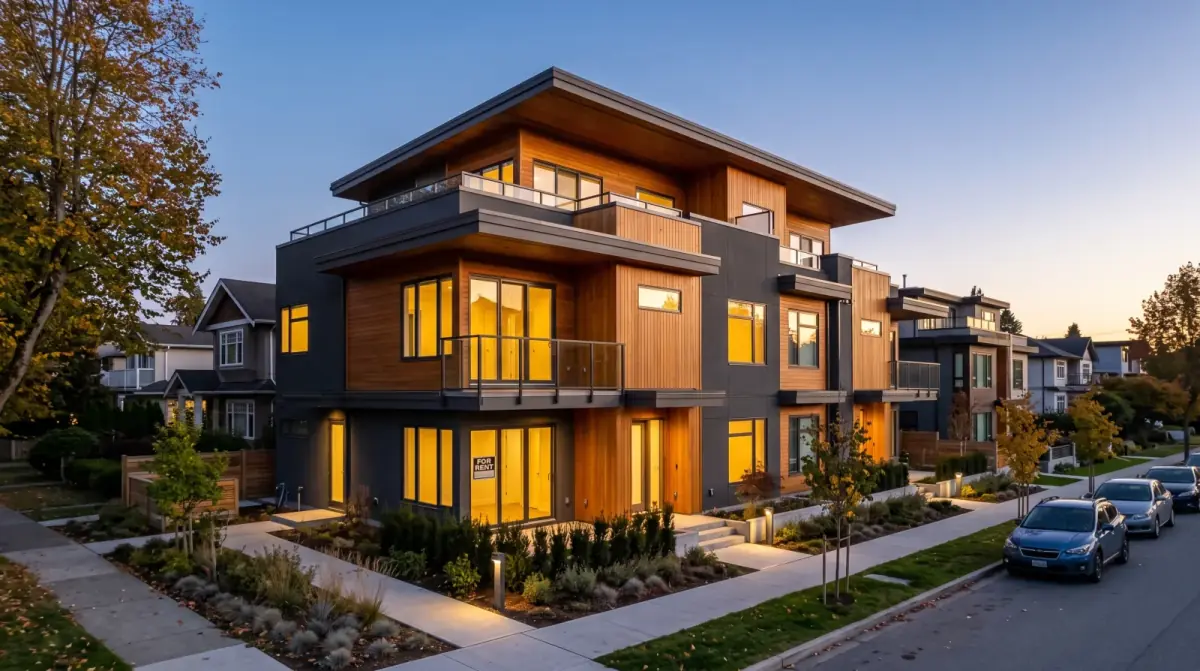
In short, This post explains how choosing between build-to-rent and strata sale changes the financial outcome of a Metro Vancouver and the Fraser Valley multiplex, covering the BTR density bonus, CMHC MLI Select eligibility, and the tax differences between the two paths. It is aimed at homeowners and investors deciding on tenure before committing to a development structure.
When a homeowner decides to develop a Metro Vancouver and the Fraser Valley lot into a multiplex, the first question is usually about the building: how many units, what size, which city permits it. That's the wrong place to start. The more consequential decision comes before the building is designed, are you building to sell or building to hold?
You can build the same 6-unit multiplex and either sell all units as strata or hold every one of them as secured rental. The building is identical: same floor plates, same construction cost, same permitting timeline. The economics over the next 25 years are not.
The strata exit: clean, taxable, complete
In a strata sale, you build and then sell each unit on the open market. The upside is clarity: you collect your profit, typically as a capital gain or business income depending on your corporate structure and intent, and the project closes. You no longer carry any risk on the asset, no vacancy, no maintenance reserves, no financing exposure after the sale.
The downside is that you've converted a land asset into cash at a single point in time. Metro Vancouver and the Fraser Valley real estate has historically continued to appreciate after a sale. The buyer of your strata unit captures that upside going forward; you don't.
Strata also carries Vancouver's density bonus contribution, up to $82,000 per unit as of 2026 for market strata projects. On a 6-unit project, that's up to $492,000 in city fees on top of the Metro Vancouver and the Fraser Valley DCC and the Development Cost Levy. It's a cost that shows up in every strata pro forma and directly reduces what's left after the project closes.
The build-to-rent path: slow start, compounding finish
In a build-to-rent model, you hold the entire building as rental property after construction. Year one cash flow is usually thin. A 6-unit multiplex in Metro Vancouver and the Fraser Valley might generate $15,000 to $18,000 per month in gross rental income at 2026 market rents, but a construction-to-permanent mortgage on a $5 million total project cost runs several thousand dollars per month before maintenance, insurance, and management.
The math changes over time. Rents in Metro Vancouver and the Fraser Valley have risen consistently over the past two decades. The mortgage balance declines with every payment. By year 10, the cash-on-cash return is materially better than year one. By year 25, if you've held through, you own a free-and-clear income-producing asset in one of Canada's tightest rental markets. That is a different kind of wealth than a single capital event.
Vancouver's BTR density bonus: two extra units and no contribution fee
Here is the detail most homeowners don't know going in. Under Vancouver's R1-1 zoning, a strata multiplex is permitted up to 6 units on a standard lot. A secured rental multiplex on the same lot, if the lot meets the size thresholds of at least 557 square metres in area and 15.1 metres of frontage, can be permitted up to 8 units.
That's two additional units, which on a 6-unit baseline is a 33 percent increase in rental income potential. On top of that, secured rental projects are fully exempt from Vancouver's density bonus contribution. The contribution that runs up to $82,000 per unit on strata projects does not apply when you commit the building to long-term rental tenure.
Two extra units plus no density bonus contribution is not a marginal difference. On a project where the strata path would carry $492,000 in density bonus fees for 6 units, the BTR path on a qualifying lot avoids that cost entirely and generates income on 8 units instead. The economics of a project that looks breakeven on strata can shift considerably when modelled as a secured rental build.
CMHC MLI Select: the BTR financing product, and its hard floor
The Canada Mortgage and Housing Corporation's MLI Select program is the benchmark financing product for purpose-built rental in Canada. For projects that qualify, it offers mortgage insurance premiums reduced by 30 percent compared to standard rates (as of July 2025), and amortization terms up to 50 years. A longer amortization lowers the annual debt payment, which directly improves early-year cash flow, the period when BTR is hardest to carry.
The critical constraint: MLI Select requires a minimum of 5 units. A 4-plex is ineligible, full stop. This is not a guideline or a preference, it is a hard program floor. If you're designing a multiplex with the intent to hold it as rental and access MLI Select financing, your project needs at least 5 units, which means your lot and zone need to support that density.
A homeowner on a lot that only supports 4 units can still hold as rental, but won't have access to the most favorable financing available. A homeowner whose lot supports 6, 7, or 8 units in a secured rental configuration is in a meaningfully better financing position from the start.
Tax considerations: different structures, different outcomes
The strata exit and the rental hold are taxed differently, and those differences compound over the life of the project. A strata sale creates a taxable event at the point of sale, whether classified as a capital gain or business income depends on your holding structure, intent, and the nature of the development activity. Your accountant and tax lawyer need to weigh in before you choose a structure, not after.
Rental income is taxed as income in the year it's earned, but it can be offset by legitimate deductions: mortgage interest, property taxes, insurance, management fees, repairs and maintenance, and capital cost allowance (depreciation). Over time, the effective tax rate on rental income can be meaningfully lower than headline rates suggest, particularly when the mortgage interest deduction is high in the early years of a loan.
This is not tax advice, and no article substitutes for a qualified accountant who knows real estate development in BC. But the structures are different in ways that matter, and the right choice depends on your personal tax situation, your corporate structure if you're developing inside a company, and your long-term financial goals.
Who chooses build-to-rent and why
Not every landowner is positioned for BTR. The investors who benefit most from it tend to share a few characteristics: they can absorb thin early-year cash flow without financial strain, they're not dependent on the project's proceeds for near-term needs, and they have a lot that qualifies for the 8-unit secured rental density under Vancouver's R1-1 rules.
Homeowners who want to remain connected to the land they grew up on, or land that has been in the family, also gravitate toward BTR. A strata sale permanently severs that connection. Holding as rental means the asset stays under your name or your family company's name, and the relationship with the property continues.
Strata is the right answer when immediate capital is the priority, when the lot doesn't qualify for the secured rental density bonus, or when the investor's tax situation makes a capital gain more attractive than rental income. Neither path is universally superior. The decision depends on your lot, your finances, and your timeline.
Model both paths before you commit
The decision between strata and build-to-rent should be made before the building design is finalized, not after. Unit size, unit mix, parking layout, and lobby configuration all shift depending on whether you're selling to owner-occupants or renting to tenants. A strata buyer wants something different from a rental tenant, and a building optimized for one is not always optimal for the other.
In a feasibility review, we model both paths for your specific lot: the strata case with its density bonus fee and 6-unit cap, and the BTR case with its exemption and potential 8-unit density if the lot qualifies. The two pro formas side by side make the decision concrete rather than abstract. If you want to know which path makes more sense for your property in Vancouver, Burnaby, Richmond, or the surrounding municipalities, a free feasibility review is the right place to start.
Frequently asked
Can a secured rental multiplex in Vancouver get more units than a strata project?
Yes. Under Vancouver's R1-1 zoning, a strata multiplex is permitted up to 6 units on a standard lot. A secured rental multiplex on the same lot, if the lot meets the size thresholds of at least 557 square metres in area and 15.1 metres of frontage, can be permitted up to 8 units. That is a 33 percent increase in rental income potential on the same land.
What is the density bonus contribution and do build-to-rent projects pay it?
The density bonus contribution is a city fee applied to strata multiplex projects in Vancouver, running up to $82,000 per unit as of 2026 on market strata projects. Secured rental projects are fully exempt. On a 6-unit strata project, that exemption removes up to $492,000 in city fees from the build-to-rent path.
What is CMHC MLI Select and does it work for small multiplexes?
CMHC MLI Select is a mortgage insurance program for purpose-built rental housing, offering amortization terms up to 50 years and insurance premiums reduced by 30 percent compared to standard rates as of July 2025. It has a hard minimum of 5 units, a 4-plex is ineligible. If you are designing a multiplex for the build-to-rent path and want MLI Select financing, your project must support at least 5 units.
How is rental income from a multiplex taxed compared to a strata sale?
A strata sale creates a taxable event at the point of sale, classified as capital gain or business income depending on your structure and intent. Rental income is taxed as income in the year earned, but can be offset by mortgage interest, property taxes, insurance, management fees, and capital cost allowance. The effective tax rate on rental income varies significantly based on your personal and corporate situation. A qualified accountant familiar with BC real estate development is essential before choosing a path.
Who benefits most from the build-to-rent model?
Investors who can absorb thin early-year cash flow, are not dependent on immediate project proceeds, and own a lot that qualifies for the 8-unit secured rental density under Vancouver's R1-1 rules. Homeowners who want to keep a long-term connection to land, including family-owned properties, also benefit, because a strata sale permanently severs ownership while a rental hold keeps the asset in the family.
Looking for your next multiplex opportunity? We'll help you find the right lot in the right area and build the feasibility study needed to secure a strong return. Book a free consultation to talk it through.
Written by

Real Estate Developer
Trent Praski leads investment and development at Venture Pacific, sourcing missing-middle opportunities across Metro Vancouver and the Fraser Valley and structuring transparent homeowner and investor partnerships.
Full profile