
Metro Vancouver · District of North Vancouver
Multiplex development in the District of North Vancouver
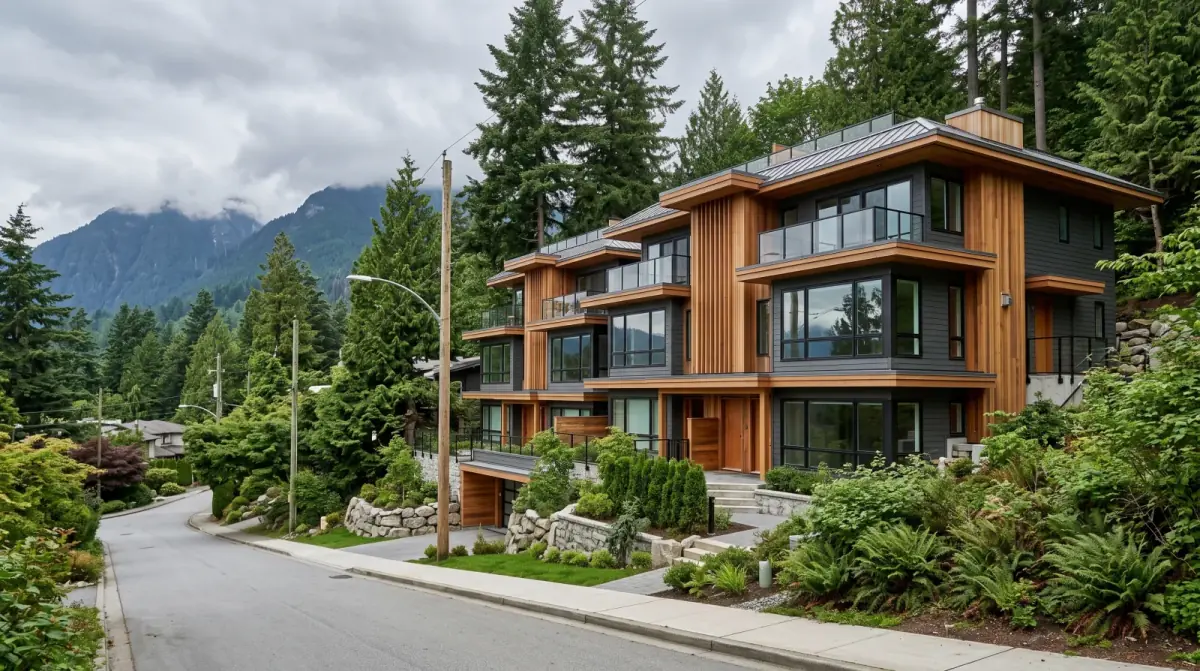
The District of North Vancouver is the larger, hillier municipality that wraps around the City, Lynn Valley, Edgemont, and the residential slopes running up toward the mountains. It adopted its ground-oriented housing and small-scale multi-unit housing rules in December 2025, permitting up to four homes on more than four thousand properties, and under the provincial Bill 25 it must extend that to up to six units near frequent transit by June 30, 2026. What makes the District distinct is its terrain: a large share of its lots sit within creek, slope, or wildfire-hazard areas that change what can be built. Venture Pacific partners with District homeowners to sort the promising lots from the constrained ones and deliver the project from feasibility to keys. (For the separate City of North Vancouver, see that page.)
- Units
- Up to 4 now; 6 near transit by mid-2026
- Bill 25 deadline
- June 30, 2026
- Terrain
- Hazard permit areas common
- Adopted
- December 2025 (Bill 44)
In short, The District of North Vancouver, the larger, hillier North Shore municipality around Lynn Valley and Edgemont, adopted its ground-oriented housing and SSMUH rules in December 2025, permitting up to four units on 4,000+ properties, with a Bill 25 update to six units near frequent transit required by June 30, 2026. Roughly 8,500 District lots sit in creek, slope, or wildfire-hazard development permit areas that require extra technical studies. A 2026 District study found strata multiplexes more viable than rental at current construction costs. Venture Pacific partners with District homeowners through a GP/LP structure. The City of North Vancouver is a separate municipality with its own page.
What changed in the District
In December 2025, the District of North Vancouver adopted its ground-oriented housing and small-scale multi-unit housing regulations under Bill 44, permitting up to four units on more than four thousand properties across the District, three on lots of 280 m² or smaller and four on larger lots. The District is a separate municipality from the City of North Vancouver, with its own bylaws and its own review process.
Bill 25, enacted by the Province in November 2025, goes further: it requires the District to allow up to six units on lots within 400 metres of frequent transit. The District must adopt a compliant zoning bylaw by June 30, 2026 and is updating its Official Community Plan and zoning to meet that deadline. In practical terms, four units are permitted today on qualifying lots, and the six-unit allowance is coming for well-located sites, a real reason to get a feasibility review done now rather than wait.
Terrain and hazard areas, the first thing we check
The North Shore slopes sharply from the water toward the mountains, and the District sits across that grade. That geography creates real constraints that don't exist in Burnaby or Surrey, rocky terrain, steep slopes, creeks, and wildfire exposure. A large share of the District's single-family lots, roughly 8,500 by the District's own analysis, sit within creek, slope, or wildfire-hazard development permit areas, which are treated differently under the small-scale housing rules and require additional technical studies before anything proceeds.
Not every lot is affected, and hazard status is not an automatic no. But it is the first thing an honest feasibility review confirms, because it changes both the design and the cost. Hillside sites need engineered foundations, drainage management, and sometimes retaining structures, real scope that belongs in the pro forma from the start, not discovered later. Lots closer to the town centres and on gentler grades tend to have simpler site conditions than those higher up the slope.
- Confirm whether the lot sits in a creek, slope, or wildfire-hazard development permit area
- Geotechnical and topography review before any design work
- Multiplex or townhome design adapted to slope and site conditions
- Full management of District permits and construction, with the construction risk on us
The economics on a District lot
In early 2026, the District commissioned a study on the economics of multiplex housing. The consultant, Urban Systems, found that rental multiplexes face difficult economics at current North Shore construction costs, and that strata configurations, where homes are sold individually, tend to be more viable than build-to-rent.
That is a market-level finding, not a verdict on every lot. Sites with long-held land, good geometry, and transit access can still work. The GP/LP model matters here: when a homeowner contributes a lot they have owned for years, the land cost in the pro forma looks very different from a developer buying at today's prices, often the difference between a project that pencils and one that does not.
Where projects fit, Lynn Valley and Edgemont
The District is large and varied, but two established nodes carry most of the near-term opportunity. Lynn Valley is a genuine walkable town centre, a village, library, shops, and frequent bus service surrounded by long-held single-family streets, which makes it the part of the District most likely to see the six-unit allowance apply widely once the Bill 25 update lands.
Edgemont is a smaller, higher-value village node on the lower slopes below Grouse Mountain, with larger lots that suit a four-unit multiplex but lighter transit, so fewer of its lots will reach six units. Each has its own page with the local detail. Across the District, the strongest candidates share the same traits: a gentler grade, services at hand, transit within walking distance, and a lot clear of the creek, slope, and wildfire-hazard areas that constrain so much of the North Shore.
What this means for a District homeowner
If you own a District lot, the most useful first step is to find out which category it falls into. A clean, serviced, gently-sloped lot near a town centre is a very different prospect from a steep lot inside a wildfire-hazard area, and only a proper review tells them apart.
Venture Pacific partners with District homeowners through a written GP/LP partnership: you contribute the land, and we carry the design, the hazard and geotechnical studies, the permit applications, the construction financing, and the construction risk. You are not taking on a construction project or a construction loan, you are a limited partner contributing land into a structured development, and if you have held the lot for years, that land equity is what makes the numbers work.
- Free feasibility review, hazard-area check, unit count, and a preliminary pro forma
- Geotechnical and slope review built in before design
- Multiplex design tuned to the District's ground-oriented standards and the site's grade
- Permit management through the District of North Vancouver
- Construction and quality control end to end, with the construction risk on us
Questions about District of North Vancouver
How many homes can I build on my District of North Vancouver lot?
The District currently permits up to four units on qualifying lots, three on lots of 280 m² or smaller and four on larger lots. Under Bill 25 the District must allow up to six near frequent transit by June 30, 2026, which will most affect town-centre areas like Lynn Valley. Hazard-area status and lot size both affect the answer, so a feasibility review confirms it for your specific property.
Is the District of North Vancouver different from the City?
Yes, they are two separate municipalities with separate bylaws. The District is the larger, hillier area (Lynn Valley, Edgemont, and the slopes toward the mountains); the City is the denser urban core around Lonsdale. This page covers the District. Both adopted small-scale housing rules in December 2025, but the details differ, so it matters which one your lot is in.
Do hillside lots qualify for a multiplex in the District?
Many do, but not all. A significant number of District lots sit within creek, slope, or wildfire-hazard development permit areas that are treated differently under the small-scale housing rules and require additional technical studies. Even outside those areas, steep grades add cost and complexity. We assess topography, geotechnical conditions, and hazard-area status before recommending any development path.
Is a multiplex in the District economically viable?
It depends on the lot and the configuration. A 2026 District-commissioned study found rental multiplexes face challenging economics at current construction costs, while strata, homes sold individually, tends to be more viable. The GP/LP partnership is often well-suited to the District: when a homeowner contributes long-held land, the economics look different from a developer buying at today's prices. Feasibility tells you what your specific site supports.
When will the District allow six units near transit?
The District currently permits up to four units. Under Bill 25, enacted provincially in November 2025, it must allow up to six units on lots within 400 metres of frequent transit, and it has to adopt a compliant zoning bylaw by June 30, 2026. The District is updating its Official Community Plan and zoning to meet that deadline. Town-centre areas like Lynn Valley, with the most frequent transit, are where the six-unit allowance will reach the most lots. A feasibility review done now can position you to move as soon as the bylaw passes.
Does my District lot need to be on municipal sewer and water?
Yes. Like all small-scale housing under the provincial rules, a District multiplex requires connection to municipal sanitary sewer and municipal water, and the lot must sit within the District's urban area rather than on a septic field or well. Servicing is one of the first things we confirm in a feasibility review, alongside the lot's hazard-area status and grade.
What's the first step for a District of North Vancouver homeowner?
A free consultation and feasibility review. We confirm your lot's District zoning, whether it sits in a hazard development permit area, how many units it can support now and after the June 2026 Bill 25 update, and whether the project makes financial sense, before you commit to anything.
Related guides
- Slope, trees, and easements: site constraints on a North Shore lot
- How frequent transit proximity affects how many homes you can build
- Strata vs rental multiplex: which tenure fits your District project
- What a multiplex feasibility review actually covers
- How the GP/LP partnership model works for landowners
Let's talk about your property
A conversation, not a commitment.
Whether you're curious about the multiplex value of your land or looking to partner on a missing-middle build, we're here to start the conversation.