

When you are planning a custom home or major renovation, choosing the right custom home contract Vancouver homeowners can rely on is one of the most important decisions you will make, often before design is even complete.
Most residential projects fall into three common contract types:
Fixed Price also called Stipulated Sum
Construction Management using CCDC 5B
They do not just affect price. They shape risk, flexibility, transparency, and your overall experience as a homeowner.
Quick answer
If your design is still evolving, Cost Plus can work, but the final cost is open ended unless you negotiate a cap.
If your drawings and specifications are fully complete and you want one number, Fixed Price can fit, but changes tend to be expensive.
For most custom homes and major renovations in Vancouver, Construction Management using CCDC 5B offers the best balance. You can start flexible, then optionally add a GMP or convert to fixed price once scope and pricing are clearer.
Understanding each custom home contract Vancouver option early can help homeowners make better decisions about flexibility, cost certainty, and risk.

Custom Home Contract Vancouver Options Explained
1. Cost Plus
We will build it and you pay the actual cost plus our fee.
You reimburse the builder for:
All actual construction costs including labour, materials, trades, permits, and equipment
Plus an agreed builder fee, either a percentage or a fixed amount
What homeowners like
Easy to start before design is fully finished
Flexible for changes and upgrades
Transparent open book invoicing
What homeowners often underestimate
There is no hard cap on final cost unless a separate limit is negotiated
If the fee is a percentage, higher costs mean a higher fee
Budget control relies heavily on ongoing owner discipline
Good fit if
You want to start while design is still evolving
You want maximum flexibility for changes and upgrades
You are comfortable staying actively involved in budget decisions throughout
Not a fit if
You need a hard cap or a firm total cost early
You do not want frequent budget conversations and decision making
You want to minimize financial uncertainty
2. Fixed Price also called Stipulated Sum
We agree on the price up front and that is what you pay.
The builder commits to delivering a defined scope for a single fixed amount.
What homeowners like
High cost certainty
Easy to understand
Shifts most cost risk to the builder
What homeowners often do not see
Fixed prices require very complete drawings and specifications
Builders typically include contingency and risk premiums
Changes after signing are usually expensive and can become contentious
Allowances matter. Many fixed price contracts include allowances for items like cabinetry, plumbing fixtures, tile, and lighting. If your selections come in above the allowance, you pay the difference.
Exclusions and assumptions can change the real price. Items can be excluded or assumed, such as site conditions, engineering, permits, utility upgrades, hazardous materials, or specialty finishes. If they show up later, they become extra costs or change orders.
The contract is only as fixed as the scope. The more incomplete the drawings and specifications, the more likely the project is to rely on allowances, assumptions, and change orders.
Good fit if
Your drawings and specifications are complete and detailed
You want one agreed price and minimal cost variability
You are unlikely to change scope once construction starts
Not a fit if
You expect design changes or you are still selecting key finishes
You want to move fast before documents are complete
You want full transparency into trade pricing and cost build up
3. Construction Management using CCDC 5B
Let us plan it together first, then build it, with options to lock in price later.
This is where CCDC 5B stands apart.
Under CCDC 5B:
CCDC 5B is a widely used industry standard contract form developed by the Canadian Construction Documents Committee. It is designed to clearly define roles, responsibilities, and risk in construction management projects.
The builder acts as Construction Manager
The Construction Manager holds the trade contracts, while you still have one main point of accountability
Under CCDC 5B as VPCM uses it, you still deal with one accountable lead for budget, schedule, quality, and coordination, even though trades are under the Construction Manager’s management.
The project starts on an actual cost plus fee basis
Critically, the contract includes built in options to:
Add a Guaranteed Maximum Price
Convert to a Fixed Price once scope is defined
Good fit if
You want to start with flexibility, then add certainty later once pricing is real
You value collaboration, transparency, and a strong pre construction process
You want one accountable lead to manage budget, schedule, and trades
Not a fit if
You want a single fixed number at signing regardless of design maturity
You are not willing to invest time in pre construction decisions and alignment
You prefer to avoid any open book period, even early on

How Each Custom Home Contract Vancouver Option Works in Practice
Cost Plus
One contract with the builder
Builder holds all trade contracts
Monthly billing for actual cost plus fee
Easy to change scope, but cost risk stays with the owner
Fixed Price
One contract with one number
Builder controls trades and pricing
Fewer financial surprises but less flexibility
Changes typically mean change orders and price increases
Construction Management CCDC 5B
One contract with the Construction Manager
Construction Manager holds trade contracts, similar simplicity to a general contractor
Strong pre construction phase including:
Budgeting
Scheduling
Constructibility review
Value engineering
Start flexible, then optionally lock in:
Guaranteed Maximum Price
Fixed Price
Why the GMP and Fixed Price option matters so much
This is the key homeowner advantage of CCDC 5B.
In plain English, a Guaranteed Maximum Price is a cost cap with defined rules. If the project costs exceed the GMP outside of approved changes, the Construction Manager absorbs the overage.
If costs come in below, the savings treatment depends on what the contract says. A GMP is optional and only applies if it is added to the agreement.
Most Cost Plus contracts stay Cost Plus for the entire project and have no built in mechanism to reduce cost risk later.
With CCDC 5B:
You do not have to guess the final price too early
You can wait until drawings are 80 to 90 percent complete
Major trades are priced
Unknowns are reduced
Then decide:
Let us keep it open book
Let us cap it with a GMP
Let us convert to a Fixed Price
That flexibility is extremely valuable in custom homes and major renovations.
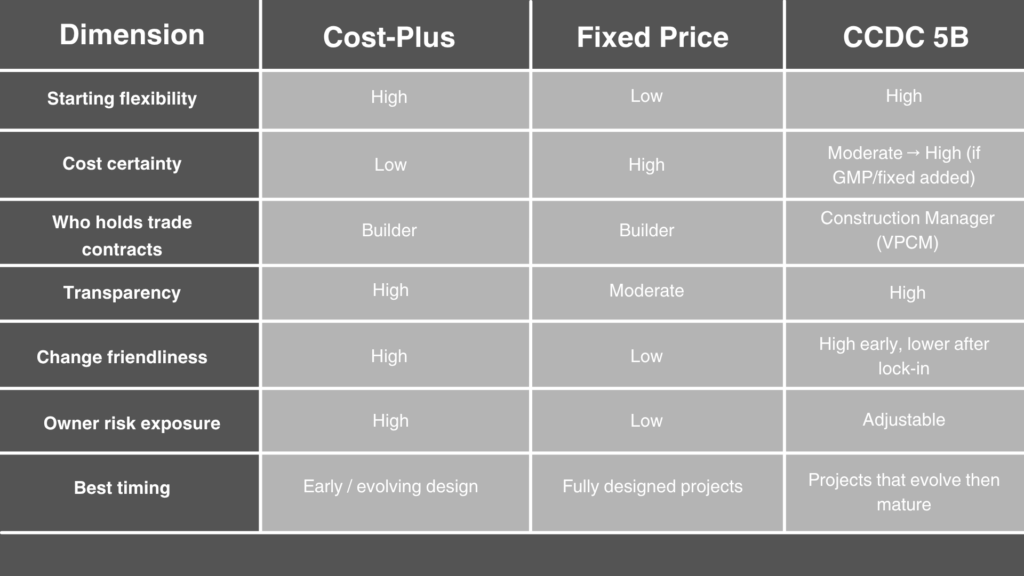
Risk control and certainty comparison
Which contract should you choose
Each Vancouver construction management contract structure handles pricing, trade management, and risk differently.
If you are building a custom home or doing a major renovation, the best contract usually depends on one thing. How complete your design and selections are today.
Our general recommendation at VPCM is Construction Management using CCDC 5B.
For most homeowners, it is the best balance because it lets you:
Start with flexibility while design and selections are still evolving
Use pre construction to reduce unknowns with real pricing and planning
Add certainty later by capping cost with a GMP or converting to a Fixed Price when the scope is actually defined
Simple rule of thumb:
Choose Fixed Price if your drawings and specifications are complete and you want one number with minimal change
Choose Cost Plus if you want to start fast and stay flexible and you are comfortable with more budget responsibility
Choose CCDC 5B if you want collaboration and transparency now with the option to lock in cost once the project is ready
When each contract truly makes sense
Cost Plus
Highly custom fast start projects
Owners comfortable with open ended cost risk
Fixed Price
Well defined scope
Minimal unknowns
Limited appetite for changes
Construction Management CCDC 5B
Custom homes and major renovations
Owners who want collaboration transparency and optional cost caps
Projects where locking it in later makes more sense than guessing early
The VPCM approach and why we prefer CCDC 5B
At VPCM, we lead a structured pre construction phase where we pressure test the budget with real trade input, sequence the schedule, review constructibility, and clarify selections and assumptions. This allows you to make an informed decision about staying open book or adding a GMP or Fixed Price.
We use CCDC 5B because:
It keeps us on the same side of the table as you
It allows strong pre construction leadership
It avoids premature fixed pricing
It gives homeowners real options rather than false certainty
Under CCDC 5B, VPCM manages and holds the trade contracts.

Questions to Ask Before Signing a Custom Home Contract in Vancouver
What is included versus excluded in the price and where are the assumptions listed
What allowances are included and what happens if selections exceed them
How are change orders priced and approved
Who holds the trade contracts and who is accountable for schedule and quality
If there is a GMP, what is included and how are savings or overages handled
Every project is different, so the best approach depends on your scope, timeline, and risk tolerance.
If you are early in design, this decision is worth making now before drawings are finalized and pricing hardens.
Next step
If you are planning a custom home or major renovation in Metro Vancouver, ask us for a contract fit walkthrough. We will help you choose the best structure based on your design maturity, risk tolerance, and timeline before you commit.