
Building on a Sloped or Difficult Lot in Metro Vancouver
Steep lots produce the best views and the biggest budget surprises. Here is what slope, rock, groundwater, and access actually do to a custom home project, and how to find out before you buy.
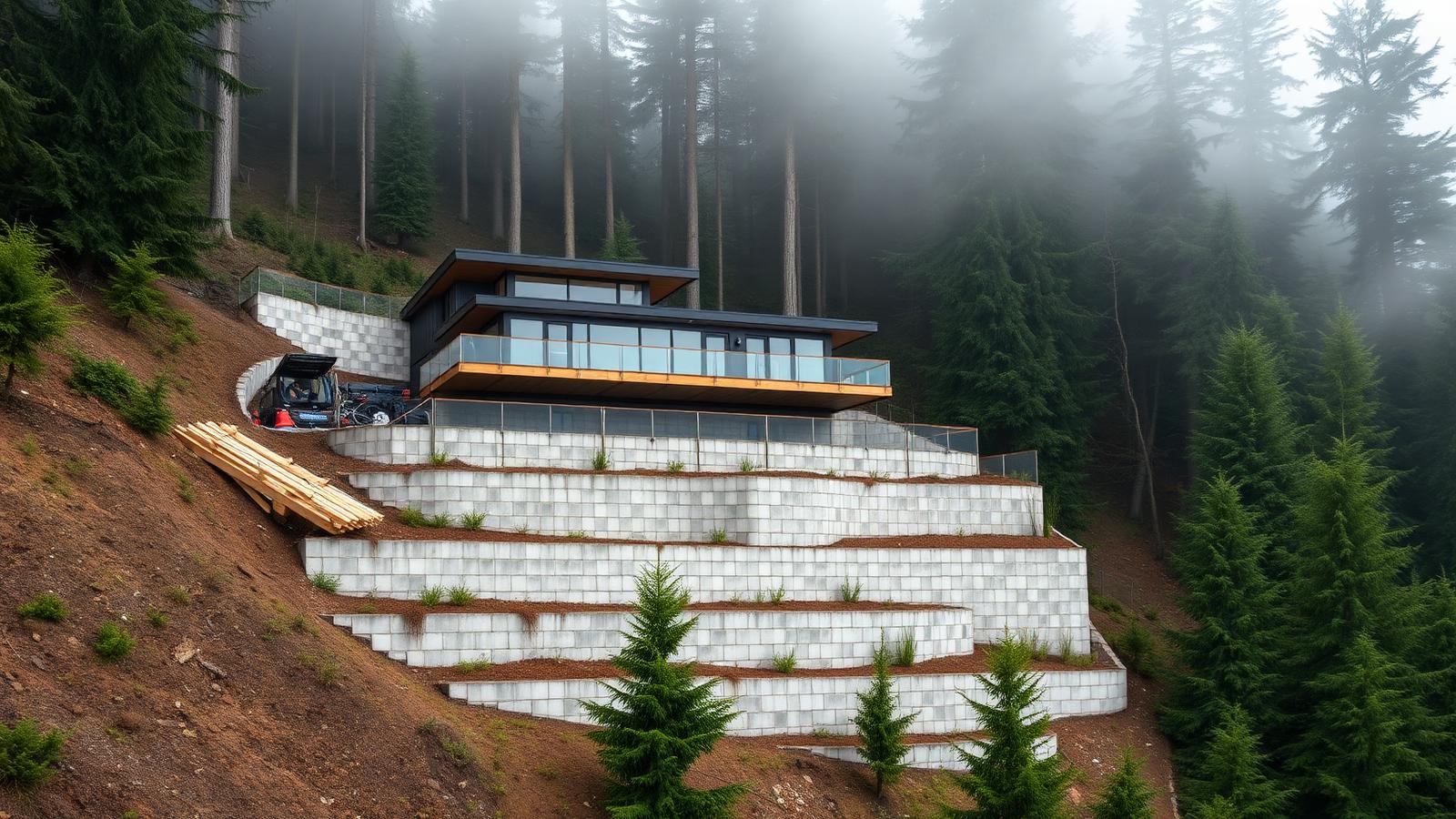
In short, Sloped and constrained lots in Metro Vancouver add cost through retaining structures, deeper foundations, rock excavation, drainage, geotechnical requirements, and restricted site access. Assessing these conditions before purchase is the most effective way to control a custom home budget.
Some of the best homes in this region sit on the worst lots. Slope, rock, and awkward access are also where custom home budgets go wrong, and almost always because the site was assessed after the purchase rather than before.
What slope does to a project
Slope changes the parts of the house nobody photographs.
- Foundations step down the hill, which means more concrete, more formwork, and more time.
- Retaining structures hold back soil at the edges of the building and the driveway, and engineered walls are expensive.
- Drainage becomes a design problem. Water moves downhill, and it will find the house if the site is not built to route it around.
- Driveways and access have maximum grades, and meeting them can force cuts, fills, or a different siting.
- Equipment and material handling take longer on a site where nothing sits level.
The house itself, framing, envelope, and interior, costs roughly what it would anywhere. It is the ground that gets expensive.
Rock and groundwater
On the North Shore and parts of the Fraser Valley, excavation can hit rock. Hammering or blasting is slower and costlier than digging soil, and it needs its own approvals and neighbour notification.
Groundwater is the other one. A hillside site can have water moving through the soil year-round, which means drainage design, waterproofing, and sometimes permanent dewatering.
Access is a cost, not a detail
A narrow street with no place to park a concrete truck, a shared driveway, or a lot with a single tight approach all change how work gets done. Material may need smaller loads and more trips, or a crane where a forklift would normally do.
This is worth walking before you buy. It takes twenty minutes and it is one of the more reliable predictors of site cost.
Trees and setbacks
Protected trees have root protection zones that can restrict excavation right where the house wants to sit. Combined with setbacks and any watercourse or slope-hazard setbacks, the buildable area can end up smaller than the lot suggests.
How to assess a lot properly
The sequence we recommend is short.
- Confirm zoning: allowable floor area, height, setbacks, and any slope-specific rules.
- Walk the site with your builder and look at access, grade, trees, and where services connect.
- Get a geotechnical opinion where slope or soil is in question.
- Price site work separately from the house, so you can see what the ground is costing you.
We do this as a site visit plus a high-level budget before a purchase, which is the same advice we give in buy land first or find the builder first. Site work belongs in your soft cost and pre-construction planning, not as a surprise during excavation.
The upside
Difficult lots reward good design. Stepped floor plates, walk-out lower levels, and rooms that open to a view are all products of the slope. Owners who price the site honestly at the start tend to be the ones who enjoy the result.
If you are looking at a challenging lot, book a free consultation and we will walk it with you before you commit.
Frequently asked
How much more does a sloped lot cost to build on?
There is no single multiplier. The added cost concentrates in excavation, retaining structures, foundations, and drainage, and it varies enormously between a gentle grade and a steep rock face. A geotechnical review turns the guess into a number.
What reports should I get before buying a difficult lot?
A survey, a geotechnical report where slope or soil is a question, and an arborist report where protected trees are present. Together they cost far less than the surprises they prevent.
Are sloped lots worth it?
Often, yes. They frequently come with views, privacy, and design opportunities a flat lot cannot offer, and they sometimes purchase for less. The point is to price the site work before you commit, not after.
Written by

Founder & President
Mark Van Ek is the founder and president of Venture Pacific, bringing more than 40 years of Metro Vancouver and the Fraser Valley construction management experience and multiple Georgie and HAVAN awards to every custom home, renovation, and multiplex project.
Full profile