
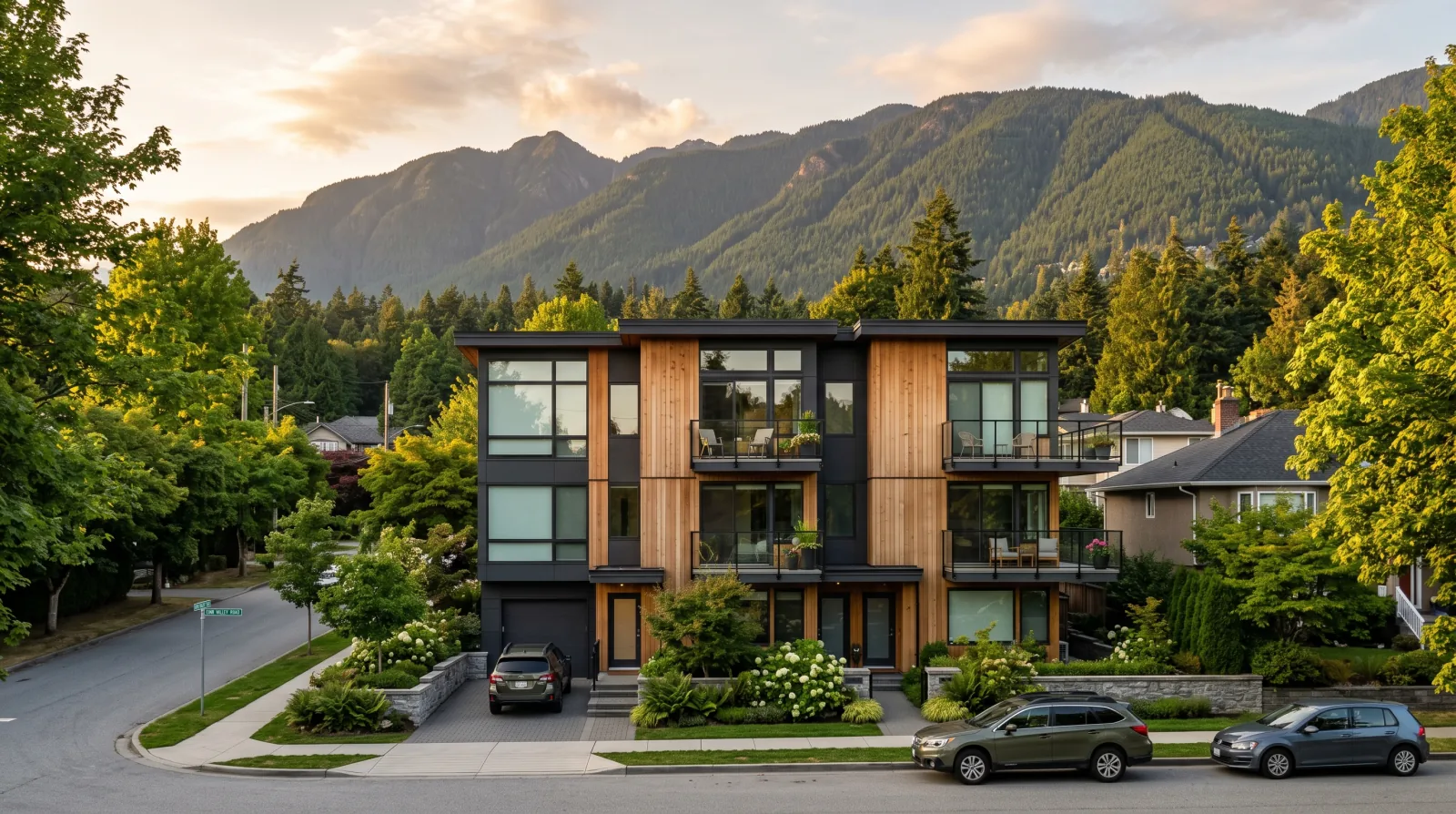
Lynn Valley is one of the District of North Vancouver's established town centres, a genuine walkable core with a village, library, and shops surrounded by long-held single-family streets. That walkability makes it one of the more promising North Shore locations for small-scale multi-unit housing, but the District's density rules are currently in dispute. Since June 2024 the District has allowed up to three homes on a typical lot: a main house, a secondary suite, and a coach house. The Province's Bill 25 requires it to allow four, or up to six within 400 metres of frequent transit, but on April 13, 2026 District council voted to refuse those changes and did not meet the Province's June 30, 2026 deadline. The Province can still impose the higher density by ministerial order, so Lynn Valley's near-term certainty is three homes, with a real prospect of more, especially on its transit-served town-centre lots, if the rules are enforced. Venture Pacific partners with Lynn Valley homeowners through a written GP/LP partnership: you contribute the land, we carry design, permitting, financing, construction, and the construction risk, and we map both scenarios before you commit.
- Homes today
- Up to 3
- If enforced
- 4 to 6 near transit
- Setting
- Walkable town centre
- Status
- Contested (Apr 2026)
In short, Lynn Valley is a walkable town centre in the District of North Vancouver. The District currently allows up to three homes per lot (house, suite, coach house); on April 13, 2026 its council refused the Province's Bill 25 requirement for four-to-six units and missed the June 30, 2026 deadline, though the Province may still impose it by ministerial order. Hillside terrain and creek, slope, and wildfire hazard development permit areas affect many District lots. Venture Pacific partners with Lynn Valley homeowners through a GP/LP structure and maps both the current and potential density scenarios.
Where the District's rules stand
The District of North Vancouver is a separate municipality from the City, with its own bylaws and its own review process, and on housing density it has taken a different path. Since June 2024 it has allowed up to three homes on a typical residential lot: a main house, a secondary suite, and a coach house. The District's position was that this already met the provincial small-scale housing rules.
The Province disagreed. Bill 25, enacted in late 2025, requires municipalities to allow four homes on most lots, and up to six within 400 metres of frequent transit, and closed the loophole that let a suite and coach house count as enough. On April 13, 2026, District council voted 4 to 3 to refuse those changes, the first Metro Vancouver municipality to openly decline the mandate, and did not adopt a compliant bylaw by the Province's June 30, 2026 deadline. The Province's housing minister can impose the zoning directly by ministerial order, so the higher density may still arrive, it is simply not settled today. For a Lynn Valley homeowner, that means planning for three homes now while positioning for four to six if enforcement lands, which is exactly what a feasibility review maps.
Terrain and hazard areas, the first thing we check
The North Shore slopes sharply from the water toward the mountains, and Lynn Valley sits partway up that grade, close to Lynn Canyon and its creek systems. That geography matters. A large share of the District's single-family lots, on the order of 8,500 by the District's own analysis, sit within creek, slope, or wildfire-hazard development permit areas. Lots in those areas are treated differently under the small-scale housing rules and require additional technical studies before anything proceeds.
Not every Lynn Valley lot is affected, and hazard status is not the same as a no. But it is the first thing an honest feasibility review confirms, because it changes both the design and the cost of a project. Hillside sites need engineered foundations, drainage management, and sometimes retaining structures, real scope that has to be in the pro forma from the start, not discovered later.
- Confirm whether your lot sits in a creek, slope, or wildfire-hazard development permit area
- Geotechnical and topography review before any design work
- Multiplex design adapted to grade and site conditions
- Full management of District permits and construction, with the construction risk on us
Why Lynn Valley suits missing-middle housing
Lynn Valley Town Centre is one of the few North Shore locations where you can live without depending on a car for daily errands, the village, library, grocery, and frequent bus service are all within walking distance. That walkability is what makes a multiplex here attractive to future buyers or tenants, and it is also what puts town-centre lots in line for the six-unit allowance under Bill 25.
The economics still have to be tested lot by lot. A District-commissioned study in early 2026 found that rental multiplexes face difficult economics on the North Shore at current construction costs, and that strata configurations, where homes are sold individually, tend to be more viable than build-to-rent. The GP/LP model matters here: when a homeowner contributes a long-held Lynn Valley lot, the land cost in the pro forma looks very different from a developer buying at today's prices, which can be the difference between a project that works and one that does not.
Questions about Lynn Valley
How many homes can I build on my Lynn Valley lot?
Right now, the District of North Vancouver allows up to three homes on a typical lot, a main house, a secondary suite, and a coach house. The Province's Bill 25 requires four, or up to six near frequent transit, but District council voted in April 2026 to refuse those changes and missed the June 30, 2026 deadline, so the higher counts are not in force in the District today. The Province can still impose them by ministerial order, and Lynn Valley's town-centre transit means it would be among the first areas to reach the higher counts if that happens. A feasibility review maps both the current and the potential scenario for your lot.
Does Lynn Valley's terrain affect what I can build?
It can. Many District of North Vancouver lots, including some in Lynn Valley, sit within creek, slope, or wildfire-hazard development permit areas that are treated differently under the small-scale housing rules and require extra technical studies. Even outside those areas, slope adds cost through engineered foundations and drainage. Confirming your lot's hazard status and grade is the first thing we do in a feasibility review.
Will the District be forced to allow four to six units?
Possibly. The District missed the Province's June 30, 2026 deadline to allow four-to-six-unit small-scale housing, and the Province's housing minister has the power to impose compliant zoning by ministerial order under the Local Government Act. Whether and when that happens is not settled. Lynn Valley's walkable, transit-served town centre is exactly the kind of area where the six-unit allowance would apply most widely if it is enforced, which is why a feasibility review done now positions you to move quickly.
Is a rental or strata multiplex better in Lynn Valley?
It depends on the lot and your goals. A District-commissioned study in early 2026 found rental multiplexes face difficult economics at current North Shore construction costs, and that strata, selling homes individually, tends to be more viable. When a homeowner contributes long-held land through our GP/LP partnership, the project economics can look very different from a developer's. We test both paths during feasibility.
What is the first step for a Lynn Valley homeowner?
A free feasibility review. We confirm which District rules apply to your lot, whether it sits in a hazard development permit area, how many units it can support now and after the June 2026 bylaw update, and whether the project makes financial sense, before you commit to anything.
Nearby areas
Let's talk about your property
A conversation, not a commitment.
Whether you're curious about the multiplex value of your land or looking to partner on a missing-middle build, we're here to start the conversation.