
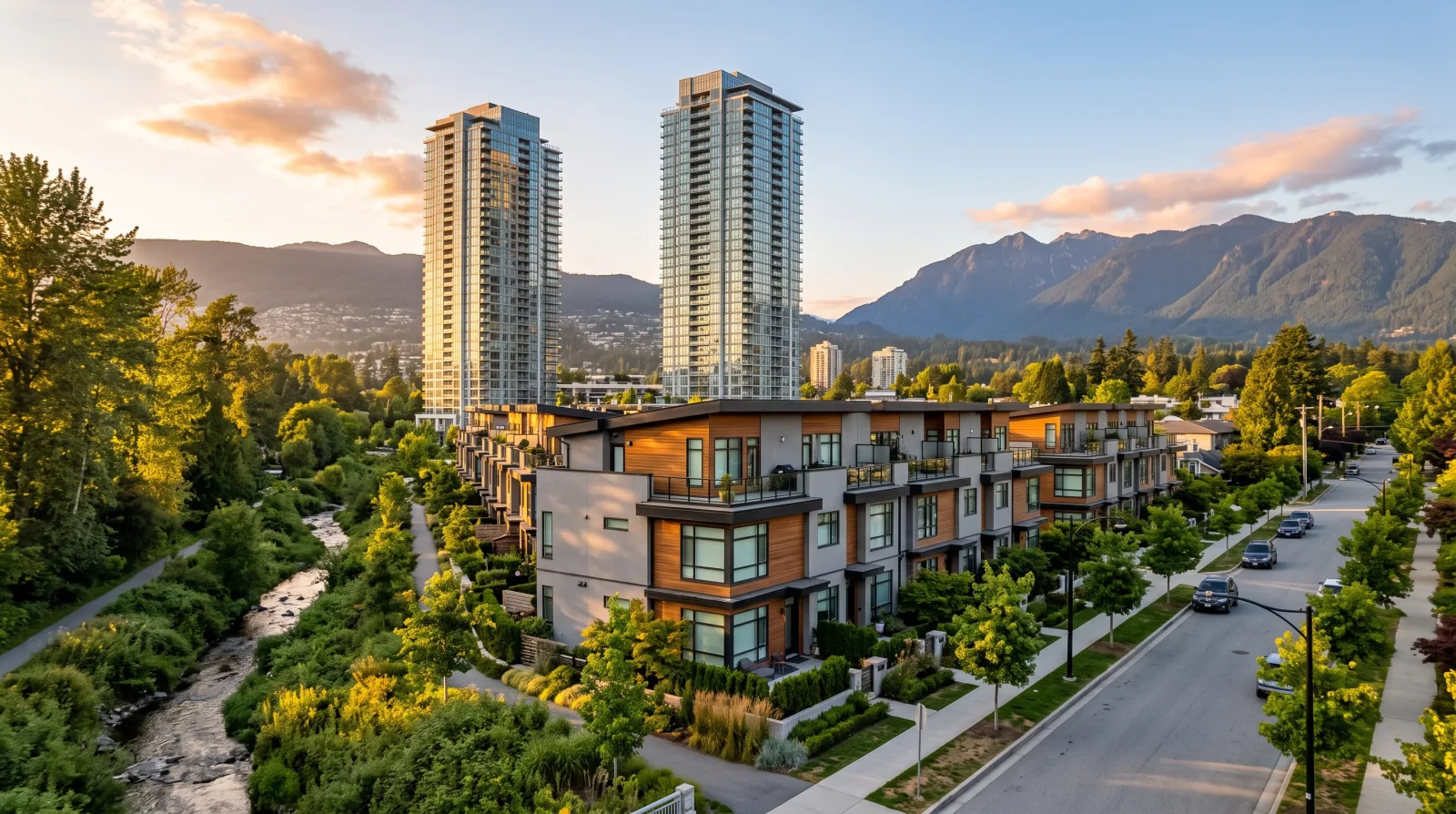
Metro Vancouver · Lynn Creek
Multiplex development in Lynn Creek (Lynnmour), North Vancouver
Lynn Creek, the area many locals still call Lynnmour, is the District of North Vancouver's fastest-changing neighbourhood, wrapped between Lynn Creek and the Seymour River at the north foot of the Second Narrows Bridge. It is where the North Shore's density has jumped the most: modest, older, relatively affordable single-family streets now sit directly beside the 24-to-32-storey towers of Seylynn Village, with Phibbs Exchange and Capilano University close by. The District's small-scale housing rules are contested, so an older Lynn Creek lot allows up to three homes today, but this is also the District neighbourhood best positioned for more if the Province's rules are enforced, thanks to its frequent-transit access. Venture Pacific partners with Lynn Creek homeowners through a written GP/LP partnership: you contribute the land, and we carry design, permitting, financing, construction, and the construction risk.
- Homes today
- Up to 3
- If enforced
- 4 to 6 near Phibbs/R2
- Setting
- Transit town centre
- Status
- Contested (Apr 2026)
In short, Lynn Creek (Lynnmour) is the District of North Vancouver's most transit-rich, fastest-changing neighbourhood, between Lynn Creek and the Seymour River, anchored by Phibbs Exchange and the R2 RapidBus and the Seylynn Village towers. The District currently allows up to three homes per lot; it refused the Province's Bill 25 four-to-six-unit mandate in April 2026, but Lynn Creek's frequent transit means it would be first in line for six units if the Province enforces. Venture Pacific partners through a GP/LP structure.
Where the District's rules stand
The District of North Vancouver is a separate municipality from the City, and its density rules are unsettled. Since June 2024 it has allowed up to three homes on a typical lot, a main house, a secondary suite, and a coach house. The Province's Bill 25 requires four homes on most lots, or up to six within 400 metres of frequent transit, but on April 13, 2026 District council voted 4 to 3 to refuse those changes and did not meet the Province's June 30, 2026 deadline. The Province's housing minister can still impose the zoning by ministerial order, so the higher counts may yet arrive, they are simply not in force today.
Lynn Creek is the strongest transit location of any District neighbourhood. Phibbs Exchange, one of the busiest bus hubs on the North Shore, anchored by the R2 Marine Drive RapidBus every eight to ten minutes and being extended across the bridge toward Metrotown, sits at its southern edge, alongside routes to downtown Vancouver, Burnaby, and Capilano University. That means if the Province's rules are enforced, a large share of Lynn Creek's older lots would qualify for the full six-home count. It is the District neighbourhood where the higher density would land most widely.
The North Shore's sharpest old-and-new contrast
Nowhere else in the District shows the density jump as plainly as Lynn Creek. The Seylynn Village towers, Beacon, Compass, and Apex, rising from 24 to 32 storeys, stand directly beside modest older single-family streets, with more towers approved nearby. Those older streets, some of the more affordable in North Vancouver, are the missing-middle infill opportunity: ground-oriented homes that bridge the gap between a single house and a highrise.
For an owner of one of those older Lynn Creek lots, that context matters. The area is already planned and built for growth, services and transit are in place, and a well-designed three-to-six-home building fits naturally between the existing houses and the towers. Through the GP/LP partnership you contribute the land and we carry the rest, design, permitting, financing, construction, and the risk.
- Free feasibility review: transit-band check, unit-count scenarios, and a preliminary pro forma
- Ground-oriented design that fits between older houses and the Seylynn towers
- Full management of District permits and construction, with the construction risk on us
- GP/LP partnership: you contribute the land, we carry design, financing, and construction
Between two rivers, next to a university and a transit hub
Lynn Creek's identity comes from its geography, the "inter-river" position between Lynn Creek and the Seymour River, which is where the name Seylynn (Seymour + Lynn) comes from. Bridgman and InterRiver Parks follow the creek, Capilano University is a short bus ride up Lillooet Road, and Phibbs Exchange connects the whole area to the region.
That combination, parks, a university, a major transit hub, and an established growth plan, is exactly why gentle density belongs here. If you own an older single-family lot in Lynn Creek or Lynnmour, a feasibility review will map both what you can build under the District's current three-home rule and what would open up if the Province's higher-density rules are enforced, so you can plan around either outcome.
Questions about Lynn Creek
How many homes can I build on my Lynn Creek or Lynnmour lot?
Right now, the District of North Vancouver allows up to three homes on a typical lot, a main house, a secondary suite, and a coach house. The Province's Bill 25 requires four, or up to six near frequent transit, but the District refused those changes in April 2026 and missed the June 30, 2026 deadline, so the higher counts are not in force today. Lynn Creek has the District's best frequent-transit access (Phibbs Exchange and the R2), so it would be first in line for the six-home count if the Province enforces its rules. A feasibility review maps both scenarios for your lot.
Is Lynnmour the same as Lynn Creek?
Effectively yes. "Lynnmour" is the older residential name locals and real-estate listings use; "Lynn Creek" is the District's planning name for the same area and its growing town centre, and "Seylynn" is the tower community and park within it. They all refer to the neighbourhood between Lynn Creek and the Seymour River at the north end of the Second Narrows Bridge.
Why is Lynn Creek better positioned for more homes than other District neighbourhoods?
Transit. The six-home allowance under the Province's rules applies to lots within 400 metres of frequent transit, and Lynn Creek has the District's strongest frequent-transit access: Phibbs Exchange and the R2 Marine Drive RapidBus every eight to ten minutes, with the R2 being extended toward Metrotown. If the Province enforces its rules, more of Lynn Creek's lots would reach the higher count than anywhere else in the District.
The area already has highrise towers. Does a smaller multiplex still fit?
Yes, that is exactly the gap ground-oriented housing fills. Lynn Creek's older single-family streets sit between detached houses and the Seylynn towers, and a three-to-six-home building bridges that scale naturally. It adds homes near transit without a tower, on a lot that is already in a planned-growth area with services in place.
What is the first step for a Lynn Creek homeowner?
A free feasibility review. We confirm your lot's distance to frequent transit, map how many homes it can hold under the current District rules and under the Province's higher-density rules if they are enforced, check any site constraints, and run a preliminary pro forma, before you commit to anything.
Let's talk about your property
A conversation, not a commitment.
Whether you're curious about the multiplex value of your land or looking to partner on a missing-middle build, we're here to start the conversation.