
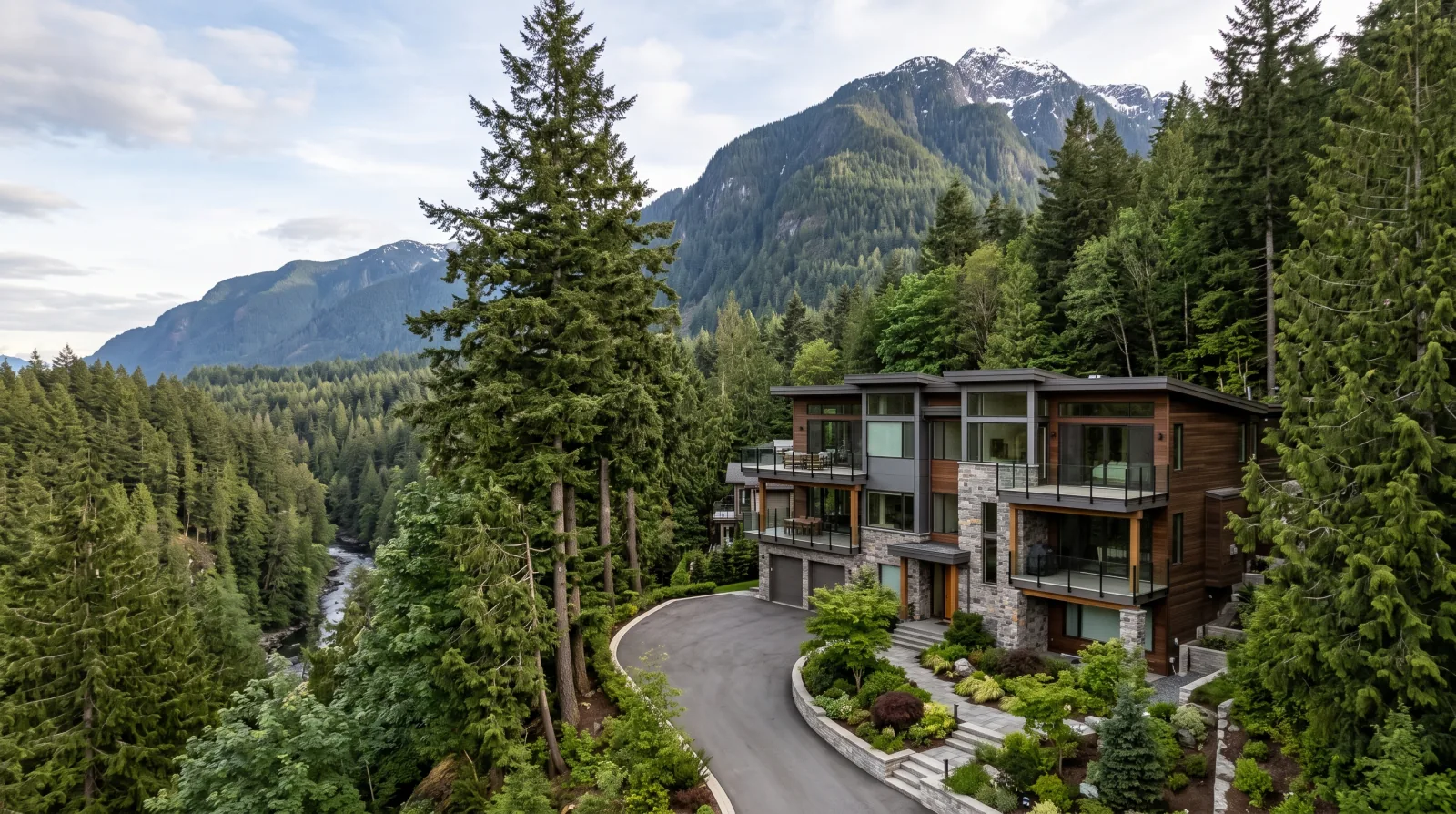
Canyon Heights is an affluent hillside neighbourhood at the foot of Grouse Mountain in the District of North Vancouver's Upper Capilano community, edged on the west by the Capilano River canyon and Cleveland Dam. It is a quiet area of large, treed lots and winding streets, a short drive from Edgemont Village. The District's small-scale housing rules are currently unsettled, so a Canyon Heights lot allows up to three homes today, and its large lots suit a carefully designed three- or four-home building where terrain and mature trees are the main considerations. Venture Pacific partners with Canyon Heights homeowners through a written GP/LP partnership: you contribute the land, and we carry design, permitting, financing, construction, and the construction risk.
- Homes today
- Up to 3
- If enforced
- 3 to 4 (light transit)
- Setting
- Hillside, large lots
- Status
- Contested (Apr 2026)
In short, Canyon Heights is an affluent, large-lot hillside neighbourhood at the foot of Grouse Mountain in the District of North Vancouver's Upper Capilano community, by the Capilano River canyon and Cleveland Dam. The District currently allows up to three homes per lot; it refused the Province's Bill 25 four-to-six-unit mandate in April 2026. Canyon Heights' light transit means three to four homes even under enforcement, and its large treed lots suit that scale with slope and tree retention as the main design factors. Venture Pacific partners through a GP/LP structure.
Where the District's rules stand
The District of North Vancouver is a separate municipality from the City, and its density rules are unsettled. Since June 2024 it has allowed up to three homes on a typical lot, a main house, a secondary suite, and a coach house. The Province's Bill 25 requires four homes on most lots, or up to six within 400 metres of frequent transit, but on April 13, 2026 District council voted 4 to 3 to refuse those changes and did not meet the Province's June 30, 2026 deadline. The Province's housing minister can still impose the zoning by ministerial order, so the higher counts may yet arrive, they are simply not in force today.
Canyon Heights is an affluent, hillside single-family neighbourhood served by the commuter-oriented 246 bus rather than a frequent all-day route; the nearest frequent buses run along the Capilano Road corridor to the west. So even if the Province enforces its rules, Canyon Heights lots would realistically reach three to four homes, not six. Its large, treed, sloping lots suit a well-designed three- or four-home building, with terrain and tree retention the main things to plan around.
Large lots at the foot of the mountain
Canyon Heights is one of the District's more spacious neighbourhoods, larger lots, often 4,000 to 10,000-plus square feet, on winding streets and cul-de-sacs below Grouse Mountain. Much of the housing is mid-century, with a steady trend toward larger contemporary rebuilds on the generous lots. That space is the opportunity for gentle density: a three- or four-home ground-oriented building can sit on a large Canyon Heights lot with real separation, yards, and parking, at a scale that respects the street.
For a long-time owner, the GP/LP partnership turns that land into a project without selling or self-funding: you contribute the lot, and we carry the design, financing, construction, and the risk. Because these are high-value lots, the economics are lot-specific, feasibility is the honest way to see what works.
- Free feasibility review: lot size, slope, tree retention, and a preliminary pro forma
- Three- or four-home design tuned to Canyon Heights' large, treed lots
- Full management of District permits and construction, with the construction risk on us
- GP/LP partnership: you contribute the land, we carry design, financing, and construction
Terrain, trees, and a canyon-edge setting
Canyon Heights sits on sloping ground between Grouse Mountain and the Capilano River canyon, so terrain and mature trees are the defining design factors. Cleveland Dam and Capilano River Regional Park form the wooded western edge, the reservoir behind the dam supplies roughly a third of Metro Vancouver's drinking water, and the Capilano Suspension Bridge draws visitors nearby. Grade drives foundation and access design, and significant trees can carry retention requirements.
None of that stops a project; it shapes it, and it has to be handled early. Canyon Heights Elementary on Highland Boulevard, feeding Handsworth Secondary, and nearby Edgemont Village give the area a settled, family character that suits ground-oriented homes. We confirm slope and tree constraints up front and design to them.
Questions about Canyon Heights
How many homes can I build on my Canyon Heights lot?
Right now, the District of North Vancouver allows up to three homes on a typical lot, a main house, a secondary suite, and a coach house. The Province's Bill 25 requires four, or up to six near frequent transit, but the District refused those changes in April 2026 and missed the June 30, 2026 deadline. Canyon Heights has only commuter-oriented bus service, so even if the Province imposes its rules, the realistic range here is three to four homes, not six. A feasibility review confirms the number for your lot.
Canyon Heights lots are large. Does that help a multiplex?
Yes. Canyon Heights has some of the District's larger lots, often 4,000 to 10,000-plus square feet, which give a three- or four-home ground-oriented building room for real separation, yards, and parking at a scale that fits the street. The space is the main advantage here. A feasibility review confirms your exact lot size and what it can carry.
Do the slope and trees limit what I can build in Canyon Heights?
They shape it. Canyon Heights sits on sloping ground near the Capilano River canyon, so grade drives foundation and access design, and significant mature trees can carry retention requirements that affect where a building sits. These are design factors we confirm at the feasibility stage and design to from the start, not automatic barriers.
Is Canyon Heights going to be forced to allow more homes?
It is possible but unsettled. The District missed the Province's June 30, 2026 deadline, and the Province can impose zoning by ministerial order. Even if it does, Canyon Heights' lack of frequent transit means the six-home count would not apply, the practical range stays around three to four homes. We plan for the current rule and track any change.
What is the first step for a Canyon Heights homeowner?
A free feasibility review. We measure your lot, assess slope and tree retention, confirm how many homes the current District rules allow, and run a preliminary pro forma, before you commit to anything. That review tells you whether a three- or four-home project makes sense on your Canyon Heights lot.
Related guides
Let's talk about your property
A conversation, not a commitment.
Whether you're curious about the multiplex value of your land or looking to partner on a missing-middle build, we're here to start the conversation.