
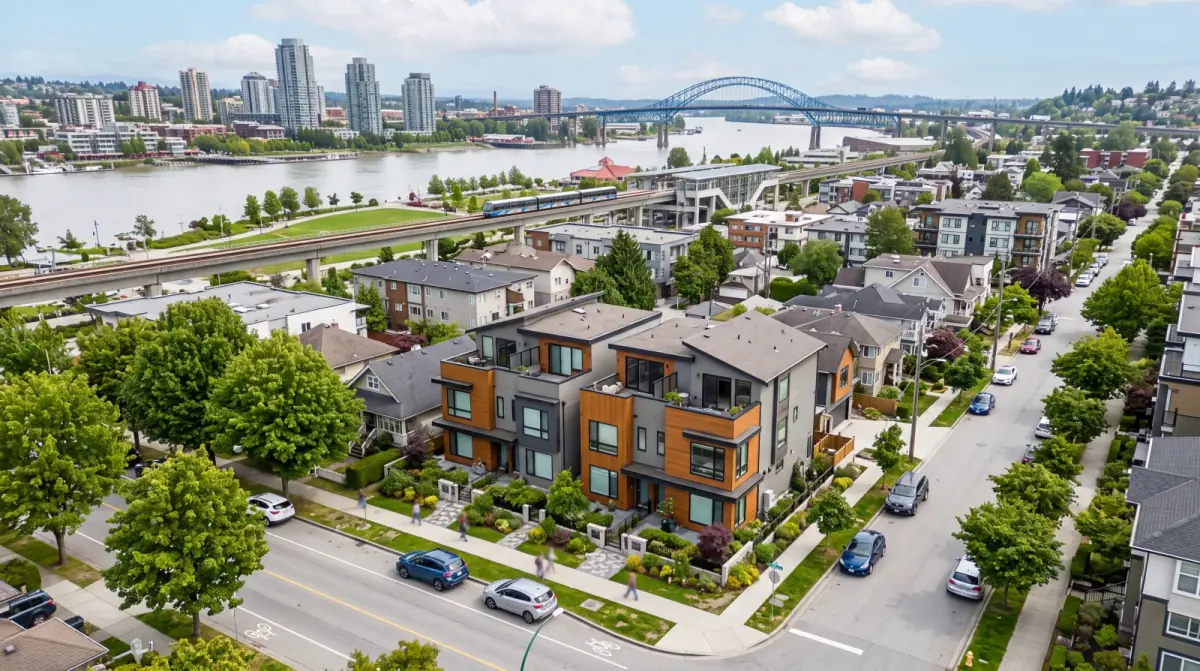
New Westminster moved faster than most Metro Vancouver cities to put infill housing on the ground. The City adopted its Infill Housing Program in June 2026, pre-zoning roughly 3,000 single-family and duplex lots under two new RGO sub-zones that allow up to four or six units per lot, no rezoning required for conforming projects. Three SkyTrain stations connect the city to the broader region, which means a lot of New Westminster's residential fabric sits within walking distance of frequent transit. Venture Pacific works with homeowners and investors here to figure out what a lot can realistically hold, and to carry the project through design, approvals, and construction.
- Zones
- RGO-A (4 units) · RGO-B (6 units)
- Lots pre-zoned
- ~3,000 citywide
- SkyTrain stations
- Columbia · New Westminster · 22nd Street
- Program adopted
- June 2026
In short, New Westminster adopted its Infill Housing Program in June 2026, pre-zoning approximately 3,000 lots under two RGO sub-zones: RGO-A (up to 4 units, ~1,900 lots) and RGO-B (up to 6 units, ~1,100 lots near frequent transit). Projects require a Development Permit and Building Permit but no rezoning for conforming applications. Queensborough is excluded until May 2029. Queen's Park Heritage Conservation Area has additional interim restrictions. A new DCC bylaw effective January 12, 2026 added fire protection and police facility charges. Venture Pacific partners with New Westminster homeowners on multiplex development.
What changed in New Westminster
New Westminster's Infill Housing Program is the City's response to the province's Small-Scale Multi-Unit Housing (SSMUH) legislation under Bill 44. The program was formally adopted in June 2026, following a Public Hearing on May 25, 2026, where Council supported the bylaw amendments that created the new RGO, Residential Ground Oriented Infill Housing designation.
The City divided eligible land into two sub-zones. RGO-A covers approximately 1,900 properties and allows up to four units per lot. RGO-B covers roughly 1,100 properties and allows up to six units, these are generally lots that sit near frequent transit. Permitted housing forms include duplexes, triplexes, quadplexes, multiplexes, secondary suites, laneway houses, carriage houses, and side-by-side townhouses of up to six units. Freehold (non-strata) tenure requires a separate rezoning, but strata, co-op, and rental tenures are all permitted within the RGO framework as-of-right.
The program also updated Development Permit Area guidelines (DPA 1.2) to focus on site design quality and greenhouse gas reduction, meaning projects still need a Development Permit in addition to a Building Permit, but they do not need an OCP amendment or rezoning if they meet the RGO standards. One infrastructure note worth flagging: projects developing more than three units may trigger servicing upgrades at developer cost, because existing water and sewer infrastructure was originally sized for the old single-family-plus-three-unit maximums.
What this means for a New Westminster homeowner
If your lot sits in an RGO-A or RGO-B zone, its potential has changed. A single-family house that once defined the ceiling of what the land could do now sits below it. Whether you develop that potential or sell the lot outright is the real decision, and it is worth making with a clear picture of what the numbers look like first.
A multiplex is a real construction project. In New Westminster that means a Development Permit, a Building Permit, a Works and Services Agreement, potentially a utility servicing upgrade, and construction management across design, trades, and approvals. We carry that work and the construction risk through a transparent GP/LP partnership. You contribute the land; we run the project.
- Confirm your lot's RGO sub-zone and what it allows, not every lot near transit automatically qualifies for six units
- Feasibility review covering site geometry, servicing capacity, and the form that makes the most sense for your lot
- Multiplex design calibrated to New Westminster's RGO development standards and DPA 1.2 guidelines
- Management of Development Permit, Works and Services Agreement, and Building Permit with the City
- Construction and quality control end to end
Neighbourhoods and transit fit
New Westminster is compact, about 15 square kilometres, and its three SkyTrain stations on the Expo Line anchor the densest redevelopment activity. The Columbia Station area and the blocks around New Westminster Station (Downtown/Uptown) are where the highest transit proximity bonus applies, supporting the six-unit RGO-B allowance on qualifying lots. The 22nd Street Station corridor in the city's western residential streets is seeing growing interest as infill opportunities become clearer.
Sapperton and Braid, on the city's northeast side, near the Expo Line's Sapperton Station, are established working neighbourhoods with a mix of standard lots and some larger parcels that can support side-by-side townhouse forms. The Connaught Heights and Queensborough areas are different stories: Queensborough is excluded from the Infill Housing Program until at least May 2029, pending infrastructure research on water and sewer capacity, so the standard RGO zoning does not apply there.
The Glenbrooke North and West End neighbourhoods, which sit between New Westminster and 22nd Street stations, tend to have the kind of straightforward rectangular lots that suit a four-unit RGO-A project, enough lot depth and width for a well-designed multiplex without needing the full six-unit configuration.
Heritage areas and the Queen's Park consideration
New Westminster has a larger stock of older character housing than most Metro Vancouver cities, and Queen's Park is the largest formal Heritage Conservation Area in British Columbia, more than 300 heritage-protected homes on tree-lined streets. The City's interim policy for Queen's Park restricts infill to cases where lot consolidation is not possible, and it holds that restriction in place until the City completes comprehensive heritage design guidance for the area.
That interim policy is not an outright ban on infill. Laneway houses, carriage houses, and garden suites have been permitted in Queen's Park and continue to be. But a full multiplex redevelopment in the conservation area requires additional review and carries more design constraints than a standard RGO lot elsewhere in the city. If your property sits in or near Queen's Park, we confirm the applicable rules during feasibility before recommending any path.
Outside the conservation area, heritage character does not automatically block redevelopment, but it can shape the design, particularly in older blocks where the City's DPA 1.2 guidelines place weight on neighbourhood fit and building scale.
A note on development cost charges in 2026
New Westminster's DCC Bylaw came into effect on January 12, 2026, and it expanded the categories of infrastructure that DCCs can fund. Fire protection facilities and police facilities were added as eligible categories for the first time, joining the existing transportation, drainage, water, sanitary, and parkland charges. The 2025 interim DCC update had already included an inflationary increase.
In practical terms, a project permitted and started in 2026 faces a higher DCC load than the same project would have in 2025. That increase belongs in the feasibility model from the start, not as a late surprise during permit intake. We factor current DCC schedules into every pro forma we build for New Westminster.
Questions about New Westminster
How many units can I build on my New Westminster lot?
It depends on whether your lot is designated RGO-A or RGO-B under the City's Infill Housing Program. RGO-A allows up to four units; RGO-B allows up to six. Proximity to frequent transit is a key factor in which sub-zone applies. A feasibility review confirms the answer for your specific property, don't assume the six-unit allowance without checking first.
When did New Westminster's infill housing zoning take effect?
The City's Infill Housing Program was formally adopted in June 2026. Council supported the bylaw amendments at a Public Hearing on May 25, 2026. The underlying SSMUH legislation from the province (Bill 44) was adopted into New Westminster's framework in 2024 and updated in 2025, with the full RGO pre-zoning program completing in 2026.
Do I still need a Development Permit in New Westminster?
Yes. Unlike Burnaby, which removed the Development Permit requirement for SSMUH-conforming projects, New Westminster still requires a Development Permit for infill housing, along with a Building Permit and a Works and Services Agreement. You do not need a rezoning or OCP amendment for a conforming RGO project, but the permit process is still a real step that needs managing.
Is Queensborough included in the infill housing program?
No. The City has given itself until May 2029 to study Queensborough's water and sewer infrastructure before deciding whether SSMUH-style pre-zoning applies there. Queensborough properties should not assume the RGO framework applies, confirm with the City's planning department before making any development assumptions.
What happens with Queen's Park heritage lots?
Queen's Park is British Columbia's largest Heritage Conservation Area and operates under an interim infill policy that restricts multi-unit redevelopment to cases where lot consolidation is not an option. Laneway and carriage houses remain permitted. Full multiplex redevelopment in the conservation area carries extra design review requirements. We work through the applicable rules during feasibility for any Queen's Park property.
Did DCCs go up in New Westminster in 2026?
Yes. The new DCC Bylaw came into effect January 12, 2026, and added fire protection and police facility categories for the first time, alongside an earlier inflationary increase. A project starting in 2026 faces higher city fees than it would have in 2025. We include the current DCC schedule in every New Westminster feasibility review.
What's the first step for a New Westminster property?
A free consultation and feasibility review. We confirm your lot's RGO sub-zone, check servicing capacity (since projects over three units may require infrastructure upgrades), and give you a clear picture of what the lot can hold and what the process looks like before you decide anything.
Related guides
- New Westminster and Coquitlam SSMUH zoning: what changed
- How Bill 44 and SSMUH changed what you can build across Metro Vancouver
- How transit proximity increases the number of units your lot can hold
- When you need a rezoning and when you don't
- What a multiplex feasibility review actually covers
- How the GP/LP land development partnership works for homeowners
Let's talk about your property
A conversation, not a commitment.
Whether you're curious about the multiplex value of your land or looking to partner on a missing-middle build, we're here to start the conversation.